5 from 126 votes
Champagne lychee jelly recipe
Champagne lychee jelly combines lychee fruit and its syrup with champagne and agar agar powder to create a delicate jelly dessert with a hint of fizz and sweetness. The recipe uses agar as a gel setting agent, allowing for a light, refreshing texture that holds embedded lychee pieces and optional fruits like nata de coco. Adjusting the champagne concentration alters the flavor intensity, making this a flexible dessert option.
Prep Time
5 mins
Cook Time
15 mins
Total Time
20 mins
Servings:
10
people
Calories:
474 kcal
Course:
Dessert
Cuisine:
Asian, Chinese, Japanese, Singaporean
Ingredients
Making jelly with 1 litre of liquid (water/ champagne/ lychee syrup)
- 1 Can lychees My 565g can of lychees yielded 230g of lychees once drained. If you can get them, use fresh lychees instead- the weight should be of the peeled fruits.
- 1 Packet agar agar powder amount as per back of the packet; can be substituted with konjac powder or gelatine. If the amount of water required for your jelly packet is not 1 litre, please adjust the rest of the ingredients accordingly. For eg, if your packet only requires 500ml, please halve the amount of lychees etc used
- 0.22 lb white sugar Only add if your konnyaku jelly packet does not include sugar- you may need to add more/less depending on how much lychee syrup you use (and also depending on how sweet your champagne is). Rock sugar is a good substitute but brown sugar is not. If vegan, make sure the sugar is bone char free, granulated
- 1 litre liquid You can use water, lychee syrup, champagne, sparkling or a mix of these liquids to make up 1 litre. Don't use less than 20% champagne (calculated as a percentage of the total liquid ie 200 ml of champagne is the minimum for 1 litre of water), if not you won't be able to taste it! Vegans note that not all brands of champagne are free of animal-products
- aloe vera
- rambutan
- nata de coco Optional, etc
Instructions
- Open the can of lychees and separate the lychees from the liquid. Do not throw away the liquid in the can, unless you do not want to use the lychee brine.
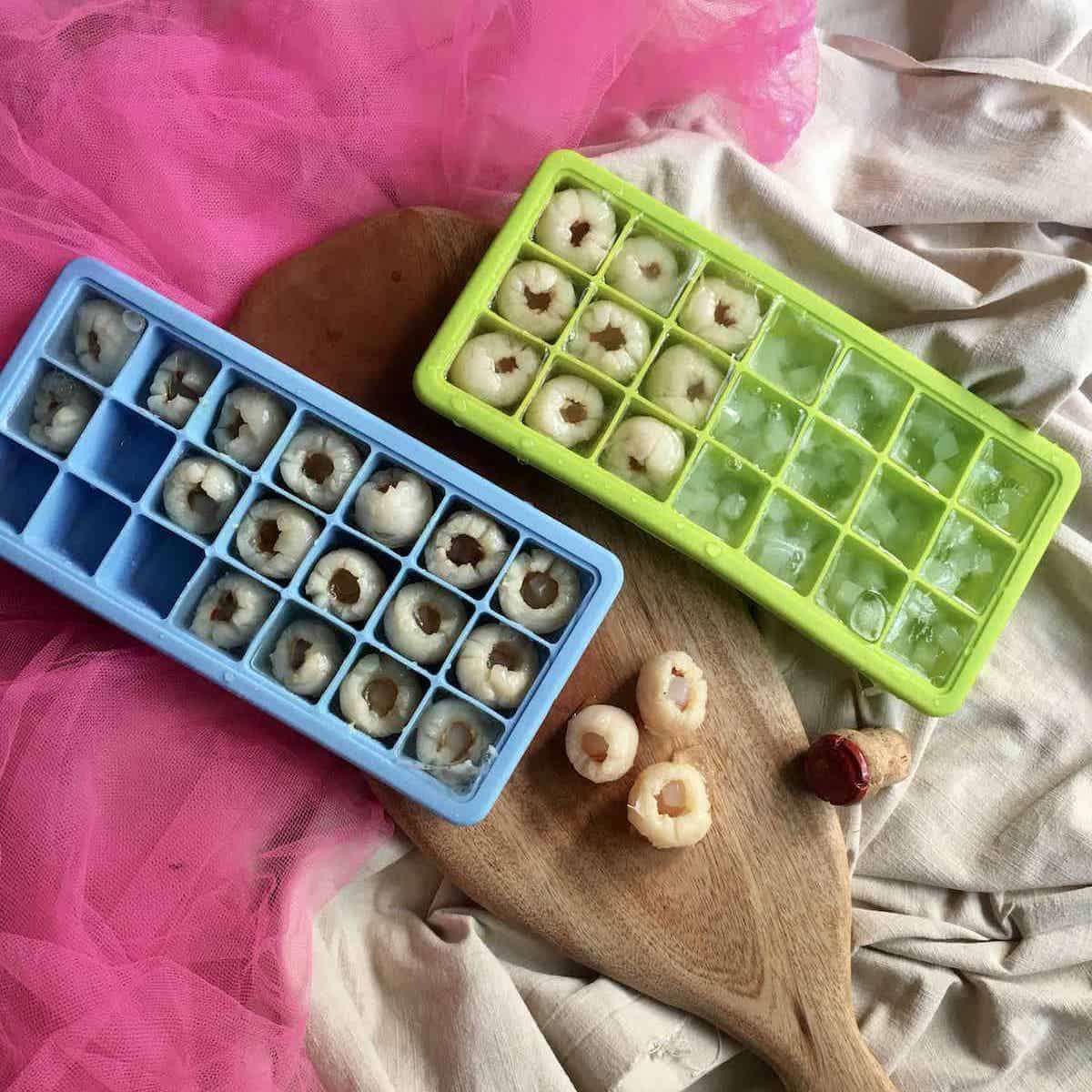
- Place the lychees in the molds- I would suggest not more than 1 lychee in each mold. You may want to cut up the lychee if your mold is very small. (Alternatively you can use the lychee as the vessel for the jelly and set the jelly in the lychee (as shown in the photo)- tips on how to do this is in the text above this recipe.)
- If using nata de coco or any other fruits (suggestions in the text above), place an appropriate amount in each mold.
- Mix the sugar and agar powder together well - this is to reduce clumping when the agar powder is poured into the liquid.
- Add the liquids (but not the champagne) to the pot- i.e. water and/ or lychee syrup. The amount of water and/or lychee syrup added would depend on the champagne concentration you want. For example, if you want the jellies to be 50% champagne, add 500 ml of water and/or lychee syrup to the pot.
- Heat the liquid in the pot and when almost boiling (you will see small bubbles forming at the bottom of the pot), very slowly add the agar agar- sugar mixture. Keep stirring continuously whilst adding slowly, if not the powder will form unattractive white clumps in your jelly.
- Bring the mixture to a boil then reduce to a simmer, stirring continuously for 3 minutes (or till the bubbles disappear).
- Switch off the fire then add the champagne to the jelly mix and stir well.
- Pour into molds and allow to cool in the fridge for at least 3 hours.
- Remove the jellies from the mold just before serving, if not you will sometimes see the liquid leach out of the jellies.
Cup of Yum
Notes
- If substituting konnyaku powder, ensure proper dissolving to prevent jelly from oozing water after setting.
- Adjust sugar quantity based on sweetness of lychee syrup and champagne used.
- Maintain at least 20% champagne in the liquid mixture to ensure its flavor is perceptible.
- Exercise caution when serving jelly containing alcohol to children and elderly due to choking hazards related to jelly texture.
Nutrition Information
Calories
474kcal
(24%)
Carbohydrates
128g
(43%)
Protein
0.4g
(1%)
Fat
0.03g
(0%)
Sodium
6mg
(0%)
Potassium
76mg
(2%)
Fiber
0.3g
(1%)
Sugar
128g
(256%)
Vitamin C
1mg
(1%)
Calcium
9mg
(1%)
Iron
1mg
(6%)
Nutrition Facts
Serving: 10 people
Amount Per Serving
Calories 474
% Daily Value*
| Calories | 474kcal | 24% |
| Carbohydrates | 128g | 43% |
| Protein | 0.4g | 1% |
| Fat | 0.03g | 0% |
| Sodium | 6mg | 0% |
| Potassium | 76mg | 2% |
| Fiber | 0.3g | 1% |
| Sugar | 128g | 256% |
| Vitamin C | 1mg | 1% |
| Calcium | 9mg | 1% |
| Iron | 1mg | 6% |
* Percent Daily Values are based on a 2,000 calorie diet.