5 from 99 votes
Dan's Como Bread
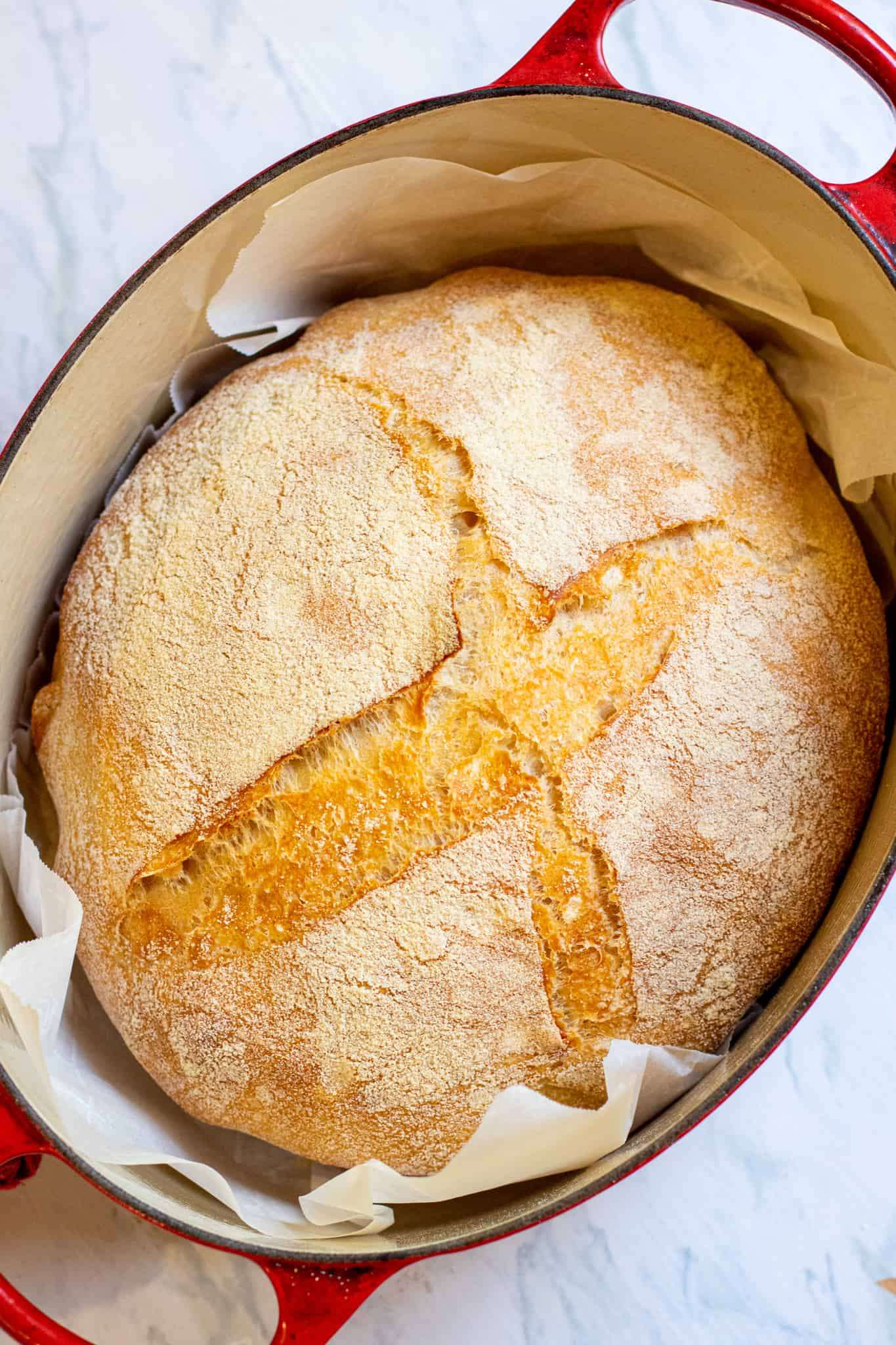
Dan's Como Bread recipe is a detailed bread-making process involving a starter fermented overnight and a large dough made with warm water, flour, salt, and semolina for dusting. The starter uses active yeast, malt barley syrup, water, milk, and flour, creating a bubbly pre-ferment that contributes depth to the bread's flavor and structure. The method ensures a slightly sticky, elastic dough, with options for mixing by hand or stand mixer, offering flexibility for home bakers.
Prep Time
10 mins
Cook Time
1 hr
Additional Time
10 hrs 30 mins
Total Time
11 hrs 40 mins
Servings:
2
loaves
Calories:
1917 kcal
Course:
Bread
Cuisine:
Italian
Ingredients
Starter
- 1 teaspoon active yeast 5 grams
- 1 teaspoon malt barley syrup 10 grams
- 1/3 cup water 80 grams, warm
- 2/3 cup milk 151 grams, 2%, at room temperature
- 1 cup all-purpose flour 135 grams
Dough
- 2 cups water 480 grams, warm
- 7 1/8 cups all-purpose flour 860 grams
- 1 tablespoon salt 17 grams
- 1/2ish cup semolina for dusting
Instructions
Make the Starter
- In a medium sized bowl, add the water, yeast, and molasses. Mix well and then let sit for 5-10 minutes, until the yeast is frothy.
- Add milk and flour and stir until combined.
- Cover the bowl with plastic wrap and let it sit out on the counter until it is bubbly - at least 8 hrs or overnight.
Cup of Yum
Make the Dough
- In the bowl of a stand mixer add 2 cups of warm water and stir with a spoon until starter is all incorporated.
- In a large bowl, measure out flour and salt and mix. Then add to the stand mixer with the starter and gently mix with a large metal spoon (by hand) until as much of the flour as your can manage is wet and incorporated. It's ok if all of the flour isn't - the stand mixer will take care of it. This is just helping it along.
- Return bowl to stand mixer with dough hook attachment and then mix on medium for 4 minutes. The dough will be a little sticky and elastic. While mixing, the dough should easily come away from the sides of the bowl, but still stick to the bottom of the bowl. If all of the dough is in a ball around the dough attachment and isn't sticking to the bottom of the bowl, your dough is too dense. See recipe notes.
- Lightly oil a large bowl with misto and add the dough. Cover with plastic wrap and let dough bulk ferment (rise) until it has doubled. About 90 minutes. You can speed this along if you have a proof setting in your oven or you can just turn the oven light on and put in the oven.
- Prep bannetons by generously coating them with semolina flour. If using bowls or pots, line with linen towels.
- Once doubled, turn dough from bowl onto UN-floured counter. Divide the dough in half and then shape them into round loaves. Do this by gently stretching the dough into rectangles, then fold over in thirds (like a letter), and repeat. Then on the sides where you'll see the layers that you just folded on top of each other, pull a small piece of the edge of the bottom layer to the top of the dough and gently pinch it into the center to hold it in place. Do this until you have a pretty round dough. Do for each half and then place in prepared bannetons or bowls. Gently lift the sides of the doughs to add a little more semolina (or flour if using regular bowls). Optional- Use a dough scraper to round the dough and get rid of the "seam" which will help with the oven spring. To do this, use the scraper to pull the dough (while keeping the ball shape) toward you. The dough will stick to the counter, but use the scraper to gently pull it and unstick it from the counter as you pull. Refer to video in post if necessary.
- Gently cover bannetons with linen towels and let the dough proof until it has roughly doubled in size, about another hour. Be careful to not over-proof.
- Meanwhile, pre-heat oven to 400 degrees and set oven rack to center (or as close to it to fit your pot with lid).
- Once doughs have proofed, gently cover with parchment paper. Hold banneton in one hand and parchment paper covered top with the other. Gently turn out the dough onto the parchment paper and on to a clean countertop. If using heavy bowls or pots, enlist some help or you can just gently turn doughs on to parchment paper, trying to maintain round shape as much as possible.
- Using a sharp knife or bread lame, score the top of your loaves at least 1/2 inch deep.
- Lift doughs on parchment paper and gently place in dutch oven or pot. Cover with lid and bake for 20 minutes - you can bake both at the same time.
- After 20 minutes remove the lids and continue baking for another 40 minutes or until tops of loaves are golden brown.
- Gently tap the bottom of the loaves and if they sound hallow, they're done. You can also check the internal temperature and if it is 200 degrees F, it is done.
- Allow the loaves to cool completely on a wire rack (at least an hour otherwise you can make the crumb of your loaf gummy) before slicing and enjoy!
Notes
- Weigh ingredients for more accurate results; if using measuring cups, spoon and level flour carefully.
- Barley malt syrup can be substituted with molasses or maple syrup.
- Different flours (all-purpose, bread flour) affect dough consistency and hydration.
- Instant yeast can be used, which will shorten the starter fermentation time and affect flavor.
- If no stand mixer, knead dough by hand on a clean un-floured surface until smooth and elastic, about 10 minutes.
- Use linen towels or pots lined with flour instead of bannetons; avoid terry cloth towels.
- Use parchment-lined and greased loaf pans for proofing to make tall sandwich loaves.
Nutrition Information
Calories
1917kcal
(96%)
Carbohydrates
396g
(132%)
Protein
57g
(114%)
Fat
7g
(11%)
Saturated Fat
2g
(10%)
Cholesterol
6mg
(2%)
Sodium
3554mg
(148%)
Potassium
762mg
(16%)
Fiber
15g
(60%)
Sugar
8g
(16%)
Vitamin A
80IU
(2%)
Calcium
185mg
(19%)
Iron
24mg
(133%)
Nutrition Facts
Serving: 2 loaves
Amount Per Serving
Calories 1917
% Daily Value*
| Calories | 1917kcal | 96% |
| Carbohydrates | 396g | 132% |
| Protein | 57g | 114% |
| Fat | 7g | 11% |
| Saturated Fat | 2g | 10% |
| Cholesterol | 6mg | 2% |
| Sodium | 3554mg | 148% |
| Potassium | 762mg | 16% |
| Fiber | 15g | 60% |
| Sugar | 8g | 16% |
| Vitamin A | 80IU | 2% |
| Calcium | 185mg | 19% |
| Iron | 24mg | 133% |
* Percent Daily Values are based on a 2,000 calorie diet.