5 from 237 votes
Easy No Knead Bread
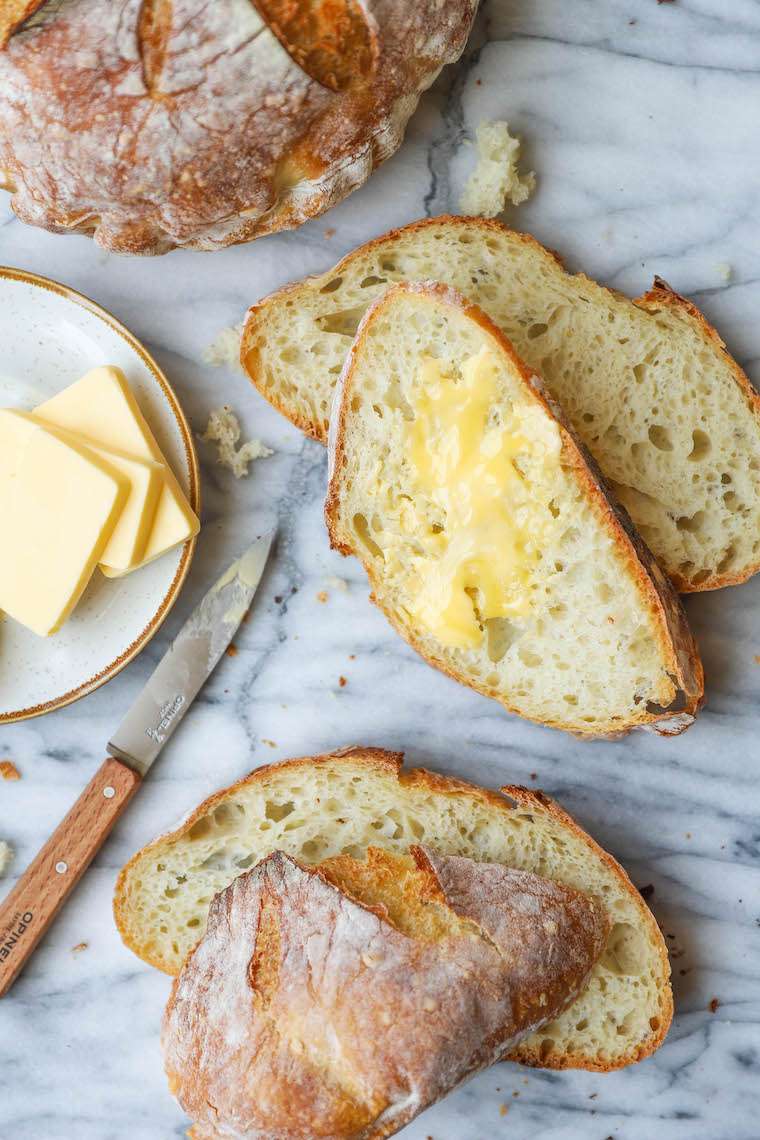
Easy No Knead Bread is a simple artisan-style loaf made with just flour, salt, yeast, and warm water, relying on a long fermentation and folding to develop structure without kneading. The dough is baked in a hot covered Dutch oven to create a crisp, golden crust and a soft, airy crumb inside. This straightforward method yields classic rustic bread with minimal effort and equipment.
Prep Time
8 hrs 30 mins
Cook Time
45 mins
Total Time
9 hrs 15 mins
Servings:
8
servings
Course:
Appetizer, Bread
Ingredients
- 3 ¼ cups all-purpose flour
- 2 teaspoons kosher salt
- ¾ teaspoon instant yeast
- 1 ½ cups water 100-110 degrees F, warm
Instructions
- In a large bowl, combine flour, salt and yeast. Create a well in the center; add water.
- Using a wooden spoon or your hand, stir until a wet, sticky dough forms, about 1-2 minutes.
- Cover bowl tightly with plastic wrap and let stand at a warm place until doubled in size and surface is dotted with bubbles, about 6-8 hours.
- Working on a lightly floured sheet of parchment paper, fold dough over itself 3-4 times, turning after each fold; gently shape dough into a round.
- Cover with a clean dishtowel and let stand at room temperature until dough has doubled in size, about 1 hour.
- Preheat oven to 450 degrees F. Place a Dutch oven, covered, in the oven for at least 30 minutes.
- Remove Dutch oven from the oven; working carefully, place dough into the Dutch oven using the parchment paper as a sling.
- OPTIONAL: Using a sharp knife or bread lame, make a few shallow cuts on the top.
- Cover and place in the oven; remove the lid after 30 minutes. Continue baking until golden brown and completely cooked through, reaching an internal temperature of 210 degrees F, about 15 minutes more. Let cool 30 minutes on a wire rack.
- Serve warm.
Cup of Yum
Notes
- This recipe is adapted from The Kitchn and yields a crusty artisan loaf using minimal ingredients and hands-on time.
- Warm water temperature is important; aim for 100-110 degrees F to activate the yeast properly.
- Use parchment paper to easily transfer the shaped dough into the hot Dutch oven.
- Making shallow cuts on the dough surface before baking helps control expansion during oven spring but is optional.