4.9 from 993 votes
Homemade Miso Soup with Tofu
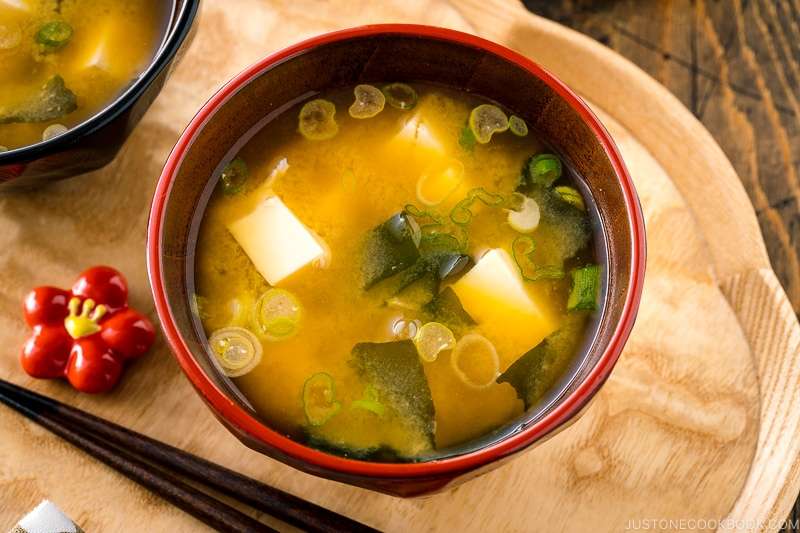
Homemade Miso Soup with Tofu features a flavorful dashi broth made from kombu and katsuobushi, combined with silken tofu, wakame seaweed, and scallions. This soup offers a delicate balance of umami from the dashi and miso paste, alongside the soft texture of tofu and the seaweed’s subtle brininess. It’s a wholesome, warming soup prepared by simmering and mixing these key ingredients thoughtfully.
Prep Time
5 mins
Cook Time
15 mins
Total Time
20 mins
Servings:
4
Calories:
57 kcal
Course:
Soup
Cuisine:
Japanese
Ingredients
For the Dashi (makes a scant 4 cups)
- 4 cups water
- 1 piece kombu ⅓ oz, 10 g per piece; 4 x 4 inches or 10 x 10 cm, dried kelp
- 1 cup katsuobushi packed; I used a loosely packed 3 cups in the video for stronger flavor, dried bonito flakes
For the Miso Soup
- 7 oz silken tofu kinugoshi dofu, soft/silken
- 4 Tbsp miso paste use 1 Tbsp, 18 g for every 1 cup, 240 ml of dashi
- 1 Tbsp dried wakame seaweed
- 1 green onion or scallion
Instructions
- Before we start... I make Awase Dashi with kombu and katsuobushi in this recipe. You can also make dashi with a dashi packet or powder. For vegan/vegetarian, make the Kombu Dashi I showed below or make Vegan Dashi with kombu and dried shiitake mushrooms.
- Gather all the ingredients.
- Cut 1 green onion/scallion into thin rounds.
Cup of Yum
To Make the Dashi (can make in advance)
- Add 4 cups water and 1 piece kombu (dried kelp) to a medium saucepan. If you have time, soak the kombu in water for 30 minutes. NEVER wash kombu and do not remove the white substance—that’s umami! These days, it‘s pretty clean, so just make sure there are no dirt particles.
- SLOWLY bring it to a boil (about 10 minutes) on medium-low heat so you can extract as much umami from the kombu as possible. Right before the stock boils, remove the kombu and set it aside for another use. (If you leave the kombu, it gets slimy and yields a bitter taste.) Now, what you have is Kombu Dashi. If you’re vegetarian/vegan, use this kombu dashi for your miso soup.
- If you‘re not vegetarian/vegan, add 1 cup katsuobushi (dried bonito flakes) to the kombu dashi and bring it back to a boil again. Once the dashi is boiling, reduce the heat, simmer for just 30 seconds.
- Turn off the heat and let the katsuobushi sink to the bottom, about 10 minutes. Then, strain through a fine-mesh sieve.
- Now you have roughly 4 cups of Awase Dashi. You can store the dashi in the refrigerator for up to 3–5 days and in the freezer for up to 2 weeks. Reserve the spent katsuobushi and repurpose it; see the suggested recipes that follow at the end of the instructions.
To Make the Miso Soup
- Add the dashi to the saucepan. If you are using dashi from the refrigerator, bring it to a slow boil (205°F/96°C) over medium heat and turn off the heat.
- Add 4 Tbsp miso. Put the miso in a ladle, slowly add the dashi into the ladle, and stir with chopsticks to dissolve completely. Here, I‘m using a miso muddler. If you accidentally add too much miso, dilute the miso soup with dashi (or water).
- Here, I‘m using a fine-mesh miso strainer, which helps you dissolve the miso faster. After dissolving the miso in the strainer, you may see rice koji (especially when it‘s koji miso). It‘s up to you if you want to include it in the miso soup or discard it (personal preference).
- Cut 7 oz soft/silken tofu (kinugoshi dofu) into ½-inch (1.3 cm) cubes and add to the miso soup. Tip: Add the tofu after the miso is completely dissolved; otherwise, you might break the tofu when stirring in the miso. Note: It is very common to cut tofu on your palm in Japan. However, I recommend using a cutting board if you have never done this.
- Add 1 Tbsp dried wakame seaweed and the chopped green onions to the pot right before serving to keep their fresh fragrance and color. Tip: If you worry about salt intake, I recommend rehydrating the dried wakame in a separate bowl of water to get rid of the saltiness, instead of rehydrating it in the soup itself. If reheating, warm up the miso soup until it is just hot. NEVER BOIL miso soup because it loses flavor and aroma.
To Serve
- Serve immediately. Place on the right side of the table setting; you can read about this in my post Ichiju Sansai (One Soup Three Dishes).
To Store
- In general, it‘s best to consume all the miso soup right away because it will lose its aroma and taste as time passes. Let your miso soup cool to room temperature (up to 4 hours; any longer and it will spoil) and then refrigerate. Keep for up to 2 days in the refrigerator. If you want to make a big batch to store for later, it‘s best to refrigerate the soup without adding the miso. When ready to use, add the miso only for the portion you need. You can freeze miso soup for up to 2 weeks. However, you have to remove the tofu before freezing as the texture will change.
To Reheat the Miso Soup
- Heat the miso soup in a pot over medium heat, but do not boil. Miso loses its nutrients, flavor, and aroma at high temperatures.
What to do with the spent katsuobushi and kombu?
- Save the spent kombu and katsuobushi in an airtight container and store it in the refrigerator for a week or in the freezer for up to a month.
- With the spent kombu, you can make Simmered Kombu (Kombu Tsukudani).
- You can also make Homemade Furikake (Rice Seasoning).
Nutrition Information
Calories
57kcal
(3%)
Carbohydrates
5g
(2%)
Protein
4g
(8%)
Fat
2g
(3%)
Saturated Fat
0.3g
(2%)
Polyunsaturated Fat
1g
(6%)
Monounsaturated Fat
0.4g
(2%)
Sodium
532mg
(22%)
Potassium
135mg
(3%)
Fiber
1g
(4%)
Sugar
2g
(4%)
Vitamin A
46IU
(1%)
Vitamin C
1mg
(1%)
Calcium
62mg
(6%)
Iron
1mg
(6%)
Nutrition Facts
Serving: 4 Serving
Amount Per Serving
Calories 57
% Daily Value*
| Calories | 57kcal | 3% |
| Carbohydrates | 5g | 2% |
| Protein | 4g | 8% |
| Fat | 2g | 3% |
| Saturated Fat | 0.3g | 2% |
| Polyunsaturated Fat | 1g | 6% |
| Monounsaturated Fat | 0.4g | 2% |
| Sodium | 532mg | 22% |
| Potassium | 135mg | 3% |
| Fiber | 1g | 4% |
| Sugar | 2g | 4% |
| Vitamin A | 46IU | 1% |
| Vitamin C | 1mg | 1% |
| Calcium | 62mg | 6% |
| Iron | 1mg | 6% |
* Percent Daily Values are based on a 2,000 calorie diet.