4.5 from 165 votes
Homemade Probiotic Yogurt
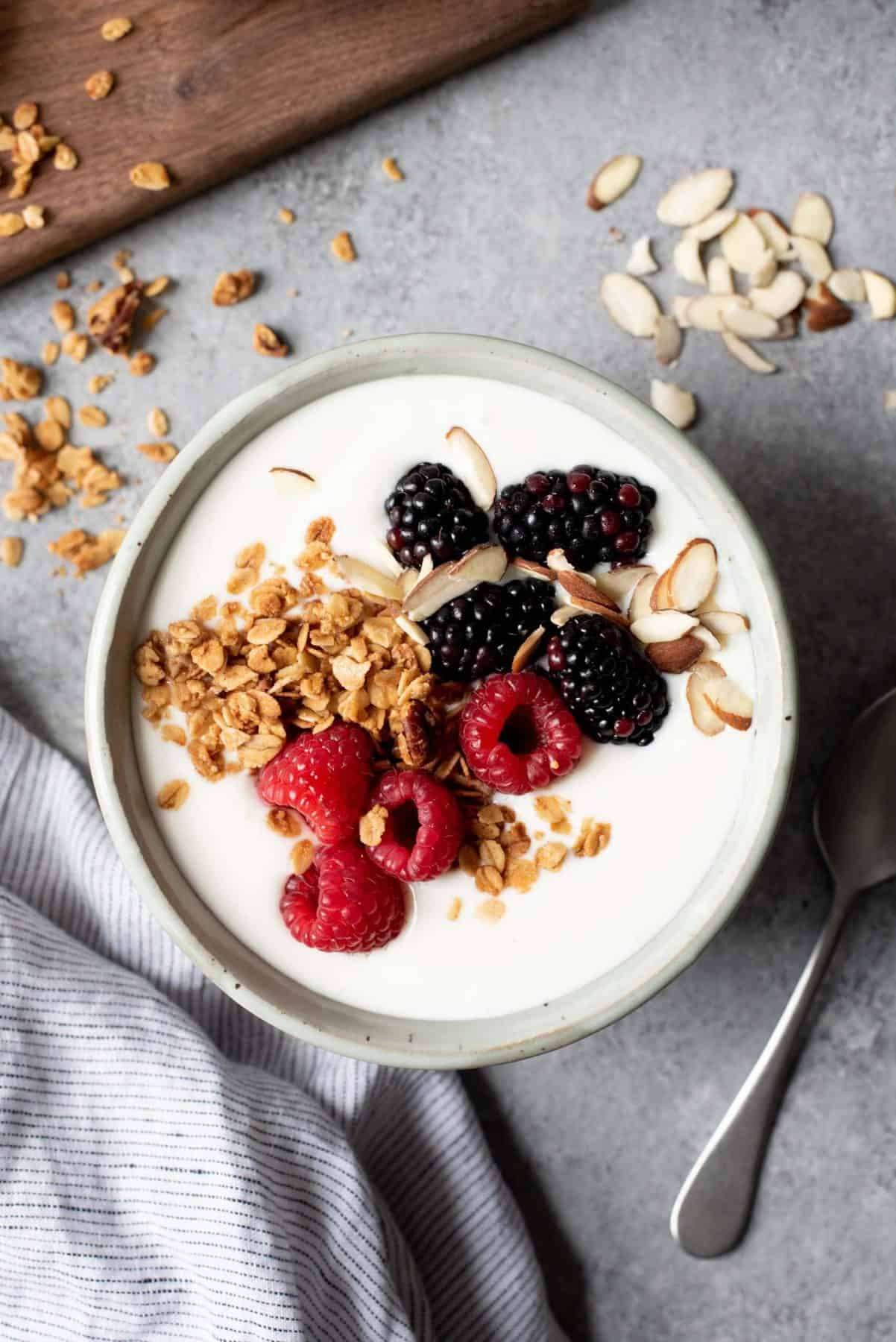
Homemade Probiotic Yogurt is made by fermenting whole milk with a yogurt starter culture or a portion of plain yogurt. The process involves heating milk until boiling, cooling it to a warm temperature ideal for fermentation, then incubating with the starter for about a day. This method produces creamy yogurt harboring beneficial bacteria, with temperature control being crucial for successful fermentation.
Prep Time
1 hr
Cook Time
1 d
Total Time
1 d 1 hr
Servings:
16
servings (makes 2 quarts regular yogurt or ~1 1/2 quarts Greek yogurt)
Calories:
99 kcal
Course:
Breakfast
Cuisine:
American
Ingredients
- ½ gallon milk whole
- yogurt starter culture OR ½ cup previous batch of plain unsweetened yogurt
- Thermometer optional but helpful
- yogurt strainer if you would like to make Greek yogurt, or nut milk bag
Instructions
Instant Pot Yogurt Directions
- Pour the milk into the basin of your Instant Pot. Press the “Yogurt” button and adjust to the “Boil” mode (if your Instant Pot does not have a yogurt cycle, follow the Stovetop directions below). Let milk heat until the Instant Pot beeps to indicate the cycle is finished.
- Allow the milk to cool down to between 95°F-110°F. If you don’t have a thermometer, a good rule of thumb is that when it’s the right temperature, you should be able to hold your (clean!) finger in the milk to a count of 10. If it’s too hot to handle for 10 seconds, it’s still too hot.
- When the milk is sufficiently cooled, sprinkle in the yogurt culture and whisk well to combine. Or, if using prepared yogurt, ladle out a small amount of the warm milk into a small bowl, add in the yogurt, and whisk until smooth. Then add the mixture to the pot of milk, whisking well to combine.
- Turn the Instant Pot Yogurt function back on, this time adjusting until you see the time on the screen. Set to 24 hours. Close lid and let it ferment until the Instant Pot beeps.
- When the fermentation time is up, spoon the yogurt into mason jars for storage (the yogurt will thicken as it cools). If you want to make Greek yogurt, spoon the yogurt into a yogurt strainer or nut milk bag and let drain for 8-12 hours, or until it is the desired thickness.
Cup of Yum
Stovetop + Heating Pad Yogurt Directions
- Pour the milk into a large soup pot. Heat over medium-low heat and whisk constantly until the yogurt reaches about 185°F or looks very frothy, but do not let boil.
- Allow the milk to cool down to between 95°F-110°F. If you don’t have a thermometer, a good rule of thumb is that when it’s the right temperature, you should be able to hold your (clean!) finger in the milk to a count of 10. If it’s too hot to handle for 10 seconds, it’s still too hot.
- When the milk is sufficiently cooled, sprinkle in the yogurt culture and whisk well to combine. Or, if using prepared yogurt, ladle out a small amount of the warm milk into a small bowl, add in the yogurt, and whisk until smooth. Then add the mixture to the pot of milk, whisking well to combine.
- Cover the pot, and then wrap completely in a large towel or blanket. Set the pot (with the blanket wrapped around it) on a heating pad set to Low for 24 hours.
- When the fermentation time is up, spoon the yogurt into mason jars for storage (the yogurt will thicken as it cools). If you want to make Greek yogurt, spoon the yogurt into a yogurt strainer or nut milk bag and let drain for 8-12 hours, or until it is the desired thickness.
Notes
- Maintain a consistent incubation temperature around 100°F for about 24 hours to ensure proper fermentation.
- Different methods such as Instant Pot yogurt settings or heating pads can be used to keep the yogurt warm during incubation.
- Use whole milk for best results; ultra-pasteurized milk may yield thinner yogurt.
- Using a fresh starter culture allows control over probiotic strains, beneficial for digestive health.
- Store-bought plain yogurt works as a starter if a culture is not available.
Nutrition Information
Serving
0.5cup
Calories
99kcal
(5%)
Carbohydrates
8g
(3%)
Protein
6g
(12%)
Fat
5g
(8%)
Saturated Fat
3g
(15%)
Polyunsaturated Fat
1g
(6%)
Cholesterol
15mg
(5%)
Sodium
76mg
(3%)
Sugar
8g
(16%)
Nutrition Facts
Serving: 16 servings (makes 2 quarts regular yogurt or ~1 1/2 quarts Greek yogurt)
Amount Per Serving
Calories 99
% Daily Value*
| Serving | 0.5cup | |
| Calories | 99kcal | 5% |
| Carbohydrates | 8g | 3% |
| Protein | 6g | 12% |
| Fat | 5g | 8% |
| Saturated Fat | 3g | 15% |
| Polyunsaturated Fat | 1g | 6% |
| Cholesterol | 15mg | 5% |
| Sodium | 76mg | 3% |
| Sugar | 8g | 16% |
* Percent Daily Values are based on a 2,000 calorie diet.