3.4 from 192 votes
How to Make Sourdough Bread
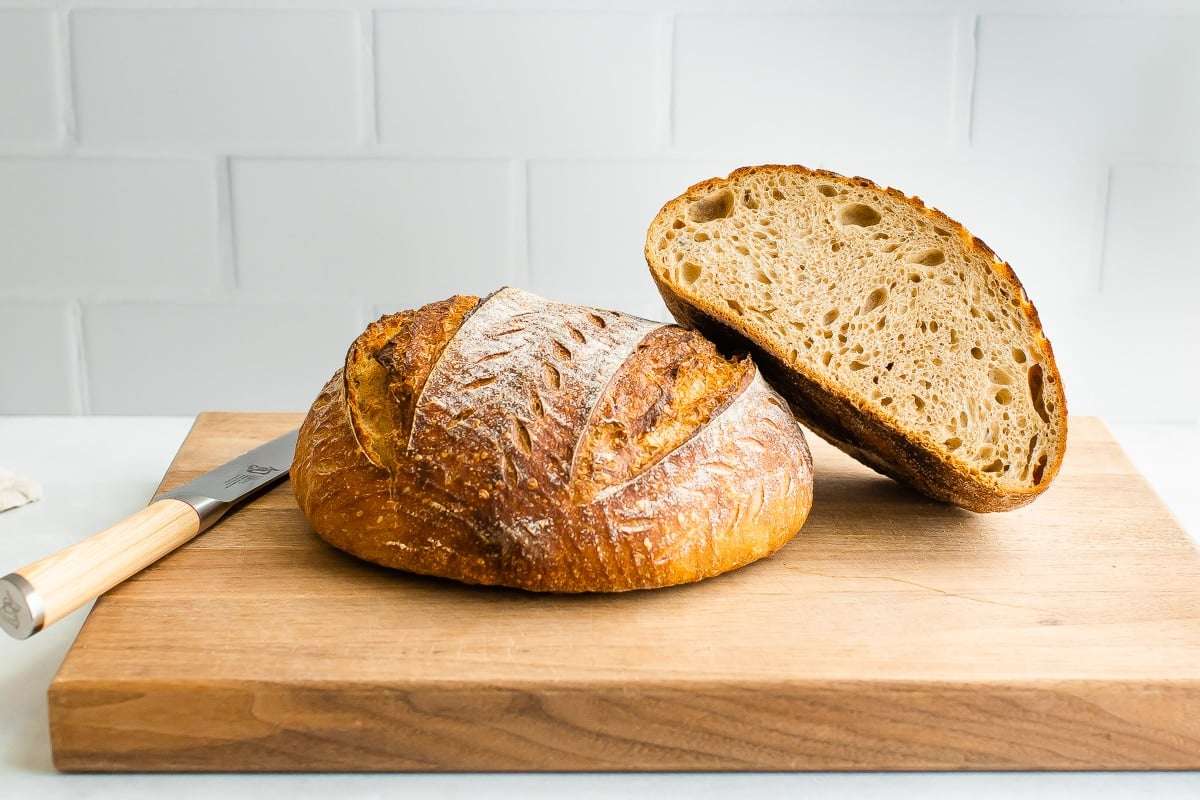
How to Make Sourdough Bread guides you through combining sourdough starter with multiple flours, water, and salt to create a fermented dough. The dough undergoes several stretch and fold cycles before bulk fermentation, resulting in a smooth resistant dough that doubles in size. Once shaped and baked, this produces the characteristic sourdough loaf with a chewy crumb and subtly tangy flavor.
Prep Time
1 hr
Cook Time
40 mins
Proof Time
1 d
Total Time
1 d 1 hr 40 mins
Servings:
2
loaves
Calories:
184 kcal
Course:
Baked Goods
Cuisine:
American
Ingredients
- 750 grams water warm or tepid
- 100 grams sourdough starter ⅓ cup
- 750 grams all-purpose flour King Arthur brand
- 50 grams rye flour King Arthur brand
- 200 grams white whole wheat flour King Arthur brand
- 20 grams salt sea salt
- rice flour to sprinkle on top before baking (optional)
Instructions
Day 1 (Start in the Morning)
- Measure out the flours using a food scale. Using a food scale helps to ensure that your getting the proper measurements!
- Add water, sourdough starter, salt and flours together in Cambro or large mixing bowl and use your hands to mix the ingredients together. Dough will be “shaggy”, just mix until all the flour is combined. Cover and leave for 15 minutes.
- Open Cambro and “stretch and fold” the dough, cover and wait another 15 minutes. Repeat until you have done four total "stretch and folds." Dough should then be smooth and should have lots of stretch by the last stretch.
- Cover tightly and leave the dough a room temperature until it has doubled in size (easiest way to measure is put a rubber band around Cambro where dough starts). This can take 6-8 hours in the summer and 10-12 hours in the winter!
- Remove dough from Cambro and place on onto lightly floured surface. A granite counter top work great or use a silicone mat. Divide dough in half (should be a little over 900 grams each).
- Take each round and pull edges to center all the way around, then flip over and cover with a tea towel for 10 minutes. Do the same thing, pulling edges out a little and tuck into center and flip over. Then take round and gently pull a few inches toward you. You can do this 3 or 4 times and feel the form “tighten” a little. Lift and flip over and place into banneton baskets.
- Cover and put into fridge overnight.
Cup of Yum
Day 2 (Ready to Bake!!!)
- Put a cast-iron Dutch oven (two if you have them) in the oven and heat at 500 degrees for 30 minutes. Take one loaf out of the fridge, flip over onto parchment, sprinkle on a little rice flour, score and put into the preheated dutch oven. If you have two Dutch ovens, repeat with second loaf otherwise wait to score the second loaf until the first one is done baking.
- Reduce heat to 450°F degrees and bake 20-23 minutes covered, then uncover and bake another 20 minutes. When done, it will have a hollow sound if you tap it and a nice crunch if you push on it gently. If you have a thermometer you can check for internal temperature of 220°F.
Notes
- Measure ingredients by weight with a food scale for best accuracy.
- Use water warmed to about 80°-82°F to optimize fermentation.
- Bulk fermentation times vary with temperature; it can take 6-8 hours in summer and 10-12 hours in winter.
Nutrition Information
Serving
1slice
Calories
184kcal
(9%)
Carbohydrates
38g
(13%)
Protein
7g
(14%)
Sodium
468mg
(20%)
Potassium
9mg
(0%)
Fiber
1g
(4%)
Nutrition Facts
Serving: 2 loaves
Amount Per Serving
Calories 184
% Daily Value*
| Serving | 1slice | |
| Calories | 184kcal | 9% |
| Carbohydrates | 38g | 13% |
| Protein | 7g | 14% |
| Sodium | 468mg | 20% |
| Potassium | 9mg | 0% |
| Fiber | 1g | 4% |
* Percent Daily Values are based on a 2,000 calorie diet.