5 from 182 votes
Japanese Milk Bread
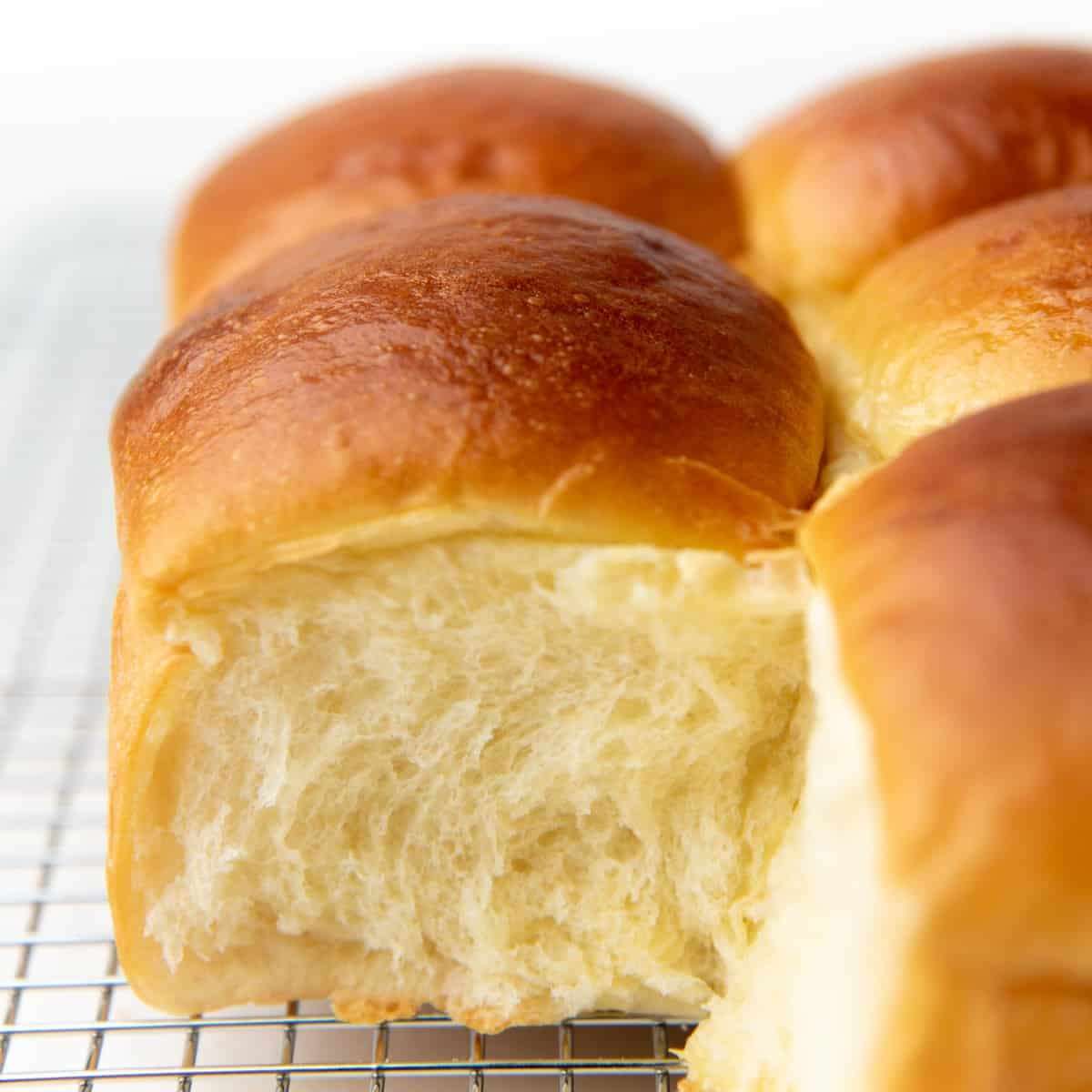
Japanese Milk Bread is a soft, fluffy loaf characterized by a tangzhong starter, which is a flour-water-milk paste cooked to a thick pudding consistency. This technique lends extra moisture and a tender crumb to the dough. The dough includes milk, sugar, milk powder, egg, bread flour, yeast, salt, and softened butter. The bread rises well, developing a shiny, golden crust and a light interior.
Prep Time
45 mins
Cook Time
40 mins
Additional Time
4 hrs
Total Time
5 hrs 25 mins
Servings:
18
slices
Calories:
118 kcal
Course:
Breakfast, Snacks
Cuisine:
Asian, Japanese
Ingredients
Tangzhong
- 60 mL water ¼ cup
- 60 mL milk ¼ cup
- 23 g bread flour 2 tbsp
Japanese Milk Bread
- Tangzhong room temperature (above)
- 120 mL milk ½ cup, lukewarm
- 7 g active dry yeast 2 - 2 ¼ tsp
- 50 g sugar ¼ cup
- 15 g milk powder 2 tbsp, dry
- 1 egg
- 350 g bread flour about 2 ⅔ cups, spoon and leveled
- 1 tsp salt sea salt
- 58 g butter softened, 4 tbsp / ½ stick, unsalted
Instructions
Tangzhong
- Place the water in a small saucepan. Add the bread flour and whisk until you have a smooth mix with no lumps. Add the rest of the milk and whisk to combine.
- Heat over medium heat while whisking constantly until the mixture thickens. The resulting mixture should have a thick, pudding-like consistency.
- Scrape the mixture into a bowl and then cover with plastic wrap. Make sure the plastic wrap is touching the surface of the tangzhong to prevent a skin from forming on top.
- Allow the tangzhong to cool to room temperature.
Cup of Yum
Japanese milk bread dough
- In your mixing bowl, place the lukewarm milk and dissolve about 1 tsp of the sugar in the liquid. Sprinkle the yeast over the milk and stir gently to mix. Allow the milk + yeast mixture to stand for about 10 - 20 minutes until the yeast is activated. The mixture should become bubbly and frothy on the surface.
- Once the yeast is activated, add the milk powder (if using), the rest of the sugar, tangzhong, the egg, flour, and finally the salt.
- Using a spatula, mix the dough to combine the ingredients and to help form a scraggly dough.
- With the dough hook attached to your mixer, knead the dough for about 5 minutes on a low speed (speed 2 or 3). The dough will be very sticky and stick to the sides, but continue mixing and the dough will start to come together.
- After 5 minutes of kneading, add the butter in 3 - 4 additions, mixing for about 20 seconds in between. Scrape down the sides and the bottom of the bowl to make sure the dough mixes well.
- Once all the butter is incorporated into the dough, turn up the speed to 4 - 5 (medium speed) and knead for a further 5 - 7 minutes. Scrape the bowl once or twice while kneading.
- The dough should become smooth, satiny and pull off cleanly from the sides of the bowl.
- Place the dough on a lightly floured surface and shape the dough into a ball. Then place the dough back in the mixing bowl and cover with plastic wrap.
- Keep the bowl in a warm place and allow the dough to double in size (about 1 - 2 hours, depending on the weather/ambient room temperature).
- When the dough has proofed in a warm place, you can transfer it to the fridge for a couple of hours just to make it a little easier to handle. THIS IS AN OPTIONAL STEP.
- Alternatively, place the bowl in the fridge and let it slow proof for about 12 hours. The dough will also be easy to handle when chilled.
- Once the dough is proofed and you’re ready to shape the dough, prepare the loaf pan. Butter 1 - 4.5 x 8.5 inch loaf pan and dust the pan with flour. If making dinner rolls, butter a 9 or 8 inch square cake pan, and dust the sides with flour. Set aside until needed.
- Turn the dough out onto a lightly floured surface and press all the excess air out of the dough.
Japanese milk bread loaf
- Weigh the dough, and divide it into 4 equal portions.
- Roll out each dough portion into a six inch (approximately) square.
- Fold the opposite corners of the square in towards the middle.
- Roll up this piece of dough, starting from the pointed end. Make sure you roll up the dough firmly, and a little tightly. If it’s too loose, you may end up with large holes in the baked bread.
- Once you’ve rolled up the dough to the top, fold the pointed edge in and pinch the seam to seal.
- Place the rolled up dough in the dough pan, seam side down. There will be 4 rolls per loaf pan.
- Repeat with all the dough portions and place them in the loaf pan.
- Cover the loaf pan with plastic wrap and let the dough proof in a warm place, until doubled in size. This can take about 1 - 2 hours depending on the ambient room temperature. The dough should rise to just below the top of the loaf pan.
Japanese milk bread rolls
- Divide the dough into 9 equal pieces.
- Roll each piece into smooth, round dough balls and place them in the square baking pan, with about ¼ - ½ inch of space between each ball. Each square baking pan should have 9 rolls each.
- Cover the baking pan with plastic wrap and let the dough proof in a warm place, until doubled in size. This can take about 1 - 2 hours, depending on the ambient room temperature.
Baking the bread
- Preheat oven to 350°F / 180°C. Once preheated, AND the bread is proofed, brush the top of the bread dough with a milk wash (for a more matte crust), or an egg wash (for a glossy crust). Bake in the preheated oven for 30 - 35 minutes (for the loaf), or 20 - 30 minutes (for the bread rolls). If the bread starts to caramelize too much in the oven, place a piece of foil over the surface of the bread to prevent it from burning.
- If you have a thermometer, bake until the internal temperature is about 190 - 205°F (88 - 96°C).
- Remove the loaf pan / baking pan from the oven and let it cool for a few minutes.
- Turn the dough out onto a wire rack and let it cool down further.
- This bread is easier to slice when at room temperature, but can be enjoyed warm too.
Notes
- For faster proofing in cooler conditions, place the dough bowl inside an oven with the light on to keep it warm.
- Use a metal bowl for proofing to help retain warmth and improve rise consistency.
- Proof dough by poking with a finger: if indentation springs back lightly, dough is ready to bake; if it remains, bake immediately to avoid overproofing; if it deflates, it is overproofed and may need to be redone.
- This bread shares similarities with brioche and other enriched doughs like Hawaiian rolls and babka.
Nutrition Information
Serving
1slice
Calories
118kcal
(6%)
Carbohydrates
18g
(6%)
Protein
3g
(6%)
Fat
4g
(6%)
Saturated Fat
2g
(10%)
Cholesterol
17mg
(6%)
Sodium
143mg
(6%)
Potassium
53mg
(1%)
Fiber
1g
(4%)
Sugar
4g
(8%)
Vitamin A
128IU
(3%)
Vitamin C
1mg
(1%)
Calcium
27mg
(3%)
Iron
1mg
(6%)
Nutrition Facts
Serving: 18 slices
Amount Per Serving
Calories 118
% Daily Value*
| Serving | 1slice | |
| Calories | 118kcal | 6% |
| Carbohydrates | 18g | 6% |
| Protein | 3g | 6% |
| Fat | 4g | 6% |
| Saturated Fat | 2g | 10% |
| Cholesterol | 17mg | 6% |
| Sodium | 143mg | 6% |
| Potassium | 53mg | 1% |
| Fiber | 1g | 4% |
| Sugar | 4g | 8% |
| Vitamin A | 128IU | 3% |
| Vitamin C | 1mg | 1% |
| Calcium | 27mg | 3% |
| Iron | 1mg | 6% |
* Percent Daily Values are based on a 2,000 calorie diet.