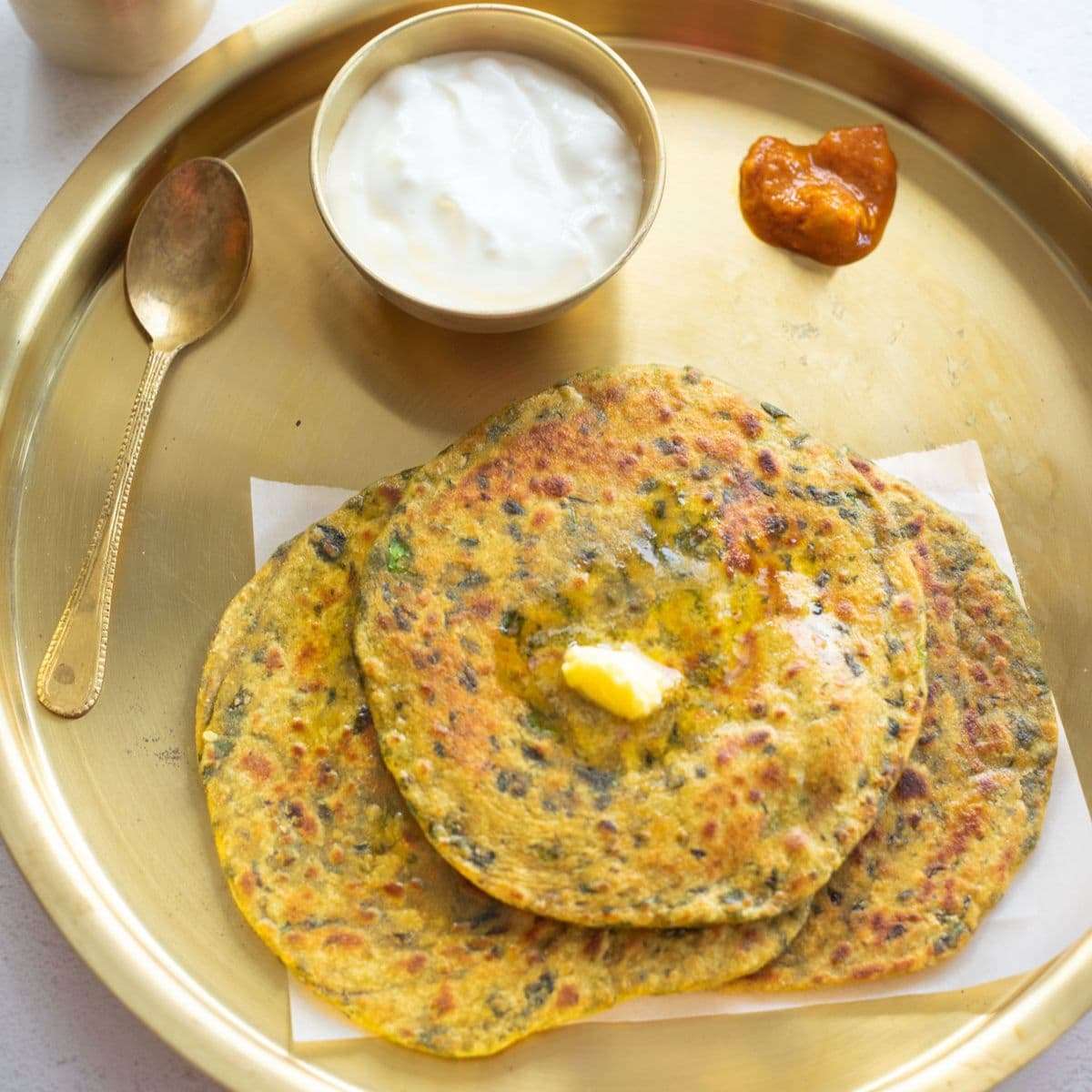
Methi Paratha
Methi Paratha combines whole wheat flour and gram flour with fresh fenugreek leaves and spices to create a savory Indian flatbread. The dough is enriched with green chili, ginger, and ajwain seeds, offering a subtle warmth and distinctive flavor. The fenugreek leaves add a slight bitterness balanced by the richness of ghee, making each paratha layered in taste and texture. These flatbreads are rolled thin and cooked with ghee until golden, delivering a mildly crisp exterior with a soft, flavorful interior, ideal for breakfast or as an accompaniment to curries.
Ingredients
- 2 cup fenugreek leaves leaves removed from stems, aka methi
- 1/2 teaspoon salt
- water for soaking
For dough
- 2 cup whole wheat flour
- 1/4 cup gram flour aka besan
- 2 green chili finely diced, adjust to taste
- 1 teaspoon ginger
- 1 teaspoon red chili powder Mirchi powder
- 1 teaspoon ajwain seeds aka carom seeds
- 1 teaspoon salt
- 2 teaspoon ghee for dough, or oil
- 1/3 cup water or lmore as needed
For paratha
- 2 teaspoon ghee for parathas
- whole wheat flour dry
Instructions
Prepping Methi Leaves
- Wash the methi leaves in a large bowl filled with water 2-3 times. Add salt to the bowl and let it rest for 3-5 minutes. Then remove the methi leaves from the top of the bowl.
- Please the leaves on a kitchen towel and gently dry them. Now chop the leaves corasely.
Make the Dough
- In a large bowl, combine atta (whole wheat flour) and besan (gram flour). Add green chili, ginger, red chili powder and salt.
- Add enough water (in small increments) and knead to make a soft and smooth dough. Make the dough smooth by kneading it with your fist. Add some water to your hand and knead 2-3 times. When you press your finger against the dough, it should leave an impression. This is the right consistency of the dough.
- Using a stand mixer or food processor to make dough: Alternatively, you can make the dough using a stand mixer. Use a dough hook attachment, and start the mixer at the lowest speed. Add water in small increments. In a couple of minutes, the dough will start coming together. The dough should be soft and pliable.
- Cover with a damp cloth or plastic wrap and let the dough rest for at least 15 minutes and up to 30 minutes.
Rolling
- Make balls from the dough by rotating between your palms. The balls will be the size of a golf ball, sightly larger in size than roti. Make the ball a bit flat.
- Dip a ball in dry flour, place on the marble or wooden base (chalka) and roll with the rolling pin.
- (Optional step) Roll into a circle of about 4 inches in diameter. Spread some ghee on the dough. Make a cut up to the center of the circle, using your fingers. Then start rolling on one side. Take the roll into your hand and flatten it.
- Dip again in dry flour and start rolling using the rolling pin. Do not apply too much pressure while rolling. Apply equal pressure on all sides while rolling. When you roll with gentle hands, the dough flattens and moves in circles with the rolling pin. You can also turn the paratha with your hands at 90 degrees multiple times while rolling, so that it forms a circle. Apply more flour if required while rolling.
Making the Paratha
- Heat the tawa (skillet or griddle). Place the rolled paratha on the hot tawa. Cook until you start seeing small air pockets and the color of the dough starts to change.
- With a flat spatula, flip the paratha and top with ghee just enough to make the surface of the paratha greasy (about ½ teaspoon). Spread the ghee or vegetable oil evenly over the paratha with the back of the spoon. Now we want to cook until there are some brown spots on the paratha.
- Flip the paratha and top with ghee/oil on the other side. Spread it evenly over the surface. Cook until there are brown spots while pressing gently with the spatula.
- Spread ghee/ oil on the second side and press the edges of the paratha till it is evenly brown and well cooked.
- When both sides have golden brown spots, transfer the paratha to a plate lined with a paper towel.
- Repeat these steps till all the parathas are cooked. You can keep parathas in an insulated container or in a roti basket wrapped in a towel. This will ensure they stay warm by the time you are ready to eat. Serve hot with white butter, pickle, raita or a cup of hot chai.
Notes
- Spinach can substitute fresh fenugreek leaves when unavailable.
- Dried kasoori methi may be used at one-third the quantity of fresh leaves.
- Finely chopped onion or minced garlic can be added to the dough for variation.
- Replace ghee with vegetable oil for a vegan version.
- Rest the dough before rolling to improve softness and ease of handling.
- Use whole wheat flours like Sujata Chakki Atta or Aashirvaad Select Sharbati for best texture.
Nutrition Information
Nutrition Facts
Serving: 9 Serving
Amount Per Serving
Calories 155
% Daily Value*
| Calories | 155kcal | 8% |
| Carbohydrates | 25g | 8% |
| Protein | 6g | 12% |
| Fat | 4g | 6% |
| Saturated Fat | 2g | 10% |
| Polyunsaturated Fat | 1g | 6% |
| Monounsaturated Fat | 1g | 5% |
| Cholesterol | 6mg | 2% |
| Sodium | 428mg | 18% |
| Potassium | 130mg | 3% |
| Fiber | 4g | 16% |
| Sugar | 1g | 2% |
| Vitamin A | 70IU | 1% |
| Vitamin C | 1mg | 1% |
| Calcium | 218mg | 22% |
| Iron | 2mg | 11% |
* Percent Daily Values are based on a 2,000 calorie diet.