4.7 from 233 votes
Retro School Dinner Cake
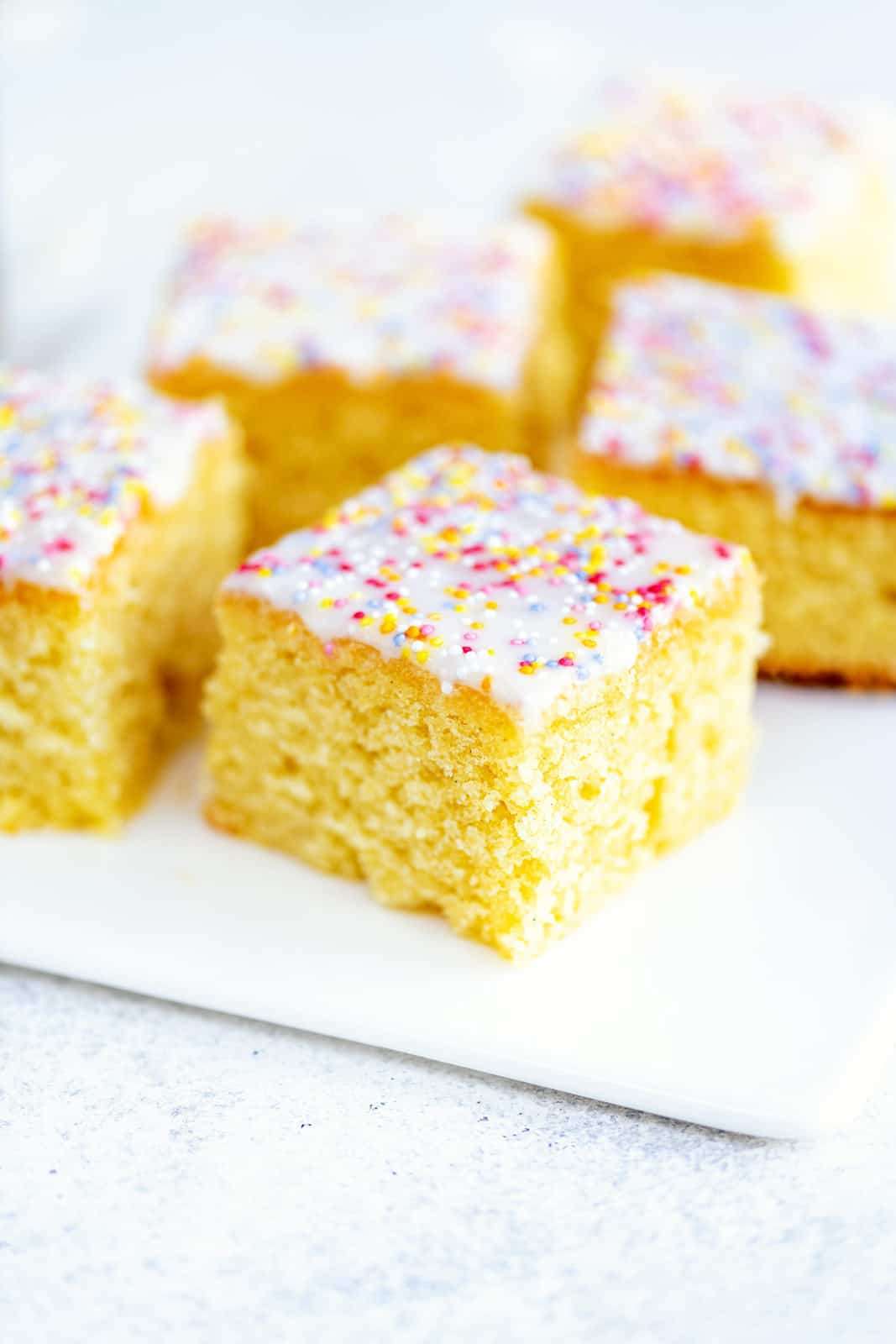
The Retro School Dinner Cake is a tender, golden rectangular cake made with basic pantry ingredients including flour, sugar, butter, eggs, and milk, leavened with baking powder and soda. The batter is beaten until smooth and baked until springy to the touch with a clean skewer test. After cooling, it’s iced on the flat side with vanilla icing and decorated with sprinkles, evoking nostalgic school celebrations. The cake's fine crumb and lightly sweet flavor suit everyday occasions or a simple dessert.
Prep Time
10 mins
Cook Time
45 mins
Total Time
55 mins
Servings:
20
slices
Calories:
310 kcal
Course:
Cake
Cuisine:
British
Ingredients
- 350 g plain flour all purpose flour or cake flour, 2¾ cups
- 330 g sugar caster or granulated, 1 ⅔ cups
- 1 tbsp baking powder
- ½ tbsp bicarbonate of soda baking soda
- ½ tsp salt omit if you are using margarine
- 200 g butter or margarine, softened
- 3 egg large
- 180 ml milk room temperature, 3/4 cup
- 2 tsp vanilla extract or vanilla paste
For the icing & decoration
- 455 g icing sugar powdered sugar) preferably sifted, 3 ½ cups
- water as needed to thin the icing
- 1 tsp vanilla extract
- Sprinkles hundreds and thousands variety
Instructions
- Preheat the oven to 170C (340F). Line a rectangular tin (mine was 23x29cm) with baking paper letting the edges hang over the sides.
- Put the flour, sugar, baking powder, soda in a large mixing bowl. If you can be bothered then sift everything into the bowl to aerate the dry ingredients. Add the eggs, milk, vanilla extract and butter or margarine (room temperature please!).
- Start beating at lowest speed setting until ingredients come together. Increase the speed to maximum and beat until the batter is completely smooth - about 30 seconds to one minute.
- Transfer to a rectangular baking tray lined with paper and level using a spatula. Bake for 45-50 minutes or until the cake is golden and feels springy to the touch. A skewer or knife inserted in the centre should come out clean – if not cook for a further 5 minutes.
- Leave the cake to cool completely then carefully invert so that you add glaze to the flat side. If the cake has domed while baking, level using a large serrated knife. This is likely to happen if your baking tray is a tad too small.
- Mix the icing sugar with just enough water to make a thick pourable glaze. Drizzle over the cake, letting it drip down the sides (you might want to do this over a large roasting tin to catch any excess glaze).
- Add sprinkles and leave the glaze to set slightly before slicing and sharing. You can serve with a little warm custard (I used tinned custard) for an extra slice of nostalgia!
Cup of Yum
Notes
- Use room-temperature ingredients including butter, eggs, and milk to achieve a smooth, unified batter without curdling.
- If milk is refrigerated, warm it briefly until just tepid before use; cold eggs can be warmed by resting in warm water for five minutes.
- Set a timer slightly before the end of the baking time and avoid opening the oven early to maintain heat and proper rise.
- The cake is done when the top springs back lightly, edges pull away slightly, and a skewer inserted in the center comes out clean or with moisture-free crumbs.
- If using self-raising flour instead of plain flour, reduce baking powder to half a teaspoon and omit baking soda.
Nutrition Information
Calories
310kcal
(16%)
Carbohydrates
55g
(18%)
Protein
3g
(6%)
Fat
9g
(14%)
Saturated Fat
6g
(30%)
Cholesterol
47mg
(16%)
Sodium
226mg
(9%)
Potassium
103mg
(2%)
Fiber
1g
(4%)
Sugar
41g
(82%)
Vitamin A
300IU
(6%)
Calcium
45mg
(5%)
Iron
1mg
(6%)
Nutrition Facts
Serving: 20 slices
Amount Per Serving
Calories 310
% Daily Value*
| Calories | 310kcal | 16% |
| Carbohydrates | 55g | 18% |
| Protein | 3g | 6% |
| Fat | 9g | 14% |
| Saturated Fat | 6g | 30% |
| Cholesterol | 47mg | 16% |
| Sodium | 226mg | 9% |
| Potassium | 103mg | 2% |
| Fiber | 1g | 4% |
| Sugar | 41g | 82% |
| Vitamin A | 300IU | 6% |
| Calcium | 45mg | 5% |
| Iron | 1mg | 6% |
* Percent Daily Values are based on a 2,000 calorie diet.