4.8 from 24 votes
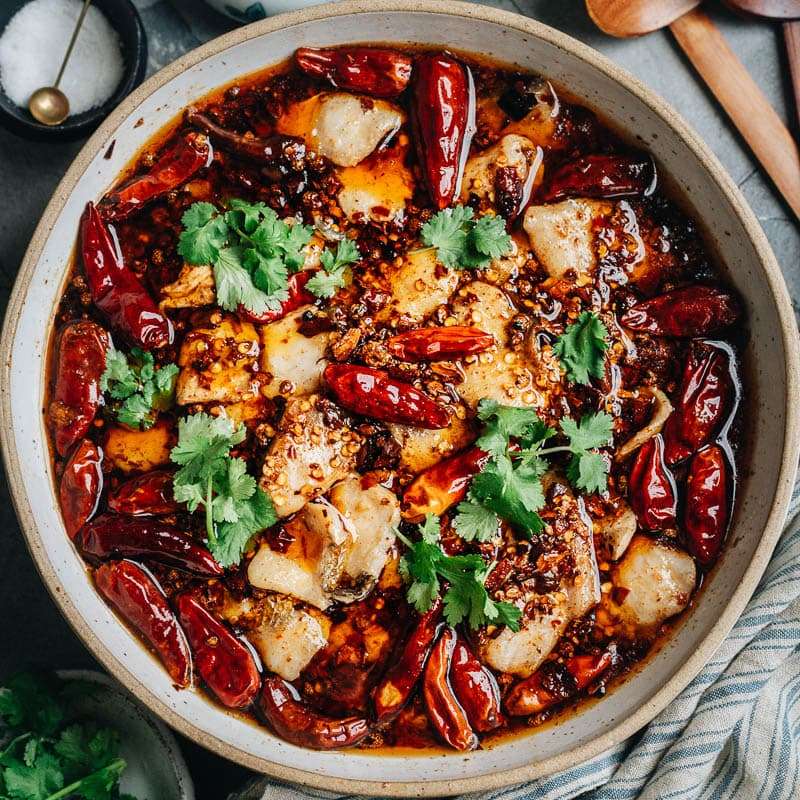
Shui Zhu Yu (Sichuan Boiled Fish, 水煮鱼)
An authentic Shui Zhu Yu (Spicy Sichuan Boiled Fish) recipe that recreates the ultra aromatic, numbing, spicy sensation you would experience in China.
Prep Time
20 mins
Cook Time
25 mins
Total Time
45 mins
Servings:
4
servings
Calories:
224 kcal
Course:
Main Course
Cuisine:
Chinese
Ingredients
- 1 fish or 2 white fish fillets (branzino, sea bass, snapper, or catfish, whole, 2 to 3 lbs / 1 to 1.3 kg
Marinade
- 1 tablespoon Shaoxing wine (or dry sherry)
- 1 teaspoon salt
- 1 teaspoon white pepper
- 1 egg white
- 2 teaspoons cornstarch
Topping
- 1/2 cup dried chili peppers and extra for garnish, Chinese variety
- 2 tablespoons Sichuan peppercorn a combo of red and green if possible (*Footnote 1
- 1/3 canola oil , separated (or other neutral oil)
Soup base
- 4 cloves garlic , smashed
- 1 " ginger , sliced
- 3 green onions , cut into 1" (2.5 cm) pieces
- 5 dried chili peppers sliced, Chinese variety
- 3 tablespoons doubanjiang
- 1 tablespoon Shaoxing wine (or dry sherry)
- 1 tablespoon sugar
- 1 teaspoon soy sauce
- 1/2 teaspoon mushroom powder (or chicken powder) (optional)
- 1/4 teaspoon white pepper
Vegetables
- 2 cups bean sprout
- 1 cup celery or regular celery) (cut into 1" / 2.5 cm sticks, chopped, Chinese variety
Slurry
- 1/2 teaspoon cornstarch
- 1 teaspoon water
Instructions
Butcher the fish (Optional)
- Check to see if there are any residual fish scales. If yes, run your knife gently from the tail to the head to remove the scales.
- Starting at the top of the head, slice along the collarbone.
- Using mainly the tip of your knife, run the blade along one side of the spine to make a 1/2” (1 cm) shallow cut through the skin.
- Make a small slice near the tail, which will be the base of the fillet.
- In smooth motions, use your knife gently to slice the flesh while pressing against the bone and the other hand holding the flesh. Slice the flesh away from the spine until it reaches the rib cage.
- Carefully angle the blade of the knife downward so that you can carve around the bone. It’s OK if some of the bones are attached with the fillet, which you can remove later.
- Once the flesh is released from the rib cage, keep slicing it until the fillet is fully detached from the bone.
- Flip the fish over and repeat on the other side, this time from the tail, until you get two pieces of fish fillets.
- Trim the thin white belly from both sides and discard the pieces (depending on the type of the fish they might taste quite oily, but you can reserve them as well).
- Using a heavy knife or a cleaver, remove the head and tail by pressing the knife against the bone and use one strong motion to cut through it. Chop the spine into 4 pieces.
Cup of Yum
Prepare the fish fillets
- Starting at the bottom of the fillet, tilt your knife to 45° and slice the fish into 1/4" (1/2 cm) thick pieces.
- Add the cut fillets, bones, and head (if using) to a medium-sized bowl. Keep the bones and the head on one side of the bowl. Add the marinade ingredients. Gently use your hand to mix the sliced fish until the ingredients are evenly coated. Then gently rub the rest of the seasonings onto the bones and fish head. Be careful not to poke your finger on the fish bones. Set aside to marinate for 15 minutes.
Prepare the topping spices
- Cut the dried chili peppers in half.
- Heat a medium-sized pot over medium-low heat with 2 tablespoons oil. Add the dried chilis, and Sichuan peppercorns. Cook and stir until fragrant but not browned, about 2 minutes. Transfer the spices to a plate to cool slightly, reserving the oil in the pan.
- Add the fried spices into a small food processor or blender. Pulse until coarsely chopped. Set aside.
Prepare the soup base
- Reheat the same pot over medium heat and add the garlic, ginger, green onion whites, and dried chilis. Cook and stir until fragrant, 1 minute or so.
- Add the doubanjiang. Stir for another 2 to 3 minutes. Turn to low heat if the paste starts to stick to the pan too much. You can also pour a bit of water into the pan to release the paste.
- Pour in the Shaoxing wine and use a spatula to lift as much of the brown bits from the bottom as possible.
- Add 5 cups of water and keep scraping the bottom.
- Add the sugar, soy sauce, white pepper, and mushroom/chicken powder (if using). Cook over medium-high heat until bringing to a boil. Reduce to a simmer and cook for another 5 minutes. Use a mesh strainer to remove the solid spices and discard them.
Finish up
- Prepare a large heat-proof bowl, large enough to hold all the broth, the vegetables, and the fish.
- Add the vegetables to the broth and blanch for 1 minute. Remove them from the broth and place them on the bottom of the big bowl.
- Bring the broth back to a simmer. Add the fish bones and head. Cook for 2 minutes, or until the fish head is cooked through. Add the fish bones to the big bowl. (You can add the fish head as well if the bowl is big enough and if you plan to serve the fish head).
- Bring the broth back to a simmer. Add the fillet slices using your hand, a few pieces at a time, and separate them during the process. Poach for 30 second to a minute, or until the fish is just cooked through. Transfer the fish into the big serving bowl.
- Bring the broth to a boil again. Stir to fully dissolve the cornstarch slurry and pour it into the broth, stirring constantly. Cook for 1 minute. Then pour the broth into the serving bowl, until the fish slices are mostly covered. Set aside the remaining broth if there is any left. (*Footnote 2)
- Spread the prepared topping spices over the broth. You can add a few pieces of dried chili peppers for garnish (optional, and they won’t add too much heat).
- Heat the remaining 1/4 cup oil over medium heat in a small pot or saucepan until just smoking. Carefully drizzle the spices over the serving dish. The oil will spatter a bit but shouldn’t cause a mess.
- Serve immediately as a main dish with steamed rice.
Notes
- I used 1 tablespoon of red Sichuan peppercorns and 1 tablespoons of green Sichuan peppercorns. If you do not have the green ones, it’s totally fine to use just the red. If you happen to have green Sichuan pepper oil, skip the green peppers and drizzle 1 teaspoon oil at the end.
- The leftover broth is essentially a fancy mapo tofu sauce. You can use it to cook meat, tofu and vegetables by boiling them in the broth, then using a cornstarch slurry to thicken the sauce.
Nutrition Information
Serving
1g
Calories
224kcal
(11%)
Carbohydrates
8.3g
(3%)
Protein
21.7g
(43%)
Fat
11.5g
(18%)
Saturated Fat
1.2g
(6%)
Cholesterol
40mg
(13%)
Sodium
724mg
(30%)
Potassium
475mg
(10%)
Fiber
0.8g
(3%)
Sugar
2.6g
(5%)
Calcium
46mg
(5%)
Iron
1mg
(6%)
Nutrition Facts
Serving: 4 servings
Amount Per Serving
Calories 224
% Daily Value*
| Serving | 1g | |
| Calories | 224kcal | 11% |
| Carbohydrates | 8.3g | 3% |
| Protein | 21.7g | 43% |
| Fat | 11.5g | 18% |
| Saturated Fat | 1.2g | 6% |
| Cholesterol | 40mg | 13% |
| Sodium | 724mg | 30% |
| Potassium | 475mg | 10% |
| Fiber | 0.8g | 3% |
| Sugar | 2.6g | 5% |
| Calcium | 46mg | 5% |
| Iron | 1mg | 6% |
* Percent Daily Values are based on a 2,000 calorie diet.