4.8 from 146 votes
Strawberry Mochi (Ichigo Daifuku)
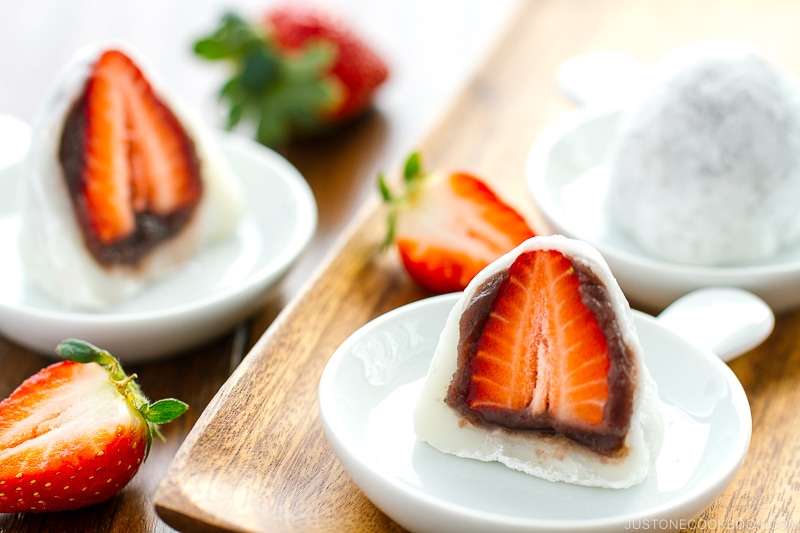
Strawberry Mochi features fresh strawberries wrapped in sweet red bean paste and enclosed in soft, chewy mochi made from glutinous rice flour and sugar. The outer mochi layer is cooked and then dusted with starch to prevent sticking. This traditional Japanese confection balances fruity, sweet, and chewy textures in individual portions.
Prep Time
40 mins
Cook Time
3 mins
Total Time
43 mins
Servings:
6
Daifuku
Calories:
145 kcal
Course:
Dessert
Cuisine:
Japanese
Ingredients
- 6 strawberries (smaller ones are easier to work with)
- 5.3 oz red bean paste I used store-bought koshian; you can make my recipe for homemade Anko or Pressure Cooker Anko, sweet, aka anko
- potato starch for dusting, or cornstarch
For the Mochi Using a 100 g Shiratamako Package
- ¾ cup glutinous rice flour aka sweet rice flour
- 1½ Tbsp sugar
- 150 ml water (⅔ cup minus 2 tsp)
For the Mochi Using a 120 g Shiratamako Package
- 120 g glutinous rice flour 1 cup minus 2 Tbsp, aka sweet rice flour
- 2 Tbsp sugar
- ¾ cup water
Instructions
- Before You Start: If you want to make more than 6 pieces, I highly recommend you to work in batches. If you do not have a microwave, please see Notes for other options to cook the shiratamako.
Cup of Yum
To Prepare the Strawberries
- Rinse, dry, and hull 6 strawberries. Divide 5.3 oz sweet red bean paste (anko) and roll into 6 same-size balls. Anko gets sticky on your hands, so wash and completely dry your hands each time you make a ball.
- Wrap each strawberry with the anko from one ball. Leave the tip of the strawberry uncovered. Wash your hands and dry completely each time you wrap a strawberry with anko.
To Cook the Shiratamako
- In a medium microwave-safe glass bowl, mix the shiratamako and sugar with a whisk. For a 100 g bag, mix 100 g or ¾ cup shiratamako (glutinous rice flour/sweet rice flour) and 1½ Tbsp sugar. For a 120 g bag, mix 120 g shiratamako (glutinous rice flour/sweet rice flour) (or 1 cup minus 2 Tbsp) and 2 Tbsp sugar.
- Using a silicone spatula, slowly add the water in 3 parts—a total of 150 ml water (⅔ cup minus 2 tsp) for the 100 g shiratamako bag and ¾ cup water for the 120 g bag. Stir until the mixture has reached a thick consistency. Cover loosely with plastic wrap.
- First, microwave the mixture for 1 minute (for 1100W microwave). Mix well with a wet silicone spatula. The mixture is still whitish and floury.
- For a second time, microwave 1 minute again, and mix well with the wet silicone spatula. Now it starts to resemble mochi, but there are still some floury parts.
- For the last time, microwave only 30 seconds. Now the mochi mixture should look translucent.
- Sift the potato starch or cornstarch on the tray and put the mochi on top.
- With the silicone spatula or a kitchen scraper, fold the mochi in half one time so it won’t be as sticky. Then, divide into 6 equal pieces.
To Shape the Strawberry Daifuku
- Put some potato starch or cornstarch on your hands. Flatten and expand each mochi into a 3-inch (7.6-cm) round or square. Then, put the anko-covered strawberry on top of it, with the tip pointing down.
- Start gathering the mochi edges to cover the strawberry from all sides. Use your thumb to hold the gathered mochi on top.
- When all edges of the mochi meet at the top, twist and close the seam. Hold the mochi with both hands and form into a nice round shape. Place the daifuku seam side down on a plate with the strawberry tip pointing up. Repeat the process for the remaining mochi.
To Serve
- Serve at room temperature.
To Store
- Keep the leftovers in an airtight container and store at room temperature. Do not put in the refrigerator as the cold temperature makes the mochi hard. Consume within 2 days.
Notes
- If a microwave is unavailable, cook the mochi dough in a rice cooker for 10-12 minutes, stirring twice, until translucent.
- Alternatively, steam the mochi dough in a heatproof bowl covered during steaming for 10-12 minutes, stirring occasionally.
- Wash and dry hands thoroughly when handling sticky anko balls to ease shaping.
- Using smaller strawberries can simplify the wrapping process.
Nutrition Information
Calories
145kcal
(7%)
Carbohydrates
32g
(11%)
Protein
3g
(6%)
Fat
2g
(3%)
Saturated Fat
1g
(5%)
Polyunsaturated Fat
1g
(6%)
Monounsaturated Fat
1g
(5%)
Sodium
24mg
(1%)
Potassium
139mg
(3%)
Fiber
2g
(8%)
Sugar
11g
(22%)
Vitamin A
3IU
(0%)
Vitamin C
7mg
(8%)
Calcium
12mg
(1%)
Iron
1mg
(6%)
Nutrition Facts
Serving: 6 Daifuku
Amount Per Serving
Calories 145
% Daily Value*
| Calories | 145kcal | 7% |
| Carbohydrates | 32g | 11% |
| Protein | 3g | 6% |
| Fat | 2g | 3% |
| Saturated Fat | 1g | 5% |
| Polyunsaturated Fat | 1g | 6% |
| Monounsaturated Fat | 1g | 5% |
| Sodium | 24mg | 1% |
| Potassium | 139mg | 3% |
| Fiber | 2g | 8% |
| Sugar | 11g | 22% |
| Vitamin A | 3IU | 0% |
| Vitamin C | 7mg | 8% |
| Calcium | 12mg | 1% |
| Iron | 1mg | 6% |
* Percent Daily Values are based on a 2,000 calorie diet.