4.7 from 241 votes
Sweet Red Bean Paste (Tsubuan and Koshian)
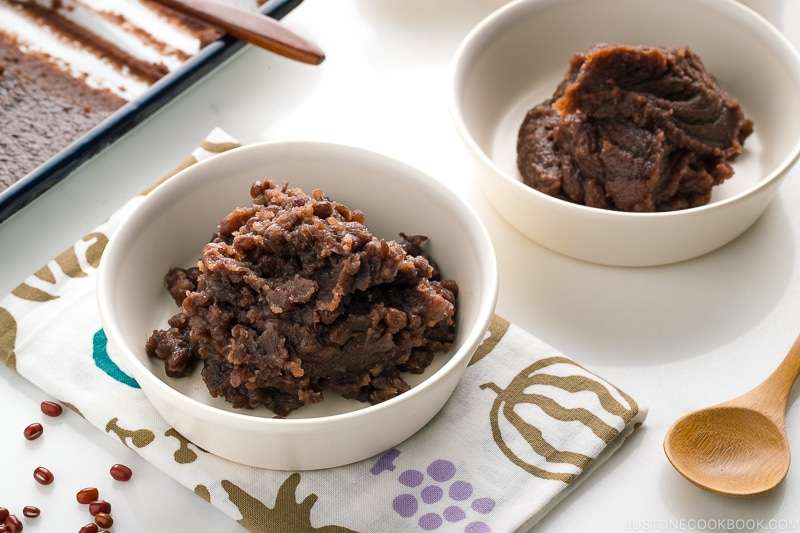
Sweet Red Bean Paste comes in two styles: Tsubuan, a chunky paste retaining whole azuki beans, and Koshian, a smooth paste achieved by sieving cooked beans. The paste is made from dried azuki beans cooked and sweetened with sugar and seasoned lightly with salt. It serves as a base for many traditional Japanese sweets.
Prep Time
10 mins
Cook Time
1 hr 30 mins
Total Time
1 hr 40 mins
Servings:
1
batch,
Calories:
45 kcal
Course:
Dessert, Condiments
Cuisine:
Japanese
Ingredients
- 7 oz azuki beans (dried; a bit less than 1 cup)
- water
- ¾ cup sugar (up to 1 cup or 200 g, to taste)
- ½ tsp kosher salt Diamond Crystal brand
Instructions
To Make Tsubuan (Chunky Red Bean Paste)
- Drain the cooked azuki beans in a sieve.
- Return the beans to the same pot. Turn the heat to medium low and add half of the ¾ cup sugar.
- Mix well. Once the sugar has dissolved, add the rest of the sugar.
- Mix well, stirring constantly. Then, add ½ tsp Diamond Crystal kosher salt and stir.
- If you plan to use the red beans for Zenzai (Oshiruko), you can use it right away. If you prefer a thicker version, reduce the soup further.
- Let the moisture evaporate. When you can draw a line on the bottom of the pot with your spatula, turn off the heat. Don‘t worry if it‘s still loose; the anko will continue to thicken as it cools. Transfer the anko to a flat baking sheet to let it cool completely. The tsubuan is now ready to use in a variety of Japanese sweets such as Daifuku Mochi, Anpan, Red Bean Pancakes, and Matcha Zenzai (Red Bean Soup). Scroll down to see how to store it.
Cup of Yum
To Make Koshian (Fine Red Bean Paste)
- Reserve some of the cooking liquid. Then, drain the azuki beans in a sieve.
- Transfer the beans to a food processor. Run the food processor until the beans become a fine paste. If necessary, add 1–2 Tbsp cooking liquid to help process the beans.
- Transfer the fine paste back into the same cooking pot. Turn the heat to medium low and add half of the ¾ cup sugar.
- Mix well with the bean paste. Once the sugar has dissolved, add the rest of the sugar.
- Let the moisture evaporate, stirring constantly. Then, add ½ tsp Diamond Crystal kosher salt and stir.
- When you can draw a line on the bottom of the pot with your spatula, turn off the heat. Don‘t worry if it‘s still loose; the anko will continue to thicken as it cools. Transfer the anko to a flat baking sheet to let it cool completely. The koshian is now ready to use in a variety of Japanese sweets such as Strawberry Mochi (Ichigo Daifuku), Sakura Mochi, Manju, and Mizu Yokan.
To Store
- Transfer the Anko to an airtight container, cool, and store in the refrigerator for up to 3–4 days or in the freezer for up to 2 months. You can also divide and wrap 100 g portions of the bean paste in plastic film and store in a freezer bag. When you’re ready to use it, defrost it in the refrigerator overnight. Tip: Compared to store-bought red bean paste, homemade anko uses less sugar and therefore doesn‘t keep as long.
Nutrition Information
Serving
1Tbsp
Calories
45kcal
(2%)
Carbohydrates
10g
(3%)
Protein
1g
(2%)
Fat
1g
(2%)
Saturated Fat
1g
(5%)
Sodium
19mg
(1%)
Potassium
84mg
(2%)
Fiber
1g
(4%)
Sugar
6g
(12%)
Vitamin A
1IU
(0%)
Calcium
4mg
(0%)
Iron
1mg
(6%)
Nutrition Facts
Serving: 1 batch,
Amount Per Serving
Calories 45
% Daily Value*
| Serving | 1Tbsp | |
| Calories | 45kcal | 2% |
| Carbohydrates | 10g | 3% |
| Protein | 1g | 2% |
| Fat | 1g | 2% |
| Saturated Fat | 1g | 5% |
| Sodium | 19mg | 1% |
| Potassium | 84mg | 2% |
| Fiber | 1g | 4% |
| Sugar | 6g | 12% |
| Vitamin A | 1IU | 0% |
| Calcium | 4mg | 0% |
| Iron | 1mg | 6% |
* Percent Daily Values are based on a 2,000 calorie diet.