5 from 18 votes
Venison Summer Sausage
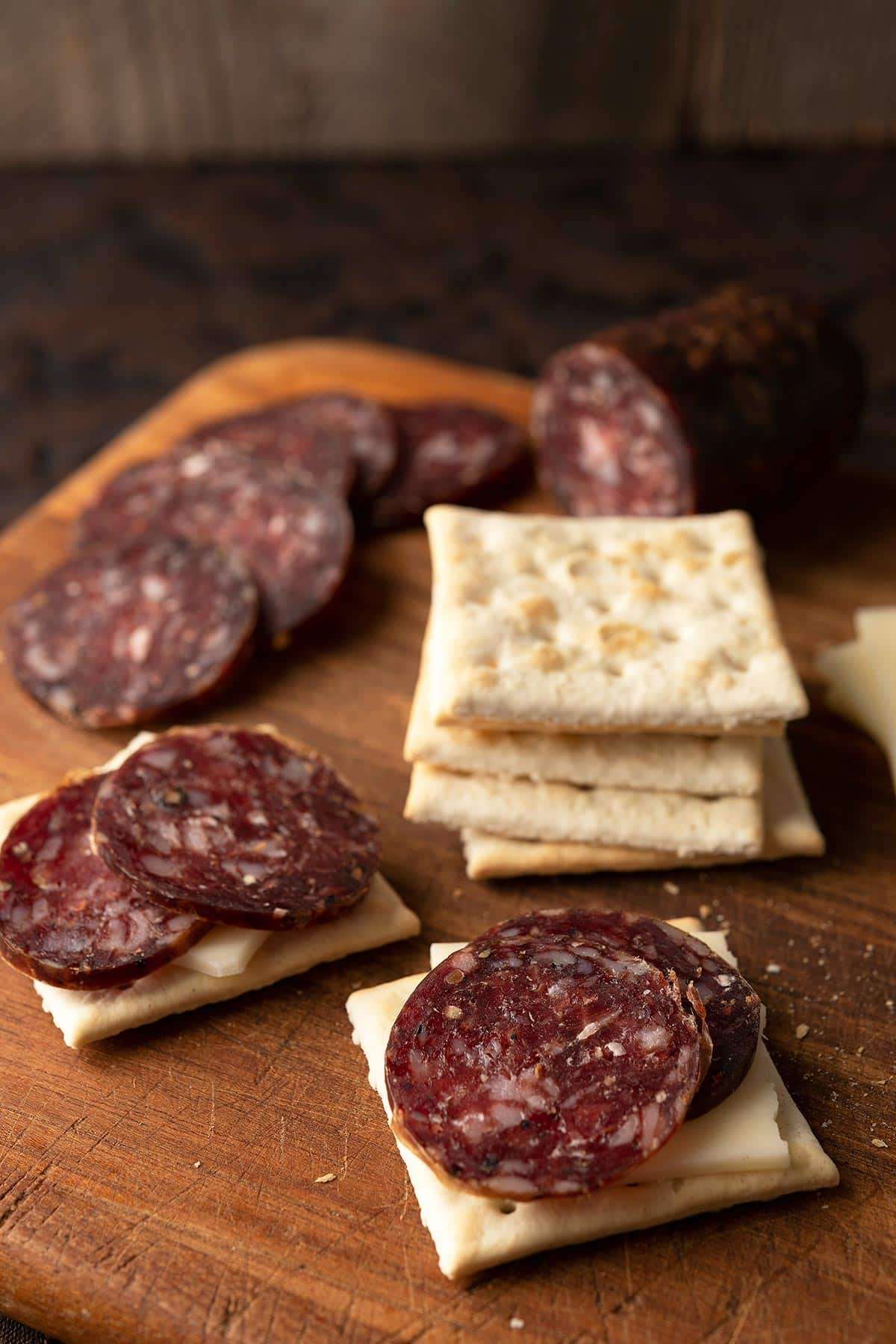
Venison Summer Sausage blends lean venison with pork shoulder and fatback to create a firmer, well-bound sausage through an overnight salt and cure soak. A mix of cracked black pepper, coriander, mustard seed, powdered ginger, and cloves infuses the sausage with traditional Dutch and German flavors. The mixture requires chilling before grinding, then stuffing into hog casings, with fermentation and curing steps essential for texture and food safety.
Prep Time
3 hrs
Smoking Time
4 hrs
Total Time
7 hrs
Servings:
25
servings
Calories:
168 kcal
Course:
Main Course, Snacks
Cuisine:
German, American
Ingredients
- 3 ½ pounds venison
- 1 pound pork shoulder fatty
- ½ pound pork fatback
- 51 grams salt
- 6 grams Instacure No. 2
- 10 grams dextrose or granulated sugar if you can’t get it
- 1 tablespoon black pepper cracked
- 1 tablespoon coriander seed coarsely ground
- 2 teaspoons mustard seed coarsely ground
- 1 teaspoon ginger powdered
- ½ teaspoon cloves ground
- ¼ cup malt vinegar
- 1/2 cup distilled water
- 10 grams Starter culture F-LC or FRM-52
- Hog casings preferably 38-42 mm wide casings
Instructions
- Cut the meat and fat into chunks that will fit into your grinder. Trim as much sinew and silverskin as you can. Put the fat into a container in the fridge. Mix the dextrose, salt and curing salt with the meats and put it in the fridge overnight. This helps develop myosin, which will give you a tighter bind when you stuff the links later.
- The next day, put your grinding equipment — blade, coarse and fine die, etc. — in the freezer. Mix the ginger, cloves and half of the remaining spices with the meat and fat. Put the mixture into the freezer and let everything chill down until it hits about 30°F or so. It won’t freeze solid because of the salt. Normally, this takes about 90 minutes. While you’re waiting, soak about 15 feet of hog casings in a bowl of warm water, and put the malt vinegar in the fridge.
- When the meat and fat are cold, take them out and grind through the coarse die of the grinder; I use a 10 mm plate. Test the temperature of the mixture, and if it’s 35°F or colder, go ahead and grind it all again through a fine die, like a 4.5 mm. If it’s warmer than 35°F, put the mix back in the freezer to chill. This might take an hour or so if you’ve let the meat warm up too much. Use the time to clean up, and to dissolve your starter culture in the distilled water.
- Once the sausage has been ground twice, test the temperature again to make sure it’s 35°F or colder. I prefer to chill the mix down to 28°F to 32°F for this next stage. Chill the mix and when it’s cold enough, take it out and add the remaining spices, the vinegar and the water-starter culture mixture. Now, mix and knead this all up in a big bin or bowl with your (very clean) hands for a solid 2 minutes—your hands will ache with cold, which is good. You want everything to almost emulsify.
- Stuff the sausage into hog casings rather loosely. For this sausage, you want long links. First cut lengths of casing about 2 feet long. Stuff each with a little more than 1 foot's worth of sausage, leaving with plenty of extra casing on either side. Do this with all the sausage before moving on.
- When you’re ready, gently compress the long links. Keep an eye out for air pockets. Use a sterile needle or sausage pricker (set it aglow in your stovetop flame) to puncture the casing over all the air pockets. Gently compress the links together to squeeze out the air pockets; this takes practice. Tie the ends of the casing together in a double or triple knot.
- Hang the links from a clothes rack or somesuch. I use “S” rings you buy from the hardware store to hang them from the clothes rack rods. Now you need to ferment your links, keeping them warm and moist. I do this by putting a humidifier under the hanging sausages and then tenting the whole shebang with big garbage bags that I’ve sliced open on one end. I also use a water sprayer to spritz my sausages a couple times a day. Doing this prevents the casings from hardening. Keep your sausages hanging at room temperature (65 to 80°F) at about 85 percent humidity for three days.
- Move the sausages to your smoker and smoke them over very low heat for up to 4 hours of continuous smoke. It is vitally important that you do not cook your links here, so put ice in the water tray of the smoker and smoke on a cold day or in the early morning. Don’t let the smoker rise above 100°F at all. If it gets too hot, open the door of the smoker or just take the links out.
- Now you need to dry your sausages and turn them into salami. Hang them in a place that is about 50°F to 60°F with about 80 to 90 percent humidity. In most cases you will need to put a humidifier under your links. I also spritz them with water once a day for the first 2 weeks. After the first week of hanging, drop the humidity to 70 to 80 percent. On the third week drop it again to 65 to 70 percent and hold it there until a total of 4 to 8 weeks has elapsed since the salami went into the chamber.
- You now have boerenmetworst. To store long-term, vacuum seal them individually and keep in the fridge. They will last indefinitely this way, and the vacuum sealing will keep them from becoming rock hard. You can also freeze them.
Cup of Yum
Notes
- Make links between 1/2 and 1 pound, about 1 foot long each.
- Prepare smoker, fermentation space, and hanging area before starting.
- Use specified amounts of salt, cure, and starter culture without reduction to ensure food safety.
- Keep sausages moist (not hot) during initial fermentation to support good bacteria and prevent drying.
- Ferment 3 to 4 weeks for softer modern texture or longer for fully cured, firmer sausage.
- Spice mix produces a Dutch/German flavor but can be altered to taste.
Nutrition Information
Calories
168kcal
(8%)
Carbohydrates
1g
(0%)
Protein
17g
(34%)
Fat
10g
(15%)
Saturated Fat
4g
(20%)
Polyunsaturated Fat
1g
(6%)
Monounsaturated Fat
5g
(25%)
Cholesterol
67mg
(22%)
Sodium
833mg
(35%)
Potassium
254mg
(5%)
Fiber
1g
(4%)
Sugar
1g
(2%)
Vitamin A
8IU
(0%)
Vitamin C
1mg
(1%)
Calcium
8mg
(1%)
Iron
2mg
(11%)
Nutrition Facts
Serving: 25 servings
Amount Per Serving
Calories 168
% Daily Value*
| Calories | 168kcal | 8% |
| Carbohydrates | 1g | 0% |
| Protein | 17g | 34% |
| Fat | 10g | 15% |
| Saturated Fat | 4g | 20% |
| Polyunsaturated Fat | 1g | 6% |
| Monounsaturated Fat | 5g | 25% |
| Cholesterol | 67mg | 22% |
| Sodium | 833mg | 35% |
| Potassium | 254mg | 5% |
| Fiber | 1g | 4% |
| Sugar | 1g | 2% |
| Vitamin A | 8IU | 0% |
| Vitamin C | 1mg | 1% |
| Calcium | 8mg | 1% |
| Iron | 2mg | 11% |
* Percent Daily Values are based on a 2,000 calorie diet.