4.9 from 86 votes
Hijiki Seaweed Salad
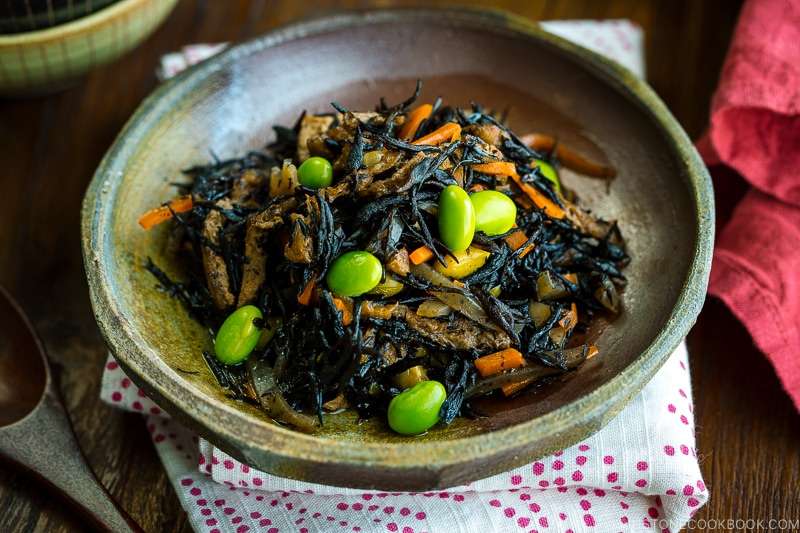
Hijiki Seaweed Salad combines rehydrated hijiki seaweed with tofu pouches, konnyaku, carrot, and lotus root, simmered in a seasoned broth. The result is a slightly sweet and savory dish with a variety of textures: tender yet chewy seaweed, soft tofu, and crisp vegetables. This salad is typically served at room temperature or chilled, making it a refreshing, nutrient-rich accompaniment.
Prep Time
15 mins
Cook Time
45 mins
Total Time
1 hr
Servings:
4
Calories:
128 kcal
Course:
Side Dish
Cuisine:
Japanese
Ingredients
- ½ cup hijiki seaweed 1 oz; increases tenfold after rehydration; I used mehijiki (芽ひじき), the small, soft “buds“ of the hijiki plant; you can also use the long and chewy “stems” called nagahijiki (長ひじき), which are less commonly found in the US, dried
- 4 cups water (for soaking)
- 2 tofu pouch 1.4 oz, 40 g; you can substitute crispy fried tofu cubes from an Asian grocery store, but blanch them first to remove the excess oil, deep-fried, aka aburaage
- 3 oz konnyaku ⅓ konnyaku block; optional, aka konjac
- 3 oz carrot (½–1 carrot)
- ¼ lotus root 1.3 oz, 37 g; pre-boiled; optional, aka renkon
- 1 Tbsp neutral oil
- 2 cups dashi use standard Awase Dashi, dashi packet or powder, or Vegan Dashi, Japanese soup stock
- ⅓ cup edamame 2 oz, 60 g; cooked; optional, shelled
For the Seasonings
- ¼ cup mirin
- 2 Tbsp sugar (this dish is typically on the sweet side to help preserve it and for better flavor when eaten at room temperature in a bento box; reduce by half, if you‘d like)
- ¼ cup soy sauce
Instructions
- Gather all the ingredients.
- Soak ½ cup dried hijiki seaweed in 4 cups water—10 minutes for mehijiki (bud hijiki) or 30 minutes for nagahijiki (stem hijiki). Meanwhile, prepare the other ingredients.
- Drain to a large fine-mesh sieve and rinse under running water.
Cup of Yum
To Prepare the Other Ingredients
- Boil water in a small saucepan and pour it over 2 aburaage (deep-fried tofu pouch). This will remove the excess oil on the aburaage. Squeeze out the liquid. Then, cut in half lengthwise and thinly slice crosswise.
- Add some water and 3 oz konnyaku (konjac) to a small pot and boil for 3 minutes to remove the odor. This also helps the konnyaku absorb flavors and improves the texture. Then, slice it into small strips (about the same size as the aburaage slices).
- Cut 3 oz carrot into julienne pieces.
- Cut ¼ lotus root (renkon) into thin quarter pieces.
To Cook the Hijiki Salad
- Heat 1 Tbsp neutral oil in a medium pot over medium heat. Add the carrot and lotus root and cook until they are coated with oil.
- Add the hijiki, then the konnyaku and aburaage. Mix it all together.
- Add 2 cups dashi (Japanese soup stock) and let it boil.
- Add all the seasonings: ¼ cup mirin, 2 Tbsp sugar, and ¼ cup soy sauce. Mix well. Cook covered on medium-low heat for 20–30 minutes.
- Add ⅓ cup shelled edamame.
- Continue to cook, uncovered, to reduce the sauce until you see the bottom of the pan.
To Serve
- Serve as a side to a Japanese meal or pack in a bento lunch box. For convenient meal prep, you can divide the Hijiki Salad into a bento portion in silicone cups for freezing.
To Store
- Store in an airtight container and keep in the refrigerator for up to 3–4 days. You can also freeze it for up to a month.
Nutrition Information
Calories
128kcal
(6%)
Carbohydrates
17g
(6%)
Protein
5g
(10%)
Fat
3g
(5%)
Saturated Fat
1g
(5%)
Polyunsaturated Fat
2g
(12%)
Monounsaturated Fat
1g
(5%)
Trans Fat
1g
(50%)
Sodium
520mg
(22%)
Potassium
189mg
(4%)
Fiber
3g
(12%)
Sugar
8g
(16%)
Vitamin A
3560IU
(71%)
Vitamin C
8mg
(9%)
Calcium
84mg
(8%)
Iron
1mg
(6%)
Nutrition Facts
Serving: 4 Serving
Amount Per Serving
Calories 128
% Daily Value*
| Calories | 128kcal | 6% |
| Carbohydrates | 17g | 6% |
| Protein | 5g | 10% |
| Fat | 3g | 5% |
| Saturated Fat | 1g | 5% |
| Polyunsaturated Fat | 2g | 12% |
| Monounsaturated Fat | 1g | 5% |
| Trans Fat | 1g | 50% |
| Sodium | 520mg | 22% |
| Potassium | 189mg | 4% |
| Fiber | 3g | 12% |
| Sugar | 8g | 16% |
| Vitamin A | 3560IU | 71% |
| Vitamin C | 8mg | 9% |
| Calcium | 84mg | 8% |
| Iron | 1mg | 6% |
* Percent Daily Values are based on a 2,000 calorie diet.