Hijiki Seaweed Salad
User Reviews
4.9
Hijiki Seaweed Salad
Description
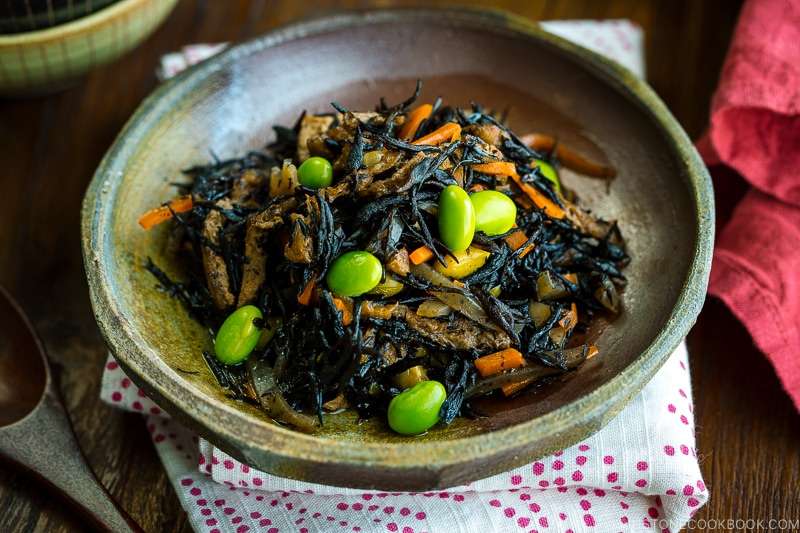
In this Hijiki Seaweed Salad, dried hijiki seaweed is soaked until rehydrated, then combined with prepared ingredients including thinly slicedfried tofu pouches (aburaage), boiled konnyaku, julienned carrot, and pre-cooked lotus root. The mixture is cooked in a medium pot with neutral oil before adding a seasoned dashi stock infused with soy sauce and sugar, giving a sweet and umami-rich taste typical of this dish.
The final dish balances textures between the soft hijiki and tofu, the chewy konnyaku, and the crisp carrot and lotus root, creating an enjoyable mouthfeel. The sweetness from mirin and sugar enhances the seaweed’s natural briny flavor, resulting in a harmonious combination often enjoyed cold or at room temperature.
Hijiki salad frequently features as a side dish or bento box addition in Japanese cuisine, providing a good source of fiber and minerals. It pairs well with rice and other savory dishes, adding variety and color to a meal.
Ingredients
- ½ cup hijiki seaweed 1 oz; increases tenfold after rehydration; I used mehijiki (芽ひじき), the small, soft “buds“ of the hijiki plant; you can also use the long and chewy “stems” called nagahijiki (長ひじき), which are less commonly found in the US, dried
- 4 cups water (for soaking)
- 2 tofu pouch 1.4 oz, 40 g; you can substitute crispy fried tofu cubes from an Asian grocery store, but blanch them first to remove the excess oil, deep-fried, aka aburaage
- 3 oz konnyaku ⅓ konnyaku block; optional, aka konjac
- 3 oz carrot (½–1 carrot)
- ¼ lotus root 1.3 oz, 37 g; pre-boiled; optional, aka renkon
- 1 Tbsp neutral oil
- 2 cups dashi use standard Awase Dashi, dashi packet or powder, or Vegan Dashi, Japanese soup stock
- ⅓ cup edamame 2 oz, 60 g; cooked; optional, shelled
For the Seasonings
- ¼ cup mirin
- 2 Tbsp sugar (this dish is typically on the sweet side to help preserve it and for better flavor when eaten at room temperature in a bento box; reduce by half, if you‘d like)
- ¼ cup soy sauce
Instructions
- Gather all the ingredients.
- Soak ½ cup dried hijiki seaweed in 4 cups water—10 minutes for mehijiki (bud hijiki) or 30 minutes for nagahijiki (stem hijiki). Meanwhile, prepare the other ingredients.
- Drain to a large fine-mesh sieve and rinse under running water.
To Prepare the Other Ingredients
- Boil water in a small saucepan and pour it over 2 aburaage (deep-fried tofu pouch). This will remove the excess oil on the aburaage. Squeeze out the liquid. Then, cut in half lengthwise and thinly slice crosswise.
- Add some water and 3 oz konnyaku (konjac) to a small pot and boil for 3 minutes to remove the odor. This also helps the konnyaku absorb flavors and improves the texture. Then, slice it into small strips (about the same size as the aburaage slices).
- Cut 3 oz carrot into julienne pieces.
- Cut ¼ lotus root (renkon) into thin quarter pieces.
To Cook the Hijiki Salad
- Heat 1 Tbsp neutral oil in a medium pot over medium heat. Add the carrot and lotus root and cook until they are coated with oil.
- Add the hijiki, then the konnyaku and aburaage. Mix it all together.
- Add 2 cups dashi (Japanese soup stock) and let it boil.
- Add all the seasonings: ¼ cup mirin, 2 Tbsp sugar, and ¼ cup soy sauce. Mix well. Cook covered on medium-low heat for 20–30 minutes.
- Add ⅓ cup shelled edamame.
- Continue to cook, uncovered, to reduce the sauce until you see the bottom of the pan.
To Serve
- Serve as a side to a Japanese meal or pack in a bento lunch box. For convenient meal prep, you can divide the Hijiki Salad into a bento portion in silicone cups for freezing.
To Store
- Store in an airtight container and keep in the refrigerator for up to 3–4 days. You can also freeze it for up to a month.
Nutrition Information
Show DetailsNutrition Facts
Serving: 4Serving
Amount Per Serving
Calories 128 kcal
% Daily Value*
| Calories | 128kcal | 6% |
| Carbohydrates | 17g | 6% |
| Protein | 5g | 10% |
| Fat | 3g | 5% |
| Saturated Fat | 1g | 5% |
| Polyunsaturated Fat | 2g | 12% |
| Monounsaturated Fat | 1g | 5% |
| Trans Fat | 1g | 50% |
| Sodium | 520mg | 22% |
| Potassium | 189mg | 4% |
| Fiber | 3g | 12% |
| Sugar | 8g | 16% |
| Vitamin A | 3560IU | 71% |
| Vitamin C | 8mg | 9% |
| Calcium | 84mg | 8% |
| Iron | 1mg | 6% |
* Percent Daily Values are based on a 2,000 calorie diet.
User Reviews
Overall Rating
4.9
You'll Also Love