Puri For Pani Puri | Suji Ke Golgappe
User Reviews
4.8
Puri For Pani Puri | Suji Ke Golgappe
Description
This recipe for Puri for Pani Puri uses fine unroasted sooji (semolina) mixed with all-purpose flour, baking soda, oil, and salt, kneaded with measured water to form an elastic dough. The elasticity, resulting from gluten strand development, is important for proper puffing during frying. After kneading, the dough is divided and rolled thin, then deep-fried at a controlled medium temperature until the puris puff and turn crisp.
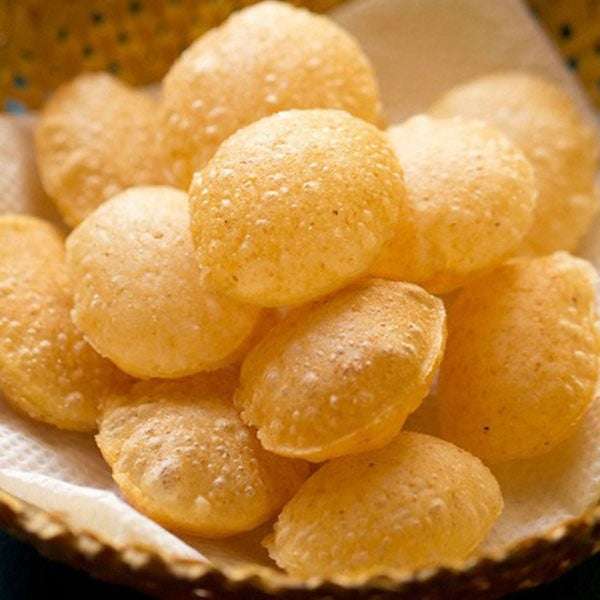
The resulting puris are lightweight, crisp, and hollow on the inside, which is essential to hold flavored pani and other fillings without becoming soggy quickly. The moderate frying temperature ensures that they cook through and puff evenly without burning or retaining excess oil.
These puris are traditionally used in the popular Indian street snack pani puri, where they can be filled with a tangy, spiced water, tamarind chutney, or other fillings. The crisp texture offers a satisfying crunch and contrast to the liquid and fillings. Keeping the dough fresh and kneading until just right ensures an optimal texture and puff.
To maintain quality, frying should be done with oil heated to medium or medium-high, avoiding both low heat, which can make the puris greasy, and high heat, which may burn them. Using fresh, fine sooji within its shelf life is important for the best results. This recipe can be scaled as needed for different serving quantities.
Ingredients
- 1 cup sooji (rava or semolina), fine and unroasted - 160 grams
- ⅛ teaspoon baking soda or 3 to 4 pinches
- 1 tablespoon all-purpose flour
- 6 tablespoon water or add as required
- ¼ teaspoon salt or add as required
- 1 teaspoon neutral cooking oil for the dough, generic cooking oil
- neutral cooking oil as required for deep frying, generic cooking oil
Instructions
Making suji puri dough
- In a mixing bowl, take the fine unroasted sooji or rava or semolina, 1 teaspoon oil, baking soda and salt. With your fingers, mix the oil evenly with the sooji.
- Now add all purpose flour to this mixture.
- Mix again very well so that the all purpose flour is mixed evenly.
- Add 3 tablespoons water first. Mix again. Then add 1 tablespoon water more and begin to knead the dough. Sooji absorbs water while kneading. Add water in parts while kneading.
- Then add 2 tablespoons more of the water and continue to knead. The kneading is very important in getting the perfect texture. The dough is not soft nor too hard.
- If you make the dough soft, then add 1 to 3 teaspoon more of the suji. If the dough looks hard, then add sprinkle some water and continue to knead.
- The suji puri dough should be elastic. Gluten strands need to be formed, which gives a structure and shape to the pooris. The correct texture of the dough, also help in puffing puris and helps in them staying crisp.
- Knead very well. Elasticity helps in rolling the dough without cracks and thinly. When rolling, the dough should roll easily without any cracks. You should be easily able to lift the rolled dough without it tearing or breaking and falling apart.
- Knead to a semi soft elastic dough and keep it in a bowl or pan.
- Cover the dough with a moist kitchen towel or napkin and allow the dough to rest for 30 minutes. You can also keep the dough for an hour.
- After 30 minutes, knead the dough again.
Assembling and Rolling
- Now divide the dough into two or three parts. Take one part on your work surface and begin to roll. Avoid adding any dry flour while kneading. Keep the remaining dough covered with the moist kitchen towel.
- Roll to a large round. There should be no cracks in the rolled dough. You can flip the entire rolled dough without it breaking or tearing apart.
- Keep on rolling to a thin and even round. The puri have to be thinly rolled. If not thin, the base becomes thick and remains soft even after frying. If the dough is not rolled evenly, then the puri won't puff up.
Making Suji Ke Golgappe
- With a cookie cutter or a small bowl, cut small to medium discs from the rolled dough. Using a cookie cutter gives even shape and size to the pooris. You can also make small balls and roll them. But then the puri won't have an even and uniform shape.
- Remove the dough edges and place the small roundels in a plate without them touching each other. Keep these puris covered with a moist kitchen towel.
- Collect the egdes and knead them lightly. Roll the edges too and make puris the same way.
- In this way make all the puris and keep them covered in a moist kitchen towel. You can also roll them and fry simultaneously like I have done.
Frying Suji Puri
- Heat oil for deep frying in a kadai or pan. The oil should be medium hot. Add a tiny piece of the dough ball in the hot oil. If the ball steadily comes up to the surface, the oil is hot and the pooris can be fried now.
- Slid a few pooris in the oil. They will puff up quickly as soon as you add them to the hot oil. You can fry up to 4 to 8 pieces at a time, depending on the size of your pan.
- With a slotted spoon flip them, once they puff up. Even after oil stops sizzling, continue to fry till light golden. Frying this way, gives a crisp texture to the pooris from outside as well as inside. Otherwise, they remain soft from inside and crisp from outside.
- Fry them till they are a light golden or golden.
- Drain fried puri on kitchen paper towels. There will be a few flat puris too. These you can use to make sev puri or papdi chaat. Continue to fry all the pooris this way.
- Drain them on paper towels.
- Once they get cooled at room temperature, immediately add puris to a jar or box and close the lid tightly.
- Make pani puri, dahi puri or ragda puri or puchka from these homemade pooris or golgappas. You will get 50 to 60 pooris from this recipe. They stay crisp and good for a month if stored in an airtight box.
Notes
- Maintain medium to medium-high oil temperature during frying to achieve proper puffing without burning or greasiness.
- Knead the dough thoroughly to develop elasticity, which helps the puris puff up well when fried.
- Use fresh, fine-textured sooji (semolina) within its shelf life for best texture and puffing results.
- You can adjust the recipe quantity to make more or fewer puris as needed.
- Nutrition information provided is approximate and based on one golgappa puri.
Nutrition Information
Show DetailsNutrition Facts
Serving: 50Suji Ke Golgappe
Amount Per Serving
Calories 21 kcal
% Daily Value*
| Calories | 21kcal | 1% |
| Carbohydrates | 3g | 1% |
| Protein | 1g | 2% |
| Fat | 1g | 2% |
| Saturated Fat | 1g | 5% |
| Polyunsaturated Fat | 1g | 6% |
| Monounsaturated Fat | 1g | 5% |
| Sodium | 19mg | 1% |
| Potassium | 5mg | 0% |
| Fiber | 1g | 4% |
| Sugar | 1g | 2% |
| Vitamin B1 (Thiamine) | 1mg | |
| Vitamin B2 (Riboflavin) | 1mg | |
| Vitamin B3 (Niacin) | 1mg | |
| Vitamin B6 | 1mg | |
| Vitamin E | 1mg | |
| Vitamin K | 1µg | |
| Calcium | 25mg | 3% |
| Vitamin B9 (Folate) | 4µg | |
| Iron | 1mg | 6% |
| Magnesium | 2mg | 1% |
| Phosphorus | 9mg | |
| Zinc | 1mg |
* Percent Daily Values are based on a 2,000 calorie diet.
User Reviews
Overall Rating
4.8
You'll Also Love






Puff Pastry Tartlets with Roasted Pear, Caramelized Red Onions, Goat Cheese and Spicy Honey Drizzle