Quick Sourdough Bread With Yeast
User Reviews
4.7
Quick Sourdough Bread With Yeast
Description
This recipe utilizes an active sourdough starter mixed with lukewarm water, bread flour, rapid rise yeast, sugar, and salt. After combining, the dough is sticky and requires a warm environment to rise, typically doubling in about an hour. The dough is then gently shaped by folding edges to the center on an oiled surface and allowed a second rise before baking. The use of both yeast and starter shortens proofing compared to traditional sourdough methods.
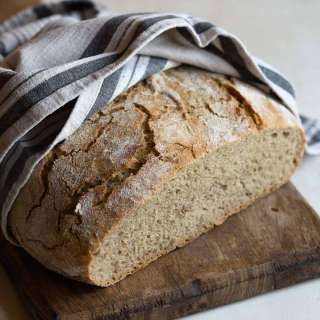
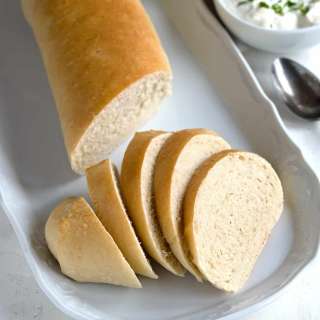
The resulting bread has a soft crumb with a mild sourdough flavor, suitable for sandwiches or toast. Unlike denser whole wheat breads, this white bread loaf is lighter, although whole wheat flour may be incorporated partially for added texture.
The recipe can be adapted for stand mixers by using a dough hook to mix, and rising can be accelerated using steam from boiling water. The bread may be scored but will naturally open up due to the dough’s softness.
Ingredients
- 150 g sourdough starter room temperature, ½ cup + 1 tbsp, or discard
- 300 g water lukewarm, 1 ¼ cups
- 480 g bread flour white
- 2 tsp Rapid Rise Yeast
- 2 tsp salt
- 2 tsp sugar
- olive oil for the bowl, spray form
Instructions
- Measure the starter to a large bowl and pour in the water. Stir well to combine – I use a dough hook.
- Add the flour and yeast. Stir again to combine and make sure there are no dry pockets of flour.
- Sugar and salt go in next – continue mixing with your dough hook or you can use your hands. Your dough will be very sticky and shaggy.
- Spray the bowl with olive oil, cover the bowl with a clean towel and place somewhere warm to rise. I usually place it in the microwave or the oven with a pot of boiling water. The steam will speed up the process.
- Check the dough has doubled in size. This should take only an hour but if your room or ingredients are cold it can take up to 90 minutes.
- Mist your countertop with olive oil and scrape the dough on it. Use an oiled bench spaper to fold the edges over towards the centre to create a round loaf. Oil a square of parchment paper and transfer the loaf onto it.
- Lift the paper by the edges and place in a bowl to rise for a further 30 minutes. Meanwhile, place your cast iron pot in the oven and preheat to 220°C (420°F).
- Lift the bread out of the bowl using the baking paper and carefully drop into the pot (be careful it will be very hot). Score the top using a knife (if the dough is very sticky then you can skip the scoring). Cover the pot and bake for 30 minutes.
- Uncover and bake for 15 more minutes. Carefully remove the bread from the pot – it should sound hollow if tapped on the underside. Cool completely on a wire rack before slicing.
Notes
- You can substitute up to 30% whole wheat flour for a denser, crustier loaf if desired.
- This recipe works well when using a stand mixer with a dough hook for mixing and kneading.
- Proofing can be sped up by placing the bowl in a microwave or oven with a pot of boiling water to create steam.
- Due to the dough's softness, scoring is optional as the bread will naturally open during baking.
- A softer dough and higher hydration leads to a softer crumb, while a denser dough can be shaped like traditional sourdough loaves.
Nutrition Information
Show DetailsNutrition Facts
Serving: 12slices
Amount Per Serving
Calories 158 kcal
% Daily Value*
| Calories | 158kcal | 8% |
| Carbohydrates | 32g | 11% |
| Protein | 5g | 10% |
| Fat | 1g | 2% |
| Saturated Fat | 1g | 5% |
| Polyunsaturated Fat | 1g | 6% |
| Monounsaturated Fat | 1g | 5% |
| Sodium | 390mg | 16% |
| Potassium | 40mg | 1% |
| Fiber | 1g | 4% |
| Sugar | 1g | 2% |
| Vitamin A | 1IU | 0% |
| Calcium | 7mg | 1% |
| Iron | 1mg | 6% |
* Percent Daily Values are based on a 2,000 calorie diet.
User Reviews
Overall Rating
4.7
You'll Also Love