Bread Recipe | White Bread
User Reviews
4.8
-
Prep Time
1 hr 15 mins
-
Cook Time
35 mins
-
Total Time
1 hr 50 mins
-
Servings
12 bread slices
-
Calories
132 kcal
-
Course
Breakfast
-
Cuisine
International
Bread Recipe | White Bread
Description
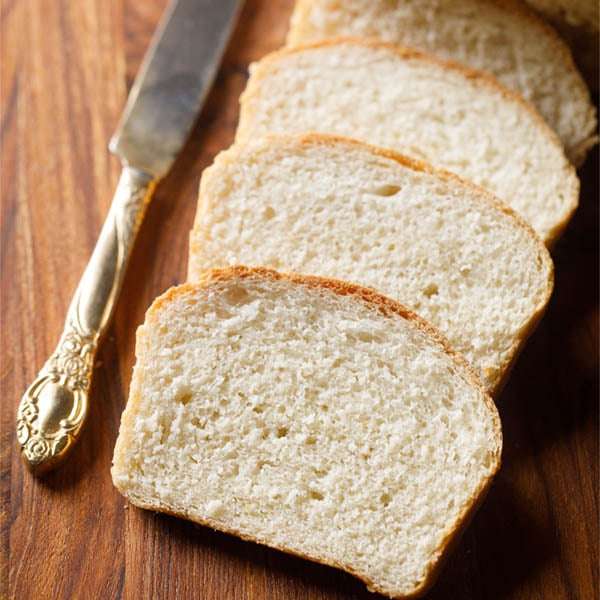
The Bread Recipe | White Bread combines flour with yeast, sugar, salt, oil, and lukewarm water to create a soft yet structured dough. After proofing the yeast with sugar and water, the mixture is blended into the flour and salt, then kneaded by hand until smooth and elastic. Adjustments to moisture are made during kneading to achieve the perfect texture.
The dough is allowed a first rise until doubled, which takes 45 minutes to two hours depending on yeast type. Then it is shaped and baked until golden with a tender crumb. The method accommodates substitutions like milk to enrich the loaf or additional sugar and nuts for sweeter variations. Herb additions can also impart fragrance.
This recipe can be scaled up or down and adapted to various yeast types using provided equivalences. Baking times may vary by oven; tenting with foil prevents overbrowning if needed. The bread can be baked as a loaf or shaped into rolls. It stores well and is suitable for home bakers aiming for fresh homemade bread with moderate effort.
Ingredients
- 3 cups all-purpose flour or bread flour (preferably unbleached), 360 grams
- 1 cup water (lukewarm)
- 1 teaspoon instant yeast or 1.5 teaspoon dry active yeast or 1 tablespoon fresh yeast
- 1 tablespoon sugar
- 1 tablespoon neutral cooking oil neutral flavored oil or olive oil, generic cooking oil
- 1 teaspoon salt or add as required
- 1 to 2 tablespoons milk (dairy or vegan) - for brushing, optional
Instructions
Proofing yeast
- In a small bowl take the instant yeast or dry active yeast and sugar. Add lukewarm water.
- Mix well and set aside until the yeast activates. For instant yeast keep for 5 minutes and for dry active yeast keep for 10 to 15 minutes.
Preparing dough
- While the proofing is happening, sieve or mix the flour with salt.
- Add the oil and the frothy yeast mixture to the flour.
- With a wooden spoon mix everything.
- Now use your hands and knead the dough for about 8 to 10 minutes. The dough has to be smooth, soft and light.
- If the dough looks sticky, then add a few tablespoons of flour and knead. If the dough looks dry or floury, add a few tablespoons of lukewarm water and continue to knead.
- Keep in a large bowl and cover loosely with kitchen napkin.
First Rise
- Set aside until the dough doubles up.
- For instant yeast – leaven dough for 45 mins to 1 hour. For dry active yeast or fresh yeast – keep for 1.5 to 2 hours.
- If needed set aside for some more minutes until the dough has doubled up nicely.
Shaping into a loaf
- Grease or brush a 9 x 5 inches loaf pan with oil.
- Take the dough on a lightly floured surface and gently knead. This will deflate the dough.
- Flatten the dough with your fingers to a round or square shape. Then begin to roll it neatly.
- The place where the edges meet, join them first. Then press, flatten and smoothen them with your fingers. Smoothen the sides of the loaf as well.
- Place in the loaf pan with the seamed joined edges touching the bottom of the pan.
Second rise
- Cover again loosely with the kitchen napkin and let it rise again for until fully doubled.
- If you have used instant yeast – leaven for 20 to 30 minutes. For dry active yeast or fresh yeast – set aside for 45 minutes to 1 hour.
- Preheat the oven to 190 degrees Celsius (375 degrees Fahrenheit) for 20 minutes prior to baking.
- With a small serrated knife or any sharp knife or a lame, make one or two long slashes lengthwise on the center of the dough about ¼ inch deep.
- Brush the surface with some milk – dairy or vegan. This is an optional step.
Baking
- Place the loaf pan in the oven. Bake for 30 to 40 minutes at 190 degrees Celsius (375 degrees Fahrenheit) until you see a golden crust.
- If your oven browns the surface very quickly, place a parchment paper or aluminium foil on the top of the loaf halfway through the baking – so as to avoid more browning.
- Wait for 3 to 4 minutes after the bread is out of the oven. Tap the bread and it should sound hollow – which means that the bread is baked well. If the bread does not sound hollow, keep it back in the oven to bake for some more minutes.
- Transfer the loaf from the pan immediately and keep it on a wired rack. If you keep it inside the pan, the bottom gets soggy. Let the loaf cool at room temperature on the wired rack or tray.
- Now enjoy your homemade bread with your favorite curry or soup or just making one of your favorite sandwiches or toast.
Storage
- Place the bread in a bread box or a covered box and refrigerate for a week. Or you can freeze it for a couple of months. Allow the bread to defrost in the refrigerator overnight before serving.
Notes
- This dough can be divided to make dinner rolls for individual servings.
- Adding fresh or dried herbs during mixing adds aromatic flavors.
- Replacing water with milk creates a softer, milk bread variation.
- Adjust sugar, nuts, berries, or dried fruits to make sweeter bread types.
- Knead by hand, food processor, or stand mixer according to preference or equipment.
- Baking time may vary; use foil to cover the bread if crust browns too quickly.
- Yeast conversions: 1 tsp instant yeast equals 1.5 tsp active dry or 1 tbsp fresh yeast.
- Recipe can be halved or doubled to produce smaller or larger batches.
Nutrition Information
Show DetailsNutrition Facts
Serving: 12bread slices
Amount Per Serving
Calories 132 kcal
% Daily Value*
| Serving | 1bread slice | |
| Calories | 132kcal | 7% |
| Carbohydrates | 25g | 8% |
| Protein | 4g | 8% |
| Fat | 2g | 3% |
| Saturated Fat | 1g | 5% |
| Cholesterol | 1mg | 0% |
| Sodium | 197mg | 8% |
| Potassium | 45mg | 1% |
| Fiber | 1g | 4% |
| Sugar | 1g | 2% |
| Vitamin A | 2IU | 0% |
| Vitamin B1 (Thiamine) | 1mg | |
| Vitamin B2 (Riboflavin) | 1mg | |
| Vitamin B3 (Niacin) | 2mg | |
| Vitamin B6 | 1mg | |
| Vitamin B12 | 1µg | 42% |
| Vitamin C | 1mg | 1% |
| Vitamin D | 1µg | 5% |
| Vitamin E | 1mg | |
| Vitamin K | 1µg | |
| Calcium | 7mg | 1% |
| Vitamin B9 (Folate) | 81µg | |
| Iron | 1mg | 6% |
| Magnesium | 8mg | 2% |
| Phosphorus | 41mg | |
| Zinc | 1mg |
* Percent Daily Values are based on a 2,000 calorie diet.
User Reviews
Overall Rating
4.8
You'll Also Love