Cream Cheese From Scratch
User Reviews
4.8
-
Prep Time
5 mins
-
Cook Time
10 mins
-
Additional Time
4 hrs
-
Total Time
4 hrs 15 mins
-
Servings
12 oz
-
Calories
177 kcal
-
Course
Others
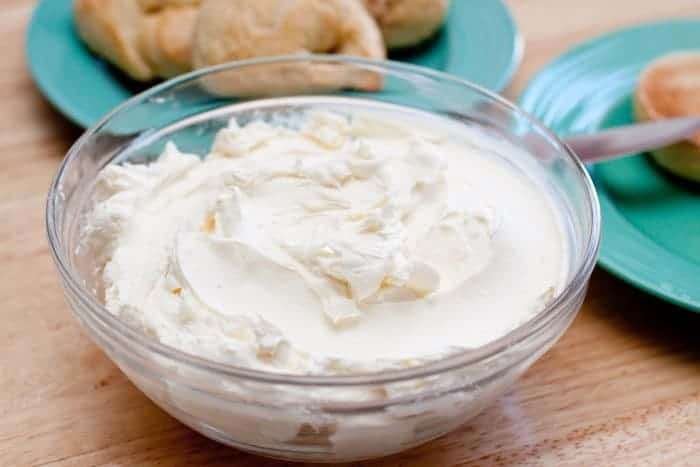
Cream Cheese From Scratch
Description
Cream Cheese From Scratch is made by heating a mixture of whole milk, half and half, and heavy cream with a small amount of salt to about 165°-170°F. Lemon juice is added to gently coagulate the dairy, forming soft curds floating in the liquid whey. The curds at this temperature are delicate and cloud-like rather than firm.
After curdling, the mixture is carefully drained using a cheesecloth-lined sieve to separate the curds from the whey. The draining softens and firms up the curds into a creamy cheese suitable for spreading. This method produces fresh cream cheese with a mild tang and soft texture.
This fresh cream cheese can be used similarly to store-bought varieties in spreads, dips, or cooking. The leftover whey can be saved to enrich soups, pasta dough, or bread recipes.
The recipe notes that substitution of dairy liquids affects texture, with more milk yielding a ricotta-like cheese. Bottled lemon juice works fine, and curd separation may be soft rather than distinct, but draining proceeds as usual.
Ingredients
- 1 cup milk whole
- 1 cup half and half
- 2 cups heavy cream
- 5 tablespoons lemon juice
- 1/2 teaspoon salt
Instructions
- Line a large sieve or colander a large cheesecloth and position over the sink or over a large bowl or pot if you plan to use the whey later. Be sure that your cheese cloth hangs quite a bit over the edges of the sieve - plenty for gathering when you drain.
- Rinse a large pot with cold water. Add milk, half and half, and creams and salt to the pot and heat over medium heat. Heat to approximately 165°-170° F, approximately 5-6 minutes.
- Stir in the lemon juice and continue for a minute or two. Curds will begin to form and float to the top and the milk/cream will begin to simmer a bit and a gentle foam will start to form. Soft curds will start to form, but they won't be as firm as curds from mozzarella, they'll be much softer and cloud-ike. Once you start to see them form, turn off heat and let it sit for another minute and then remove from heat.
- Let sit for 2 minutes and then use a large spoon to gently scoop curds into the cheesecloth, and then slowly and gently pour the rest of the curds/whey into the cheesecloth. Note: The curds will often seem very soft and cloud-like and it may seem like they're not scoopable. If that's the case, just gently pour into the cheesecloth and allow to drain.
- Gather edges of the cheesecloth and suspend over kitchen faucet or just let drain in the cheesecloth lined sieve/colander. You can give the wrapped cheesecloth a gentle squeeze or release some of the whey. See recipe notes.
- Let drain for at least an hour and up to four.
- Gently open cheese cloth and turn cheese into a large bowl. If it seems a little loose still, that's ok it will thicken a little more in the fridge as it chills.
- Cover bowl with plastic wrap or add to an air tight container and let cool for at least 2-4 hrs, this will help it thicken.
- Store in fridge for about a week or in freezer for up to 2 months.
Notes
- The curds formed are soft and may not separate clearly; continue draining to achieve creamy texture.
- You can substitute whole milk for half and half and heavy cream, though the result will be closer to ricotta than cream cheese.
- Bottled lemon juice is acceptable for curdling the dairy mixture.
- Save the leftover whey to use in soups, pasta, or bread recipes for added flavor and nutrition.
Nutrition Information
Show DetailsNutrition Facts
Serving: 12oz
Amount Per Serving
Calories 177 kcal
% Daily Value*
| Calories | 177kcal | 9% |
| Carbohydrates | 3g | 1% |
| Protein | 2g | 4% |
| Fat | 18g | 28% |
| Saturated Fat | 11g | 55% |
| Polyunsaturated Fat | 1g | 6% |
| Monounsaturated Fat | 5g | 25% |
| Cholesterol | 64mg | 21% |
| Sodium | 129mg | 5% |
| Potassium | 89mg | 2% |
| Fiber | 1g | 4% |
| Sugar | 1g | 2% |
| Vitamin A | 688IU | 14% |
| Vitamin C | 3mg | 3% |
| Calcium | 70mg | 7% |
| Iron | 1mg | 6% |
* Percent Daily Values are based on a 2,000 calorie diet.
User Reviews
Overall Rating
4.8
You'll Also Love