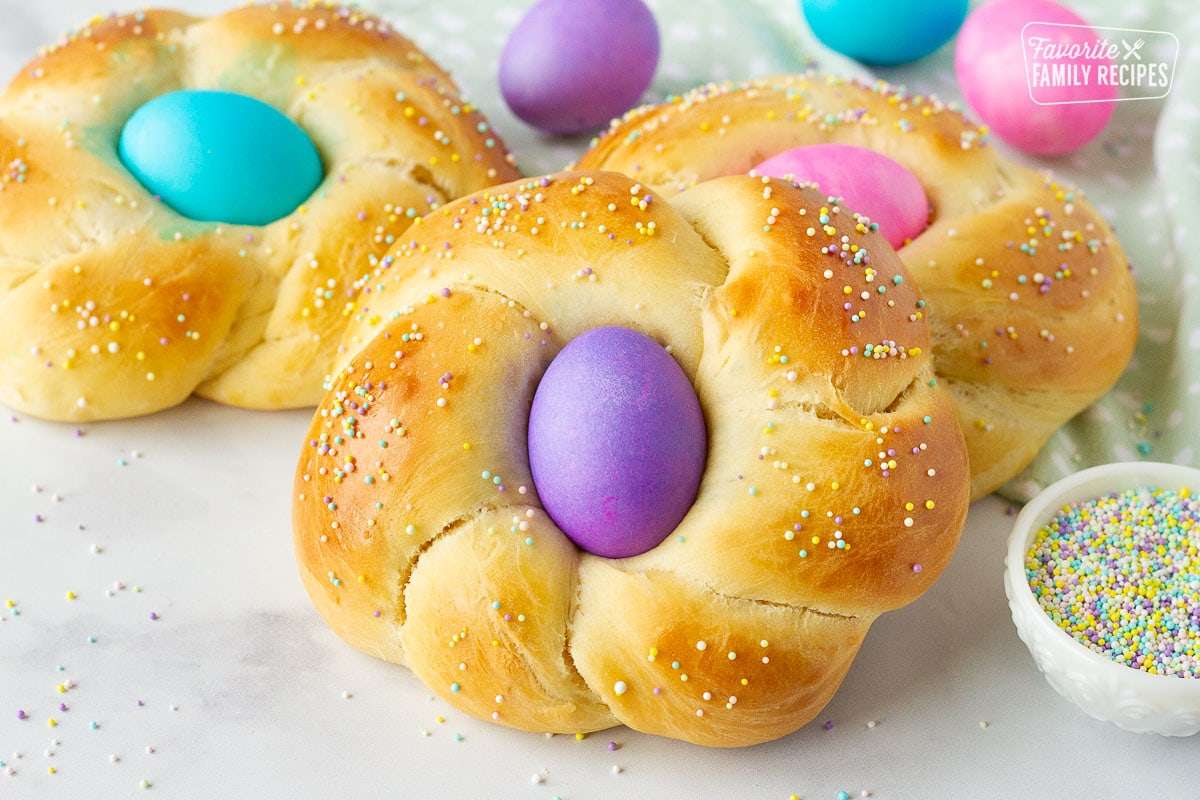
Easter Bread
User Reviews
5
Easter Bread
Description
The recipe begins by activating active dry yeast in warmed milk with sugar until frothy. Flour, sugar, salt, and beaten eggs are combined in a stand mixer with a hook attachment. Butter is added gradually while kneading on low speed to incorporate into the dough, which should become stretchy and slightly sticky but not tacky on hands. Kneading continues for 15-20 minutes to develop elasticity.
After kneading, the dough rests and rises before shaping into three roughly 7-inch loaves. Traditionally, colored eggs can be nestled into the dough during shaping. The enriched dough yields soft loaves with a rich crumb and tender texture, suitable for slicing or using in recipes like French toast.
This bread is often enjoyed during Easter but is versatile for any occasion needing a slightly sweet, tender yeast bread. Its softness and mild sweetness pair well with butter, jams, or as a breakfast bread.
Because of the eggs and butter, storage in airtight containers in the refrigerator is advised. Stale slices can be repurposed into French toast. The dough can be sticky but should not adhere excessively to hands, signaling correct kneading.
Ingredients
- 1 1/4 cup milk (2% or Whole milk)
- 1 teaspoon sugar
- 2 1/4 teaspoon active dry yeast
- 4 1/2 cups flour
- 1 1/2 teaspoon salt
- 2 egg room temperature
- 1/2 cup butter room temperature
- 3 egg for coloring, white
- 3 cups water warm
- 3 tablespoons white vinegar
- gel food colors pink, blue and purple
- Sprinkles optional
Instructions
- Heat milk and 1 teaspoon of sugar in a small bowl (microwave safe) for 1 minute. The milk should be between to 110 to 120°F. Do not heat the milk above 130°F. Add yeast and stir. Set aside for 10 minutes to allow the yeast to activate and get frothy.
- In the bowl of a stand mixer, add flour, 1/2 cup of sugar and salt. Mix together.
- Lightly beat 2 eggs, then add to the mixing bowl along with the frothy yeast.
- Using a hook attachment, set on low speed and knead for 5 minutes. Keep an eye on the dough and pull it down from the hook as needed.
- Add room temperature butter 1 tablespoon at a time while the dough is kneading on low. Once all the butter has been added, continue to knead on low for 10-15 minutes. You will need to pull down the dough from the hook as it bunches up.
- The dough will feel sticky and stretchy, but it should not stick to your fingers. If it tears easily while pulling, knead a little longer.
- Grease a large bowl. Place dough in the greased bowl, cover with damp towel or plastic wrap and allow it to rise in a warm place for 1-1 1/2 hours until it's doubled.
- Dye white RAW eggs in Easter colors. Place 1 cup of warm water in a bowl with 2 tablespoons of white vinegar. Add a generous amount of gel food coloring and mix. Place white egg in the bowl for about 3 minutes until it reaches the desired color. Place on a paper towel and let it completely dry.
- Punch down the dough, place on a lightly floured working surface and divide into 6 equal parts.
- Take two pieces of dough and create two 1 inch ropes that are 14 inches long.
- Pinch together one end and twist the two ropes together. Create a circle by pinching the two ends together. Place on a baking sheet. Repeat with the remaining dough.
- Place a colored egg in the center of each loaf. Do not push the egg down, it will sink while it bakes.
- Cover Easter Bread loaves with a kitchen towel and allow dough to rest for 30 minutes. Whisk 1 egg and 1 teaspoon of water together. Brush the dough with the egg wash being careful not to brush too close to the colored egg because it will bleed into the dough.
- Sprinkle with nonpareils or any kind of sprinkles you want.
- Bake at 350 degrees for 30 minutes until it's a nice golden brown. Immediately place on a wire rack to cool.
Notes
- This recipe yields three 7-inch loaves.
- Dough should be stretchy and slightly sticky yet not cling to hands; knead longer if it tears or is overly sticky.
- Add butter slowly to ensure thorough incorporation into the dough, preventing it from pooling.
- Due to eggs and butter, store finished bread refrigerated in airtight containers.
- If bread becomes stale after a day or two, sliced pieces can be used for French toast.
- Nutrition information excludes colorful eggs embedded inside the bread.
Nutrition Information
Show DetailsNutrition Facts
Serving: 12Serving
Amount Per Serving
Calories 282 kcal
% Daily Value*
| Calories | 282kcal | 14% |
| Carbohydrates | 42g | 14% |
| Protein | 7g | 14% |
| Fat | 9g | 14% |
| Saturated Fat | 5g | 25% |
| Polyunsaturated Fat | 1g | 6% |
| Monounsaturated Fat | 2g | 10% |
| Trans Fat | 0.3g | 15% |
| Cholesterol | 49mg | 16% |
| Sodium | 373mg | 16% |
| Potassium | 113mg | 2% |
| Fiber | 2g | 8% |
| Sugar | 2g | 4% |
| Vitamin A | 324IU | 6% |
| Vitamin C | 0.002mg | 0% |
| Calcium | 46mg | 5% |
| Iron | 3mg | 17% |
* Percent Daily Values are based on a 2,000 calorie diet.
User Reviews
Overall Rating
5
You'll Also Love