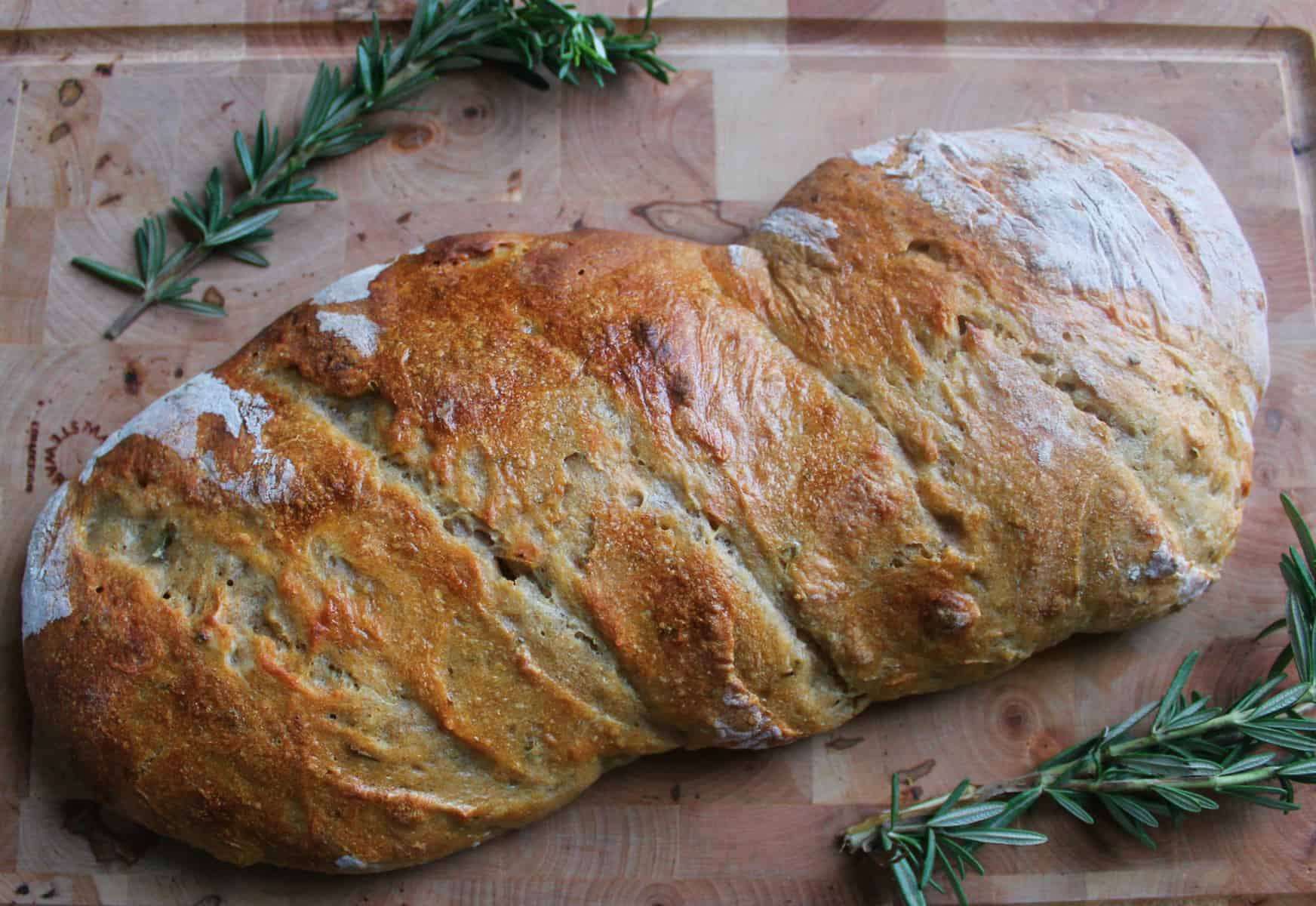
Golden Italian rosemary sourdough bread
User Reviews
4.9
Golden Italian rosemary sourdough bread
Description
This sourdough bread features a blend of all-purpose and whole-grain flour, seasoned with finely chopped fresh rosemary. The recipe starts by reviving the sourdough starter with successive feedings over two days to ensure it is active and bubbly for good rise. The dough is mixed with water, salt, and starter, then shaped and allowed to ferment for a natural leavening process. The use of cornmeal on the baking surface adds a slight crunch and prevents sticking.
The resulting bread has a golden crust with a pleasant aroma of rosemary. The crumb is moist but well-structured thanks to the sourdough fermentation. Olive oil adds a subtle richness and helps with crust coloration. This loaf pairs well with savory dishes or as a stand-alone snack.
The step of carefully feeding the starter and monitoring its activity is important for successful baking. Adjust water slightly depending on flour type to achieve the right dough consistency. Baking with a hot water bath in the broiler pan helps develop a good crust.
Ingredients
- 2 cups all-purpose flour plus more for dusting (if you're using non-Canadian flour, Fertig's recipe calls for an additional ¼ cup, unbleached, or bread flour
- ½ cup whole-grain flour
- ½ tablespoon salt fine kosher
- 1- 1.25 cups water start with one cup and add up to another quarter depending on dryness of dough. You don't want a dough that is too dry, room-temperature
- 1 cup sourdough starter instructions on how to prepare your starter in recipe body, prepared and fed
- 3 rosemary or about ⅛ of a cup, stalks, fresh
- ¼ cup cornmeal or polenta
- all-purpose flour for dusting
- olive oil a tablespoon
- 2 cups water hot, for broiler pan
For reviving starter:
- 1.5 cups water 380g
- 2.16 cups all-purpose flour 325g
Instructions
Revive the starter:
- Two nights before you're planning to bake your bread, revive your starter: remove starter from fridge and let come to room temperature. Stir the starter well to recombine any liquid that may have gathered on the top. Measure out 1 cup of starter.
- Place 1 cup starter in a large jar, bowl, or container, add 1 cup (250g) of water and 1.5 cups (225g) of flour and mix until combined. The mixture will be lumpy, like pancake batter. Cover loosely with plastic wrap and keep at room temperature (I keep my starter on top of the fridge) overnight.
- Refresh it once more in the morning with ¼ cup (65g) water and ⅓ cup (50g) flour, and once again that night with the same quantities (¼ cup (65g) water and ⅓ cup (50g) flour). The starter will be ready to use at night, or the next morning, when it bubbles and smells yeasty.
- You will need 1 cup of refreshed starter.
Prep the bread:
- When ready to bake, chop rosemary finely. Dump the bread flour and whole-grain flour into a mixing bowl, and stir with a wooden spoon to combine well. Add salt and chopped rosemary, and stir to combine.
- Pour in the water and starter and stir together until just moistened. Beat 40 strokes, scraping the bottom and the sides of the bowl, until the dough forms a thick, spongy mass.
- Transfer dough to an oiled crockpot or an oiled large glass bowl. Cover the bowl with plastic wrap or a large plate and let ferment at room temperature 72°F (22 °C) for 12 to 24 hours, or until the dough is bubbly on the surface, has a sponge-like appearance and has either doubled or risen by half. I place my bowl, covered, in a oven that is turned off, or simply under the table in the kitchen.
- Use right away or place the bowl, covered with plastic wrap, in the refrigerator for up to three days.
- When dough is ready, place it on a generously floured surface and dust with more flour. Flour your hands. Using a dough scraper or floured hands, scrape the dough up and over itself, flouring and turning it as you go, for 12 to 15 turns, or until dough is soft and not sticky (this method is fantastic, and the dough is not overworked). Dust very lightly with flour.
- With floured hands, work the dough as little as possible and form it into a wide 10-12 inch batard. Pinch the ends and all seams closed, and lightly flour sticky spots. The dough should be smooth and soft, and not sticky. If sticky, add a bit more flour.
- Prepare a baking sheet or cutting board (the bottom must be flat). Line it with a clean kitchen cloth, or parchment paper, and dust it with flour. Without moving your batard too much, use a dough scraper (or well-floured hands) to slide your dough onto the floured surface.
- Cover the dough with plastic wrap sprayed with oil, oily side down. Let rest at room temperature (again, I use a turned-off oven) for 5 to 8 hours.
Bake the bread:
- About 30 minutes before baking, place a broiler pan on the bottom rack of the oven. Place your baking sheet on in the middle of the oven. Preheat oven to 450F.
- Remove plastic wrap from batard. Using a sharp knife, make three to five crosshatch slashes diagonally across the top of the loaf.
- Very carefully and wearing oven mitts, remove the hot baking sheet from the oven, and cover with parchment paper. Sprinkle the cornmeal on the paper. Using the dough scraper and well-floured hands, slide the bread from the pan onto the baking sheet, taking care to keep its shape. Place baking sheet back in the middle rack of the oven.
- Pull lower rack of the oven halfway out, and pour 2 cups of hot water into the broiler pan. Spray batard with water, but take care not to drench it. Return rack into the oven, and close oven door immediately.
- Bake for 27 to 30 minutes, lightly spraying the loaf with water three times during baking. The bread will be ready when crust is golden-brown. Remove baking sheet from the oven, and, wearing kitchen gloves, remove bread onto wire rack to cool.
Nutrition Information
Show DetailsNutrition Facts
Serving: 1loaf
Amount Per Serving
Calories 1488 kcal
% Daily Value*
| Calories | 1488kcal | 74% |
| Carbohydrates | 301g | 100% |
| Protein | 48g | 96% |
| Fat | 9g | 14% |
| Saturated Fat | 1g | 5% |
| Sodium | 3550mg | 148% |
| Potassium | 596mg | 13% |
| Fiber | 18g | 72% |
| Sugar | 2g | 4% |
| Calcium | 88mg | 9% |
| Iron | 6mg | 33% |
* Percent Daily Values are based on a 2,000 calorie diet.
User Reviews
Overall Rating
4.9
You'll Also Love