How To Clean Clams - The Best Way to Purge Sand
User Reviews
4.7
How To Clean Clams - The Best Way to Purge Sand
Description
How To Clean Clams - The Best Way to Purge Sand details a method to prepare live clams for cooking by removing sand trapped inside. The technique uses a 3–4% salt water solution made with kosher salt and water to mimic sea water, encouraging clams to purge sand naturally. Clams with open or damaged shells are discarded to ensure freshness and safety. They are placed on a wire rack above the salt water so any sand expelled settles beneath and is not re-ingested. This purging usually takes place soon after purchase and before refrigeration slows the clam’s metabolism.
This cleaning process improves the texture of cooked clams by reducing grit. It relies on clams’ natural behavior of filtering water, so no additional soaking steps or additives are required. Maintaining proper salinity encourages clams to open and release sand inside their shells.
The recipe emphasizes doing this as early as possible after buying live clams so the purging occurs while they are still active. The clean clams can then be cooked in your desired preparation without concern for unpleasant sand.
Ingredients
- clams
For 3–4% Salt Water
- 1 Tbsp kosher salt Diamond Crystal brand
- 2 cups water
Instructions
Before You Start...
- Live clams should be cooked within 48 hours of purchase. Even though you do not use the clams right away, it‘s important to de-grit them first as soon as you bring the clams home from the store. Keeping the clams in the refrigerator will slow them down and they may not purge sand later.
To Purge Sand from Clams
- Gather all the ingredients. Gently tap any clams with open shells and discard any clams that do not close their shells within a few minutes or that have cracked or chipped shells.
- To make the salt water, combine 2 cups water and 1 Tbsp Diamond Crystal kosher salt in a measuring cup or bowl and mix well until the salt is completely dissolved. For my setup, I doubled the ingredients to 4 cups water and 2 Tbsp kosher salt.
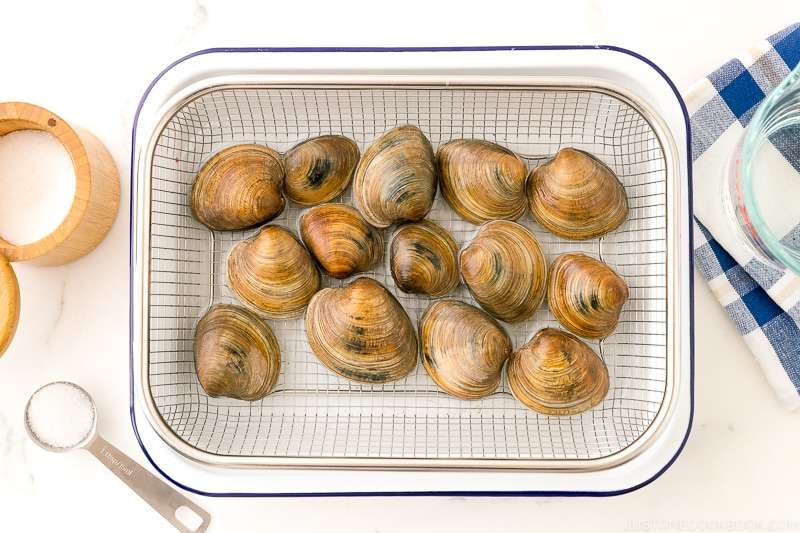
- Place a wire rack/sieve inside the large tray/bowl and put the clams in a single layer. The purged sand goes to the bottom of the rack/sieve and it will not be consumed again by the clams. Pour the salt water into the tray/bowl. The salt water should be right around the clam’s mouth. Don‘t submerge the clams under the salt water! If there isn’t enough salt water, then make more using the same ratio of water and salt.
- Cover the top with aluminum foil (clams prefer to be in a quiet and dark environment), leaving some space at the corner for air. Keep it in a cool dark place for 1 hour. Clams become active when water is around 69ºF/20ºC. If you live in a hot climate, you may need to adjust the water temperature between the refrigerator and a cool place in your house. If you get your own clams from the beach, you will need about 6 hours for clams to purge sand.
- After 1 hour, remove the aluminum foil cover and take out the rack/sieve. Discard the dirty salt water and clean the tray/bowl.
To Purge the Salt from Clams
- This step is only for clams that you got from clamming yourself. Place the rack/sieve again to de-salt as the clams contain a lot of seawater. Keep the clams in the sieve and leave them at the counter for 1 hour. Without this process, the clams may taste too salty.
To Clean the Clams
- Wash each clam with a brush under cold running water.
To Use and Store
- Now the clams are ready! Put the clean clams in a bowl/tray and cover them with a damp paper towel on top. Keep it in the refrigerator for up to 2 days. To freeze, place the live clean clams in a plastic bag and remove the air. Store it in the freezer for 2 weeks.
Nutrition Information
Show DetailsNutrition Facts
Serving: 1Serving
Amount Per Serving
Calories 25 kcal
% Daily Value*
| Calories | 25kcal | 1% |
| Carbohydrates | 1g | 0% |
| Protein | 4g | 8% |
| Fat | 1g | 2% |
| Saturated Fat | 1g | 5% |
| Polyunsaturated Fat | 1g | 6% |
| Monounsaturated Fat | 1g | 5% |
| Cholesterol | 9mg | 3% |
| Sodium | 177mg | 7% |
| Potassium | 14mg | 0% |
| Vitamin A | 88IU | 2% |
| Calcium | 11mg | 1% |
| Iron | 1mg | 6% |
* Percent Daily Values are based on a 2,000 calorie diet.
User Reviews
Overall Rating
4.7
You'll Also Love

Tofu and Charred Broccoli Bowls with Kimchi–Miso Dressing