How to Cut Salmon into Japanese-Style Fillets
User Reviews
5
How to Cut Salmon into Japanese-Style Fillets
Description
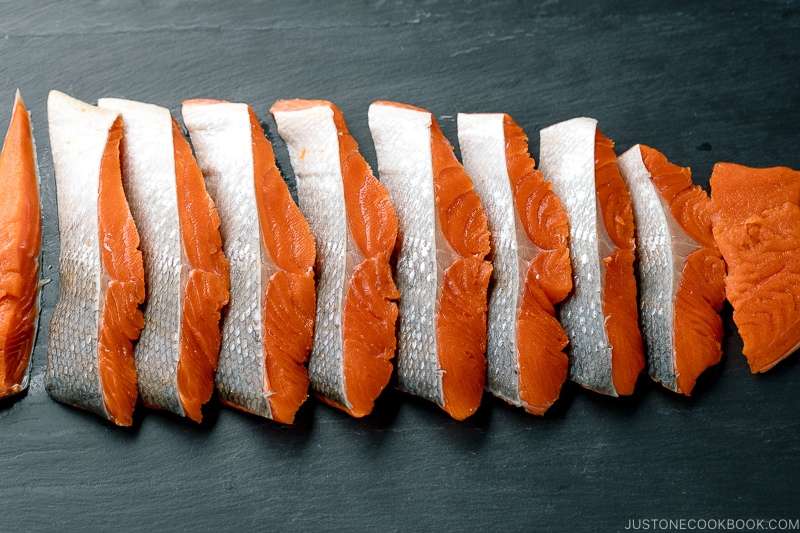
How to Cut Salmon into Japanese-Style Fillets details a precise method for slicing salmon to create fillets ideal for Japanese preparations. Starting with the skin-side down salmon, the narrow tail is trimmed and then the fish is cut diagonally at about a 30-degree angle into 1-inch thick fillets. This approach ensures the fillets cook evenly, preserving texture and consistency. The technique uses the example of wild sockeye salmon, though it is adaptable for other salmon varieties with a note to consult recipes suitable for them. This method is a useful skill for cooks preparing salmon for Japanese dishes such as sashimi, shioyaki, or salt-cured salmon.
Ingredients
- 1 salmon 1.3 lb, 600 g; you can use any type of salmon; I used the left side of wild sockeye salmon from Costco; read the blog post for why I used the left side, side
Instructions
- Pat dry 1 side of salmon with paper towels. Make sure that the salmon skin does not have scales. Run your fingers back and forth across the skin to see if any scales are left. To remove them, use the flat side of a knife and scrape against the scales.
- Place the salmon skin side down with the narrow tail end to your left (the head end is wider). Next, cut off the tail‘s narrowest part, which is too small for Japanese-style fillets. Tilt your knife back about 30 degrees and diagonally slice the salmon toward the tail end.
- Then, cut your Japanese-style fillets, again tilting your knife at a 30-degree angle to make your diagonal slices. I determine where to cut by thickness and slice the fillets 1 inch (2.5 cm) thick. Try to cut your fillets a uniform thickness so they cook at the same rate.
- My one side of salmon yields 8 Japanese-style fillets and 3 additional odd-sized fillets. For sockeye salmon, I recommend making Salted Salmon (Shiozake). For other types of salmon, check out my salmon recipes.
To Store
- I am not a big fan of plastic usage; however, to preserve the salmon and its fresh quality for a longer time, you would need to tightly wrap each fillet in plastic, remove the air, and put it in a bag/container before storing in the freezer. It will last for a month, or maybe a little longer if your freezer keeps the temperature well.
Nutrition Information
Show DetailsNutrition Facts
Serving: 8Japanese-style fillets (plus 3 additional odd-sized pieces)
Amount Per Serving
Calories 107 kcal
% Daily Value*
| Calories | 107kcal | 5% |
| Protein | 15g | 30% |
| Fat | 5g | 8% |
| Saturated Fat | 1g | 5% |
| Polyunsaturated Fat | 2g | 12% |
| Monounsaturated Fat | 2g | 10% |
| Cholesterol | 41mg | 14% |
| Sodium | 33mg | 1% |
| Potassium | 368mg | 8% |
| Vitamin A | 30IU | 1% |
| Calcium | 9mg | 1% |
| Iron | 1mg | 6% |
* Percent Daily Values are based on a 2,000 calorie diet.
User Reviews
Overall Rating
5
You'll Also Love


Tofu and Charred Broccoli Bowls with Kimchi–Miso Dressing