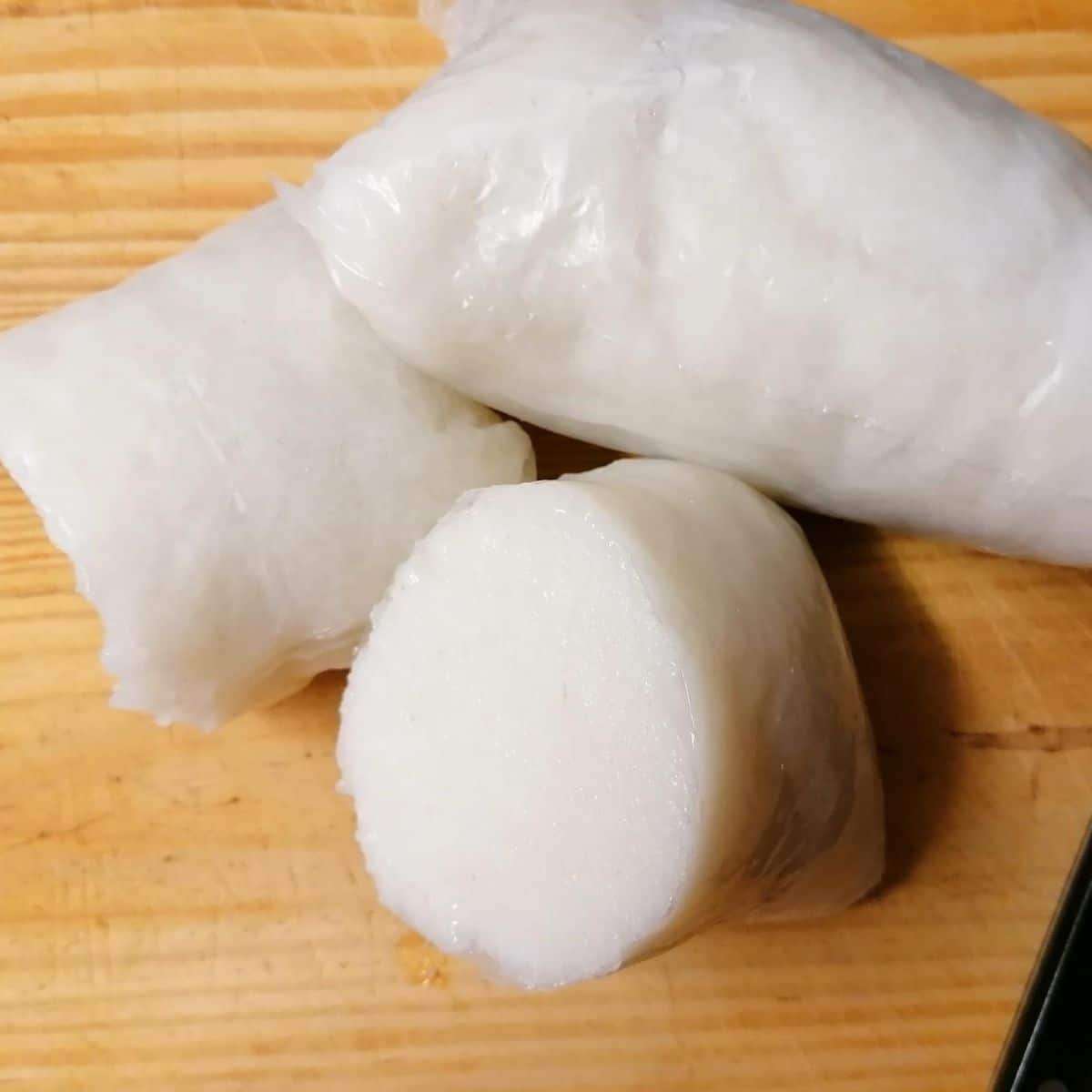
How to make Lontong without banana leaves
User Reviews
5
-
Prep Time
2 hrs
-
Cook Time
10 mins
-
Additional Time
2 hrs
-
Total Time
4 hrs 10 mins
-
Servings
2
-
Course
Others
How to make Lontong without banana leaves
Description
In this method for making lontong without banana leaves, rice (any type such as Basmati, Jasmine, or short-grain) is soaked overnight to improve texture. The soaked rice is then drained and tightly packed into food-grade plastic bags, which are doubled for durability. These bags are submerged in boiling water and cooked until the rice is fully set. Once fully cooled over several hours, the rice forms a firm, cohesive cake that can be sliced for use in various dishes.
The texture of the final lontong depends on the rice variety used, with Jasmine or short-grain rice offering a chewier finish, while Basmati rice yields a lighter texture. This cooking approach eliminates the need for banana leaves traditionally used to wrap lontong, making it more accessible.
Lontong can be served sliced as a staple carbohydrate in many Southeast Asian meals. It pairs well with spicy dishes, soups, and stews as a neutral, soft base.
Cooling is essential to allow the compressed rice to firm up sufficiently for slicing. It is recommended to chill the lontong for at least 3 to 4 hours after cooking for ease of handling.
Ingredients
- rice
- Food-grade plastic bags.
- A big pot with its lid or a pressure cooker.
- 14-16 cups water depending on the size of your pot/ pressure cooker.
- salt
- A candle and a lighter.
Instructions
- Wash, drain, and soak 1 cup of rice overnight. Note: you can use Basmati rice, long grain rice, short-grain rice, or even Jasmine rice. The difference is in the texture. If you like a chewy-kinda texture, you may want to choose Jasmine rice or short-grain rice. I personally use Basmati rice most of the time. Because that’s the rice we always have at home.
- Drain the rice.
- Get your food-grade plastic bags. Basically, you can use any size of plastic bags. But you want to make sure that the bags will fit in the pot that you’re going to use. For reference, I use a 20 x 29 cm (approx. 8 x 12 inch) bag that I fold into the half. Fill the bag with the rice until it fills up about ⅓ of the lontong size that you want to make.
- Insert the filled bag into another bag to give another layer. You can skip this step if you think your plastic bag is thick enough to handle the boiling process.
- Fold the plastic bags about ½ inch away from the point where you decide your lontong size is gonna be.
- Using the candlelight, carefully burn the folded part of the plastic bag at the bottom of the candlelight. It’s where the light is blue. Don’t burn at the top part of the fire, because it will burn your plastic bag unevenly.
- Take care and make sure the light burns all layers of the bags that all stick together.
- And then carefully press the burned bit using two fingers. If you’re worried about the heat, you can use a thick tea towel to press it.
- Next, lay your filled bag on a chopping board. Using a skewer, a toothpick, or a pin, prick the bag along the width and the length. Try to prick about a half-inch between each prick. Turn the bag around, and do the same to the other side.
- Get your big pot ready if you use a pot. I use a pressure cooker most of the time because it cuts down the cooking time to half. It only takes me around 1 hour to cook in the pressure cooker.
- Put the water in the pot/ pressure cooker, and carefully place your bags of rice in it.
- Initially, the bags will stay afloat as the rice is still raw. But once the rice is cooked, the bag will plump up and fat ?. So, you have to guess how much water you need to put to cover the bags when the rice bag shape expands. Because you want to make sure the rice bags will be fully covered with water pretty much all the way through.
- If you use a pressure cooker, you can put the lid on and set everything according to its instruction. If you use a normal pot, you can just put its lid on.
- Turn the heat to high-medium until the water boils. Then you can turn it down to medium once the water reaches boiling point.
- It takes one hour to boil with a pressure cooker, and about two hours if you use a normal pot. When the cooking is done, your rice will look mashed and solidified but very soft.
- Drain the water, and leave the rice bags on a colander. Leave it to fully cool down.
Notes
- Soaking rice overnight improves texture of the lontong.
- Doubling plastic bags helps prevent leaks during boiling.
- Cooling the cooked lontong for 3 to 4 hours is necessary for firm cutting.
User Reviews
Overall Rating
5
You'll Also Love