Oyaki (Japanese Stuffed Dumplings)
User Reviews
4.8
Oyaki (Japanese Stuffed Dumplings)
Description
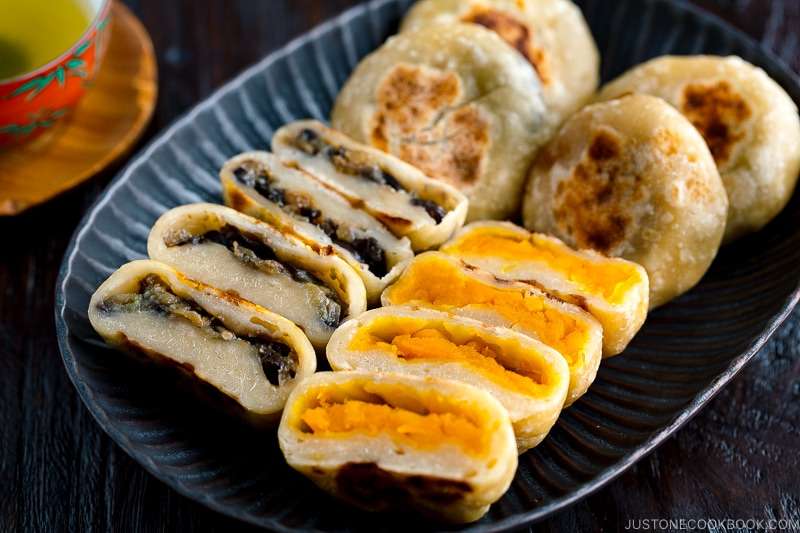
To prepare Oyaki, a dough is made by combining all-purpose flour with boiling water, neutral oil, and kosher salt, then kneaded until smooth and elastic. Resting the dough enhances its pliability for shaping. Separately, fillings such as Japanese eggplant cooked with sesame oil, sugar, miso paste, and optional shiso leaves, or kabocha squash softened with oil, water, sugar, soy sauce, and salt, provide flavorful centers.
The dough is portioned, flattened, and filled with the chosen mixture, then sealed to form dumplings. These are cooked by frying or pan-cooking in neutral oil to develop a light crust while maintaining a tender dough texture.
Oyaki offer a contrast between the slightly chewy outer dough and the richly flavored vegetable fillings, making them a satisfying snack or light meal. The choice of filling can be varied for different tastes, and the preparation emphasizes balanced seasoning to complement the mild dough.
Ingredients
For the Dough
- 2½ cups all-purpose flour
- 200 ml water 1 cup minus 2½ Tbsp, boiling
- 1 tsp neutral oil
- ¼ tsp kosher salt Diamond Crystal brand
For the Eggplant Filling
- 2 Japanese eggplant or Chinese eggplant
- 1 Tbsp sesame oil toasted
- 1 Tbsp sugar (you can reduce if you‘d like; the dough tastes rather bland, so make sure the filling has a strong flavor)
- 1 Tbsp miso paste
- 2 shiso leaves julienned; optional, aka perilla, ooba
For the Kabocha Filling
- 12 oz kabocha squash (¼ kabocha with seeds)
- 1 Tbsp neutral oil
- ¼ cup water
- 1 Tbsp sugar (you can reduce if you‘d like; if you prefer a more savory taste, you can increase the amount of soy sauce but you will need to add some sugar to balance out the salty flavor and can‘t omit it completely)
- 1 tsp soy sauce
- 1 pinch kosher salt Diamond Crystal brand
For Cooking
- 1 Tbsp neutral oil
Instructions
- Gather all the ingredients.
To Make Dough
- Using a fine-mesh strainer, sift 2½ cups all-purpose flour (plain flour) into a large bowl. Combine 200 ml boiling water (1 cup minus 2½ Tbsp), 1 tsp neutral oil, and ¼ tsp Diamond Crystal kosher salt.
- Mix the dry ingredients and wet ingredients with chopsticks until you can pick up the dough with your hands.
- Use the dough to pick up the crumbs in the bowl.
- Knead on a lightly floured surface for about 3 minutes, until a smooth dough forms. In Japan, we say “knead until the texture is like your earlobe.”
- Form the dough into a ball, put it back in the bowl, cover with plastic wrap, and let it rest at room temperature for at least 30 minutes or longer. Letting the dough rest increases its elasticity making it easier to work with later, so please don‘t skip.
To Make the Eggplant Filling
- While the dough rests, make the fillings. Remove the stems of 2 Japanese or Chinese eggplants and cut it half lengthwise. Then, slice into half circles. Soak in water for 5–10 minutes. (Meanwhile, you can cut the kabocha). Drain well and set aside.
- Heat 1 Tbsp toasted sesame oil in a large frying pan and sauté the eggplant until it is coated with oil. Cover the lid and cook on low heat for 5 minutes.
- When tender, add 1 Tbsp sugar and combine well.
- Add 1 Tbsp miso. Add 2 shiso leaves (perilla/ooba) that you‘ve julienned into thin strips. Mix well together. Transfer to a dish to let cool.
To Make the Kabocha Filling
- Cut 12 oz kabocha squash into smaller wedges and remove the skin. (See my post on How To Cut a Kabocha Squash.)
- Cut each wedge into thin slices and then cut into thin strips.
- Heat 1 Tbsp neutral oil in the frying pan and sauté the kabocha. When it’s coated with oil, add ¼ cup water and cook covered for 5 minutes on low heat.
- Add 1 Tbsp sugar and combine well.
- Add 1 tsp soy sauce and 1 pinch Diamond Crystal kosher salt. Mix well together.
- Transfer to the dish to let cool.
To Shape into Oyaki
- Roll out the rested dough into a rectangular or circle shape and divide it into 12 pieces.
- Make each dough into a ball then press down with your hand.
- Stretch the dough to 10 cm (4 inches) in diameter. The important trick is to keep the center thicker than the edges. Using your fingers, stretch the outer edges by rotating the dough. This way, when you pinch the dough to seal, the dough won’t be too thick/too much.
- Place about 1 Tbsp of the filling in the center of each piece of dough. Close the oyaki by bringing the dough up over the filling, pinching at the top to seal.
- I use the same pleating technique as my Nikuman recipe (see the video on how I close the dough and pinch).
- After pinching the dough, put the pinched-side down on a lightly floured surface and twist a few times. Then press the top of the oyaki a little bit into a slightly flat ball.
To Cook the Oyaki
- Set up a steamer by placing a steamer basket on top of a wok/pot filled with enough boiling water. Tip: If you don’t have a steamer, after cooking the oyaki in a frying pan, add ¼ cup water to the pan. Cover with a lid and steam it until the water evaporates.
- Heat 1 Tbsp neutral oil in a frying pan (12 inch) and cook the oyaki, pinched-side down.
- Pan-fry for 3–4 minutes each side, or until golden brown.
- Transfer the oyaki to a steamer basket and cover to cook on high heat for 15–20 minutes (depending on the size of the oyaki and filling—a small one should take about 10 minutes). Make sure the lid is covered with a kitchen towel so the condensation on the lid doesn’t fall onto the oyaki.
- When they are done steaming, transfer to a wire rack (I use a bamboo strainer) where the heat can escape from the bottom.
To Serve and Store
- Enjoy the Oyaki immediately. As soon as they become warm, not hot, cover the leftovers with plastic wrap (I wrap individually). Don’t wait until completely cooled down. You can freeze to store for up to a month, and re-steam to enjoy later.
Nutrition Information
Show DetailsNutrition Facts
Serving: 12pieces
Amount Per Serving
Calories 158 kcal
% Daily Value*
| Calories | 158kcal | 8% |
| Carbohydrates | 27g | 9% |
| Protein | 4g | 8% |
| Fat | 4g | 6% |
| Saturated Fat | 2g | 10% |
| Polyunsaturated Fat | 1g | 6% |
| Monounsaturated Fat | 1g | 5% |
| Sodium | 105mg | 4% |
| Potassium | 216mg | 5% |
| Fiber | 2g | 8% |
| Sugar | 4g | 8% |
| Vitamin A | 397IU | 8% |
| Vitamin C | 4mg | 4% |
| Calcium | 19mg | 2% |
| Iron | 1mg | 6% |
* Percent Daily Values are based on a 2,000 calorie diet.
User Reviews
Overall Rating
4.8
You'll Also Love