Pappardelle Pasta Recipe
User Reviews
5
-
Cook Time
5 mins
-
Total Time
1 hr
-
Servings
8 servings
-
Calories
213 kcal
-
Course
Side Dish, Main Course
-
Cuisine
Italian
Pappardelle Pasta Recipe
Description
The dough preparation starts by sifting the flour on a workspace and creating a well for the eggs. Eggs are beaten and mixed gradually with the flour, initially creating a cake batter-like texture before forming a cohesive but crumbly dough mass. Kneading by hand or with a stand mixer develops the gluten, producing a smooth, elastic dough after about 10 minutes.
The dough rests, allowing hydration and relaxation, essential to the rolling process. After resting, it is rolled out thinly and cut into wide ribbons consistent with the pappardelle style. Dusting with semolina flour prevents the pasta ribbons from sticking together during shaping or cooking.
The method emphasizes careful mixing stages, including the initial scrambled egg appearance and gradual flour incorporation, resulting in authentic fresh pasta dough texture and consistency.
Ingredients
- 4 egg room temperature, free-range
- 400 g Tipo "00" flour highly recommend weighing flour, or plain all-purpose flour, 14.10 oz
- semolina flour for dusting pasta
Instructions
- Make the dough.Sift the flour on a large work surface and make a well in the center (I like to use the bottom of a bowl to make the well). Place the eggs in a bowl, then pour into the well; with a fork, break up the eggs (like you are making scrambled eggs), then gradually mix the wet ingredients into the flour mixture just until combined. Start a little at a time and create a cake batter consistency then incorporate more of the flour until a crumble consistency form. The dough may look dry and crumbly at this point. (See Notes for more)
- If you have a dough scraper you can use it to help you incorporate the ingredients.
- Knead by hand. Dust a wooden board or work surface with flour. Start kneading each piece, push the dough away from you with the heel of your hand, fold the dough over itself and turn it counterclockwise.
- Continue pushing, folding, and turning until the dough is smooth and elastic about 10 minutes. You can also knead it in a stand mixer.
- Let dough Rest. Pat the dough into a round ball. Flatten the top slightly with your hand, wrap it in plastic wrap and refrigerate for at least 30 minutes or overnight. You will know your dough is ready when it springs back after you push into the dough. I call this the "spring back test".
- Roll out the dough. Sprinkle a large cutting board or clean the work surface with semolina. Cut 1/4 of the rested dough ball and keep the other part covered with plastic wrap so it doesn't dry.
- Rolling Pin Method. Starting in the middle, push away from you with a rolling pin, easing up on the pressure as you approach the edge.
- Dust both sides of the dough with a little semolina so it doesn't stick to the rolling pin and cutting board. Continue rolling the dough into a sheet, turning occasionally, until you can see your fingers through the bottom of the dough if you hold it to the light.
- Let the flat and rolled-out dough dry for about 10 minutes before cutting. You will repeat this step with all the pasta dough pieces.
- Pasta Maker Method. If you have a pasta maker you can run it through the machine. Start with setting #1. Feed through the machine once then fold each side into the middle to form a rectangle. Put it through the machine again on setting #1.
- Dust both sides of the dough with a little semolina so it doesn't stick in the pasta machine, and repeat as needed. Now, repeat feeding through the machine and changing the setting each time from #2, #3, #4, #5, #6, until you reach setting #7- OR- until you can see your fingers through the bottom of the dough if you hold it to the light.
- Let the flat and rolled-out dough dry for about 10 minutes before cutting. You will repeat this step with all the pasta dough pieces. (see photos in post for visual aid)
- Cut the pappardelle. Dust the top of the sheet of dough with semolina flour and loosely roll it into a cylinder. Using a sharp knife, cut into 3/4-inch-wide slices.
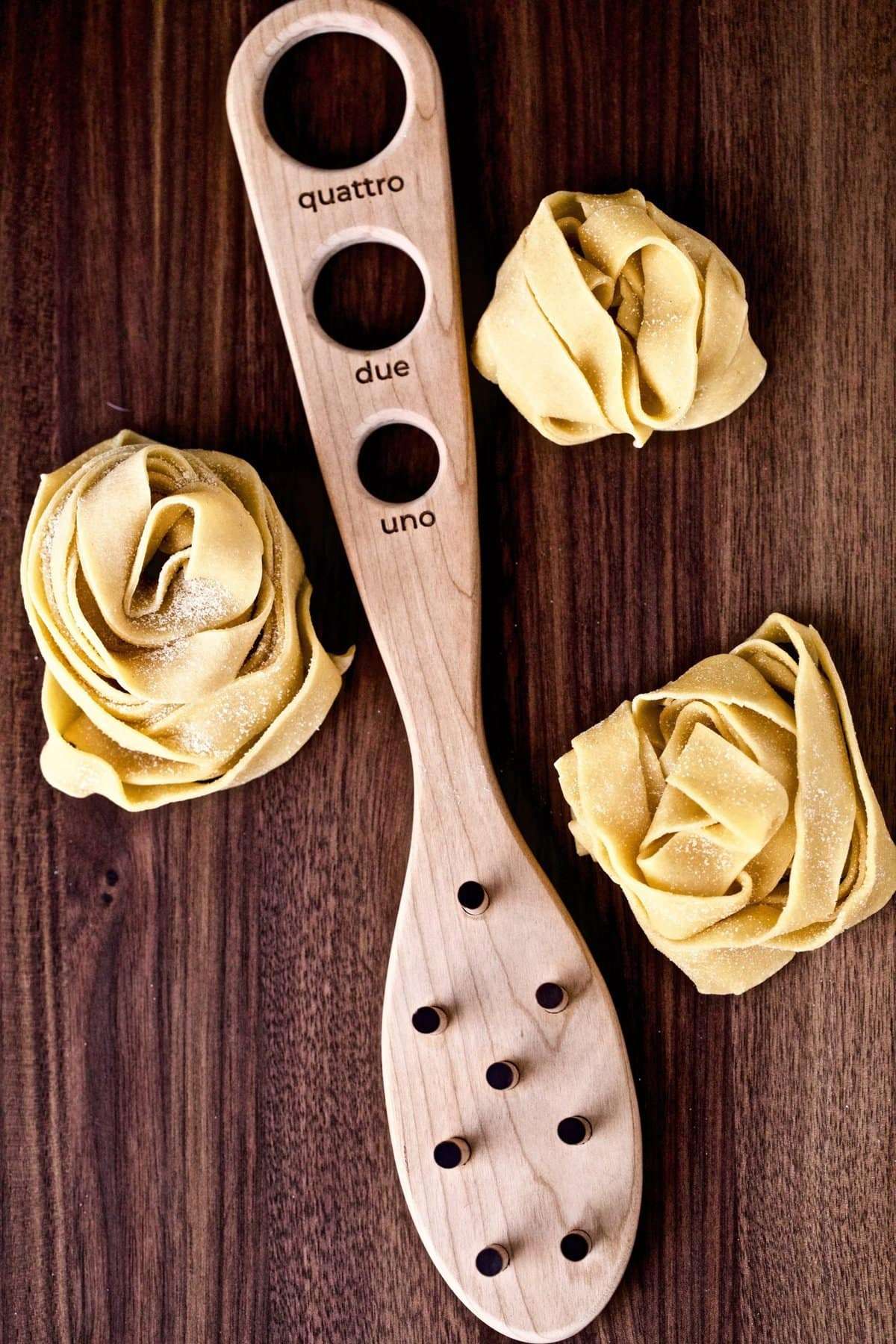
- Unwrap the pasta; dust with semolina and gently toss to separate. Place on a sheet pan and cover with a tea towel until ready to cook (or freeze in freezer bags for up to 2 months). You can make them into little nests to store them or simply put them into a freezer-safe bag.
- Cook the pappardelle. Cook fresh pasta noodles in a large pot of boiling salted water. (Use about 6 quarts of water for 1 pound of pasta.) Fresh pasta takes considerably less time to cook than dried, usually 1 to 3 minutes, so watch it carefully. To test, remove a noodle with tongs or a pasta server spoon and take a bite.
- Serve with your favorite sauce- I list my favorites in the recipe post. Mangia! (Eat!)
Notes
- Mix flour and eggs slowly, starting with a small portion of flour combined with eggs resembling a cake batter stage before adding more flour to avoid tough dough.
- Knead dough for about 10 minutes until smooth and elastic for ideal ribbon texture.
- Let dough rest to relax gluten, aiding in easier rolling and shaping of pasta sheets.
- Use semolina flour to dust pasta ribbons to prevent sticking before cooking or drying.
Nutrition Information
Show DetailsNutrition Facts
Serving: 8servings
Amount Per Serving
Calories 213 kcal
% Daily Value*
| Calories | 213kcal | 11% |
| Carbohydrates | 38g | 13% |
| Protein | 8g | 16% |
| Fat | 3g | 5% |
| Saturated Fat | 1g | 5% |
| Polyunsaturated Fat | 1g | 6% |
| Monounsaturated Fat | 1g | 5% |
| Trans Fat | 0.01g | 1% |
| Cholesterol | 82mg | 27% |
| Sodium | 32mg | 1% |
| Potassium | 84mg | 2% |
| Fiber | 1g | 4% |
| Sugar | 0.2g | 0% |
| Vitamin A | 119IU | 2% |
| Calcium | 20mg | 2% |
| Iron | 3mg | 17% |
* Percent Daily Values are based on a 2,000 calorie diet.
User Reviews
Overall Rating
5
You'll Also Love