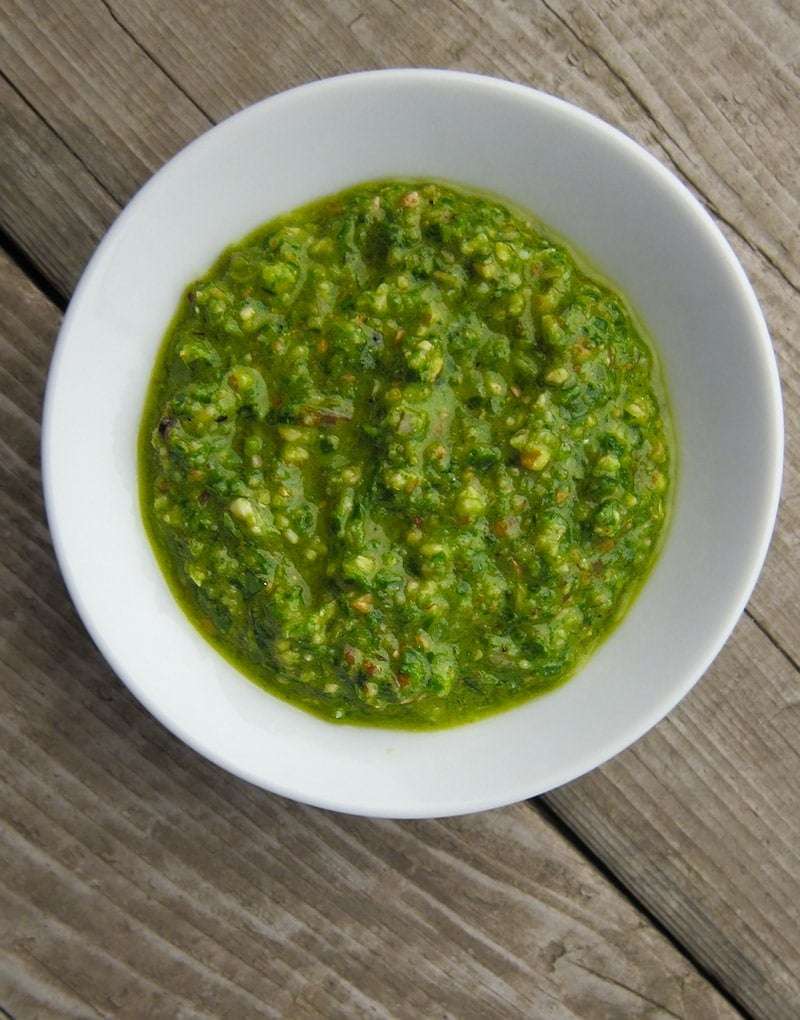
Ramp Pesto
User Reviews
5
-
Prep Time
15 mins
-
Cook Time
1 min
-
Total Time
16 mins
-
Servings
8 servings
-
Calories
56 kcal
-
Course
Condiments
-
Cuisine
Italian
Ramp Pesto
Description
This recipe begins by optionally blanching wild onions (ramps), then quickly cooling and drying them. The ramps are chopped and combined with toasted pine nuts or other nuts, garlic, and grated cheese like pecorino in a mortar and pestle. The ingredients are mashed together and stirred to form a textured paste. Olive oil is gradually incorporated, tailoring the consistency—less for spreads, more for sauces. The emphasis is on achieving a coarse paste rather than a smooth puree.
The ramp pesto brings a pungent, garlicky flavor with herbal brightness unique to ramps, complemented by the richness of nuts and cheese. This sauce can be used to dress pasta, spread on bread, or as a flavorful addition to dishes requiring a fresh, green accent.
When using a food processor, it is important to pulse ingredients first before slowly adding olive oil to avoid overprocessing and losing the pesto’s traditional texture.
Ingredients
- 3 garlic roughly chopped, cloves
- 1/4 cup pine nuts or chopped walnuts, pecans or almonds, toasted
- 3 tablespoons cheese such as pecorino, grated
- 2 cups ramp leaves about 2 dozen, or other wild onion leaves
- salt to taste
- extra-virgin olive oil About 1/2 cup
Instructions
- f you are blanching your onions, bring a large pot of water to a boil. Add enough salt to make it taste like the sea. Set a large bowl of ice water nearby. Plunge the ramp leaves into the boiling water for 1 minute. Remove and quickly cool them down in the ice water. Squeeze dry with a tea cloth or paper towels.
- Chop the ramp leaves and set aside. Pesto is best made with a mortar and pestle, thus the name, which means "pound." You can of course make this in a food processor, but it will not be the same. To start, add the toasted pine nuts and garlic and crush them.
- Add the cheese and ramps and commence pounding. Mash everything together, stirring with the pestle and mashing well so it is all fairly uniform.
- Start adding olive oil. How much? Depends on how you are using your pesto. If you are making a spread, maybe 1/4 cup. If a pasta sauce, double that. Either way, you add 1 tablespoon at a time, pounding and stirring to incorporate it. When it's a nice rough paste, taste it and add salt if you need to; sometimes the cheese makes the pesto salty enough by itself. Serve as a spread on bread, as an additive to a minestrone, as a pasta sauce or as a dollop on fish or poultry.
Notes
- If blanching the ramps, plunge leaves in salted boiling water for one minute and cool immediately to retain color and flavor.
- Using a mortar and pestle maintains a rough texture, but a food processor can be used carefully by pulsing before adding oil.
- Add olive oil gradually to control the pesto consistency for different uses.
Nutrition Information
Show DetailsNutrition Facts
Serving: 8servings
Amount Per Serving
Calories 56 kcal
% Daily Value*
| Calories | 56kcal | 3% |
| Carbohydrates | 4g | 1% |
| Protein | 2g | 4% |
| Fat | 4g | 6% |
| Saturated Fat | 1g | 5% |
| Cholesterol | 3mg | 1% |
| Sodium | 20mg | 1% |
| Potassium | 30mg | 1% |
| Fiber | 1g | 4% |
| Sugar | 1g | 2% |
| Vitamin A | 410IU | 8% |
| Vitamin C | 3mg | 3% |
| Calcium | 38mg | 4% |
| Iron | 1mg | 6% |
* Percent Daily Values are based on a 2,000 calorie diet.
User Reviews
Overall Rating
5
You'll Also Love