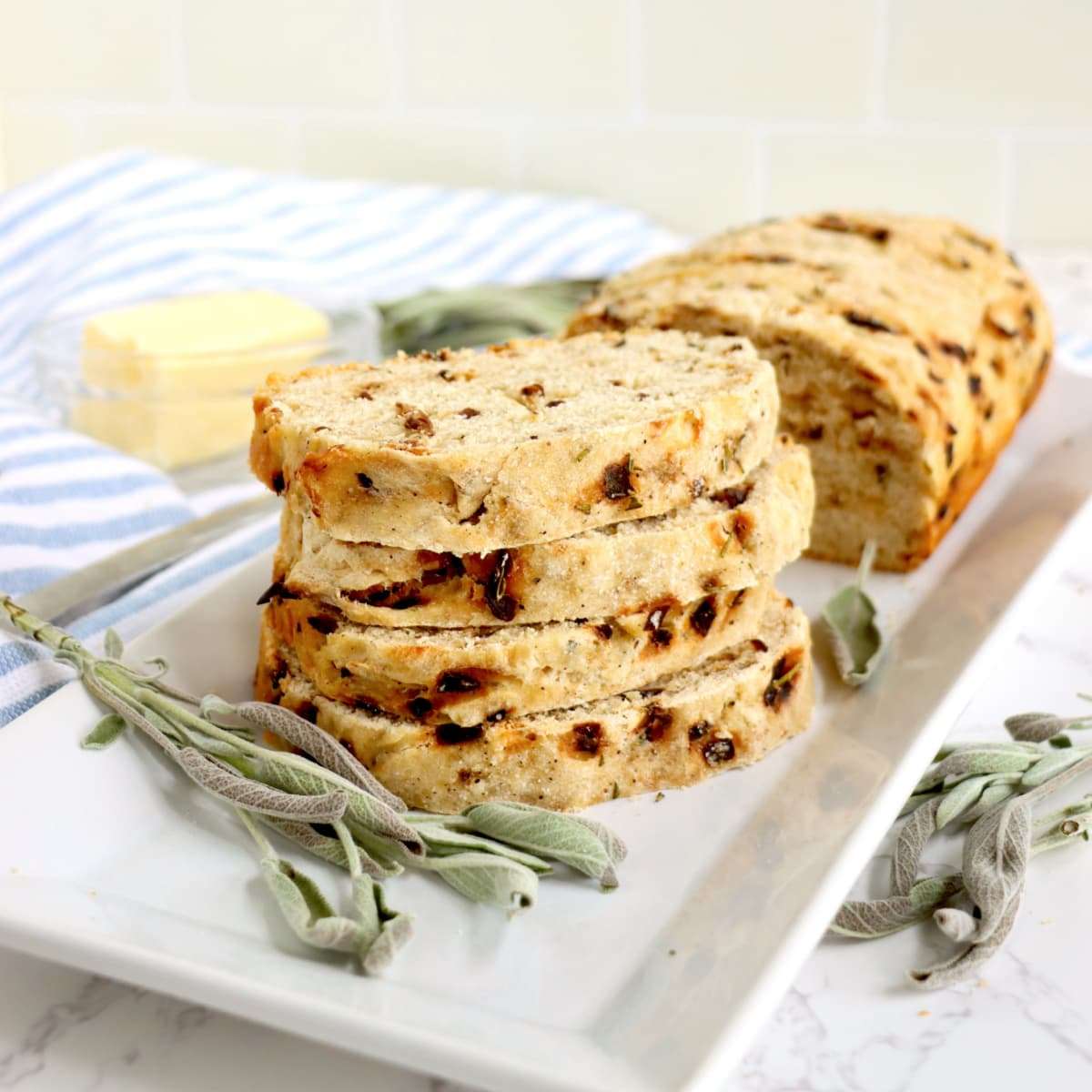
Sweet Onion Sage Bread Recipe
User Reviews
5.0
9 reviews
Excellent
-
Prep Time
30 mins
-
Cook Time
30 mins
-
Rise Time, divided
1 hr 35 mins
-
Total Time
2 hrs 50 mins
-
Servings
2
-
Calories
1356 kcal
Sweet Onion Sage Bread Recipe
Report
This sweet onion sage bread recipe has a flavor reminiscent of stuffing. It's a savory bread full of flavor, and it's so easy to make!
Share:
Ingredients
- 2 large red onions, chopped fine
- 2 teaspoons sage, dried, rubbed fine
- 2 teaspoons pepper
- 2 tablespoons olive oil
- 2 envelopes dry yeast
- 1 tablespoon sugar
- 1 ½ cups warm water
- 2 teaspoons salt
- 5 cups all purpose flour
- ¼ cup butter for greasing
For sprinkling on top of the bread
- 2 tablespoons sea salt or kosher salt or pickling salt
- 1 tablespoon black pepper, coarsely ground
- 2 tablespoons rosemary, dried, or herbes de provence, rubbed fine
Instructions
- Using your large skillet heat some olive oil, over medium heat, until it starts to shimmer or a drop of water flicked in it dances. Add finely chopped onions, sage and pepper. Stir regularly until onions are tender. Set aside and allow to cool.
- Using a small bowl combine yeast, sugar and warm water. Stir until dissolved. Let sit for between 10 and 15 minutes, until frothy add 1 tablespoon of olive oil and mix well.
- Next, using a very large bowl, combine flour and salt. Add yeast mixture and cooled onions. Mix well.
- Dust your workstation with flour and knead by hand for at least 5 minutes. Use more flour if needed to avoid the dough from sticking to your kneading surface.
- Lightly grease a big bowl with butter, large enough to hold your dough. I usually take a paper towel and put a bit of butter on the paper towel. Then I rub the butter all over the inside of the bowl. Sometimes I have to grab butter twice!
- Place dough inside your greased bowl and then flip the dough over. Using a brush totally coat the top surface of the dough with olive oil. Cover with a warm damp cloth and allow the dough to rise for 45 to 50 minutes in a warm, not hot place. I usually place it inside my oven that is turned off. Your dough should double in size. Do not leave your bread to rise too much longer or you could end up with a lot of air holes in your bread.
- Punch in the center of the dough to release air and divide the dough into two pieces. As equal as possible.
- Now shape into two loaves. I usually make them an oval shape but my husband prefers a longer, narrower loaf like shape. My best friend even braided a loaf! I wish I still had the picture!
- Grease a rimmed baking sheet with butter or even cooking spray. Once loaves are in position brush them each lightly with olive oil.
- In a small bowl combine black pepper, salt and rosemary or herbes de provence. Stir and sprinkle mixture all over the tops of the loaves. Leave loaves uncovered to rise for another 30 minutes.
- Preheat your oven to 350 degrees. Once heated, bake loaves for between 35 and 45 minutes. The crust must be a beautiful golden brown before you remove it from your oven. Remove from oven and allow your loaves to cool on a wire rack. Serve and enjoy every bite!
Notes
- Make sure your yeast has not expired or your bread will not rise.
- When you gently tap the bottom of the bread with your finger, near the end of baking, it should make a hollow sound when your bread is fully baked inside.
- If you have a thermometer insert it into the center of the loaf and check that the internal temperature is around 190-200°F (88-93°C).
- Take the time to sauté your finely chopped onions, sage, and pepper until onions are softened and caramelized before adding them to your dough to add flavor.
- Only allow the bread to rise for the exact times listed or you may end up with large air holes in your bread if left to rise longer.
- Use a food thermometer to ensure your water is around 140 degrees.
- If you don't have a food thermometer, test running hot water with the underside of your wrist, if it's just tolerable, it's generally the right temperature.
- Make sure your yeast has not expired or your bread will not rise.
- When you gently tap the bottom of the bread with your finger, near the end of baking, it should make a hollow sound when your bread is fully baked inside.
- If you have a thermometer insert it into the center of the loaf and check that the internal temperature is around 190-200°F (88-93°C).
- Take the time to sauté your finely chopped onions, sage, and pepper until onions are softened and caramelized before adding them to your dough to add flavor.
- Only allow the bread to rise for the exact times listed or you may end up with large air holes in your bread if left to rise longer.
- Use a food thermometer to ensure your water is around 140 degrees.
- If you don't have a food thermometer, test running hot water with the underside of your wrist, if it's just tolerable, it's generally the right temperature.
Nutrition Information
Show Details
Serving
1loaf
Calories
1356kcal
(68%)
Carbohydrates
259g
(86%)
Protein
37g
(74%)
Fat
18g
(28%)
Saturated Fat
3g
(15%)
Polyunsaturated Fat
3g
Monounsaturated Fat
11g
Sodium
2349mg
(98%)
Potassium
590mg
(17%)
Fiber
13g
(52%)
Sugar
12g
(24%)
Vitamin A
19IU
(0%)
Vitamin C
8mg
(9%)
Calcium
92mg
(9%)
Iron
15mg
(83%)
Nutrition Facts
Serving: 2Serving
Amount Per Serving
Calories 1356 kcal
% Daily Value*
| Serving | 1loaf | |
| Calories | 1356kcal | 68% |
| Carbohydrates | 259g | 86% |
| Protein | 37g | 74% |
| Fat | 18g | 28% |
| Saturated Fat | 3g | 15% |
| Polyunsaturated Fat | 3g | 18% |
| Monounsaturated Fat | 11g | 55% |
| Sodium | 2349mg | 98% |
| Potassium | 590mg | 13% |
| Fiber | 13g | 52% |
| Sugar | 12g | 24% |
| Vitamin A | 19IU | 0% |
| Vitamin C | 8mg | 9% |
| Calcium | 92mg | 9% |
| Iron | 15mg | 83% |
* Percent Daily Values are based on a 2,000 calorie diet.
Genuine Reviews
User Reviews
Overall Rating
5.0
9 reviews
Excellent
Other Recipes
You'll Also Love




Pork, Sage and Onion Stuffing Balls (Gluten Free, Dairy Free, Egg Free, Nut Free)
American, British
5.0
(18 reviews)