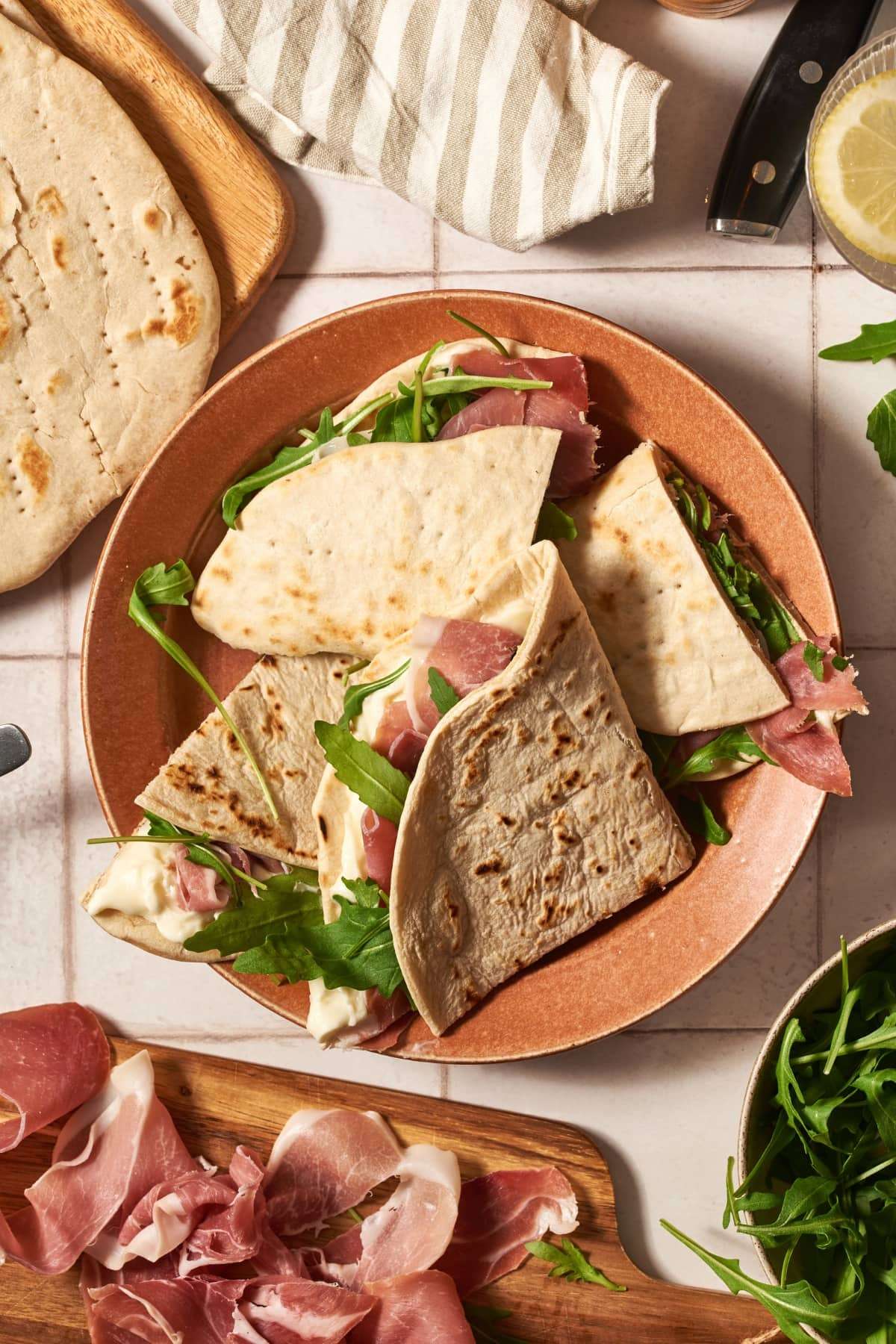
Traditional Romagnola piadina flatbread
User Reviews
5
Traditional Romagnola piadina flatbread
Description
The Traditional Romagnola piadina flatbread recipe uses a simple dough consisting primarily of flour, water, and rendered pork lard, which lends the flatbread a tender yet pliable texture. Baking powder provides a slight lift, and the resting period helps relax the dough for easier rolling. Once divided and rolled out, the thin rounds are cooked on a medium-high heated nonstick pan until they develop a light golden coloration. This method yields soft flatbreads ideal for wrapping or layering with savory or sweet fillings.
The dough's fat component is traditionally pork lard, but extra virgin olive oil can be substituted to create a slightly different flavor while maintaining a similar texture. The flexibility in fat choice allows home cooks to adapt to availability or dietary preference without significantly changing the flatbread's character. The recipe's instructions emphasize the importance of kneading to a non-sticky but soft consistency and resting the dough for at least 30 minutes, though refrigeration is possible if preparing ahead.
Piadina is typically served warmed and can be filled with a variety of ingredients, including cheeses, cured meats, and vegetables, making it a versatile flatbread suited for snacks, light meals, or street food. The simplicity of the dough lets the fillings shine while providing a chewy and tender foundation.
Ingredients
- 4 cups all-purpose flour
- ½ teaspoon baking powder
- ½ teaspoon salt
- 1 ¼ cups water lukewarm
- 1.80 .80 oz pork lard rendered
Instructions
- Pour all the flour onto a flat surface, making a well in the center.
- In a small bowl, mix together the baking powder and salt.
- Pour the salt and baking powder mixture and then the rendered pork lard (or extra virgin olive oil) and warm water into the center of the well and start mixing it together with a fork.
- Next knead the dough with your hands for about 10 minutes until quite smooth, uniform, and soft but not sticky (if it’s still sticky, add more flour).
- Make a smooth ball and cover the piadina dough with plastic wrap. Let it rest at least 30 minutes at room temperature (if the dough is being prepared more than 1 hour in advance, you can keep it in the fridge and, when needed, remove one hour before using it).
- Heat a large nonstick pan on medium-high heat.
- Divide the dough into about 5 smaller balls (about 140-150 grams per ball).
- On a flat work surface, use a rolling pin to roll out the dough into a large circle until it reaches the desired thickness (ideally about ⅙ inch) and is as perfectly round as possible. You can dust with flour if it sticks.
- Once the pan is hot, add a circle of dough, pricking it all over with a fork to avoid air bubbles.
- Cook for about 1-2 minutes for a thin piadina, 2-3 minutes for a thicker one, or however long it takes for brown spots to form on the bottom. Then flip the piadina and cook for about the same time on the other side.
- Remember that a piadina should be served hot, so it’s recommended to have your fillings ready (see below for filling ideas).
- Once cooked, you can serve the piadina immediately by placing your desired fillings on one side of the circle and then folding it into a half moon, or by cutting the piadina into triangles to use like pieces of bread.
Notes
- Rendered pork lard is traditional, but extra virgin olive oil can be used as a substitute in equal amounts for a variation in flavor.
- Allow the dough to rest at room temperature for at least 30 minutes to improve handling and texture; if refrigerated, bring it back to room temperature before shaping.
- Roll the dough to your preferred thickness; thinner results in crisper flatbreads, slightly thicker for a softer bite.
Nutrition Information
Show DetailsNutrition Facts
Serving: 4people
Amount Per Serving
Calories 565 kcal
% Daily Value*
| Serving | 150g | |
| Calories | 565kcal | 28% |
| Carbohydrates | 96g | 32% |
| Protein | 13g | 26% |
| Fat | 14g | 22% |
| Saturated Fat | 11g | 55% |
| Sodium | 297mg | 12% |
| Potassium | 184mg | 4% |
| Fiber | 3g | 12% |
| Sugar | 1g | 2% |
| Calcium | 40mg | 4% |
| Iron | 6mg | 33% |
* Percent Daily Values are based on a 2,000 calorie diet.
User Reviews
Overall Rating
5
You'll Also Love