Airy Baguette
User Reviews
5
Airy Baguette
Description
The Airy Baguette starts with mixing bread flour, water, yeast, and salt, followed by rest periods and incorporation of olive oil. The dough is developed through a series of stretch and folds every 10 minutes, four times total, to build gluten without heavy kneading. After shaping and greasing, it rests well during a cold fermentation phase lasting from one to three days, which enhances flavor and dough strength.
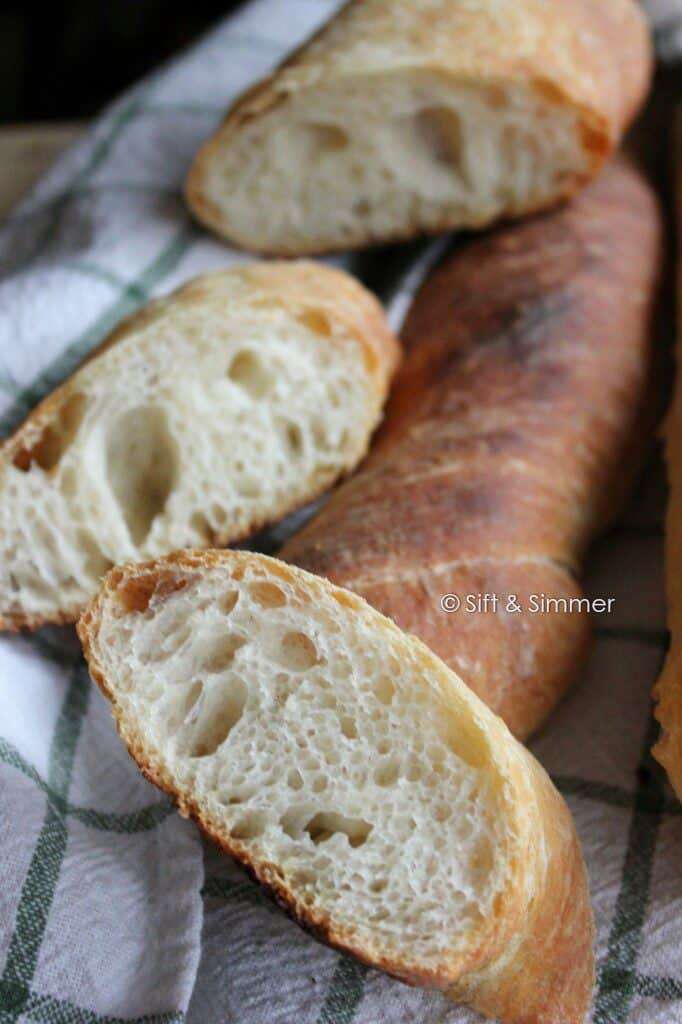
This method yields a baguette with a light, airy crumb characterized by many air bubbles, and a thin, crisp crust. The extended fermentation and gentle handling promote a chewy texture and subtle flavor development typical of artisanal baguettes.
Before baking, the dough is brought back to room temperature to activate the yeast and achieve optimal rise. Baking produces the baguette's characteristic golden crust and soft interior. This approach suits bakers aiming for authentic texture and flavor without intensive kneading.
Ingredients
- 1 ¼ teaspoon active dry yeast or instant yeast
- 450 ml water room temperature, filtered
- 5 g salt sea salt
- 567 g bread flour all-purpose flour, 20 oz
- 15 ml olive oil
Instructions
On day 1:
- In a very large bowl or container, combine the bread flour, water, yeast, and salt and give it a mix with a spatula until a dough comes together.
- Cover the dough and let it rest for 5 minutes.
- Add in the olive oil and mix it in to incorporate. Cover and rest for another 10 minutes.
- Using a sturdy spatula, stretch and fold the dough (take the top of the dough and fold it over to the bottom [North to South], and the rotate the bowl 90 degrees and repeat, until it's been folded over 4 times). Cover and let it rest for another 10 minutes.
- Repeat this stretch and fold process every 10 minutes for another 3 times. In total, the dough should be stretched and folded 4 times.
- Lightly grease the dough (and bowl), cover and place into the fridge for 1-3 days.
On the day you're ready to bake the bread:
- Remove the dough from the fridge 2-3 hour prior to baking to let the dough come up to room temperature. The dough should have lots of air bubbles in it now.
- Lightly grease your work surface.
- Tip the dough onto the work surface, being careful not to pop any air bubbles.
- Use a dough scraper to divide the dough into 3 or 4 pieces, depending on how large you want the baguettes.
If you don't have a baguette pan:
- Carefully stretch and twist each piece of dough and place onto a parchment lined baking sheet.
- Cover the baking sheet with a tea towel and let it rest for 1 hour in a warm location.
With baguette pan:
- Gather each piece of dough and form into a round ball. Create surface tension by gently rolling it until it's smooth, letting it rest seam-side up.
- Cover and let it rest for 15 minutes.
- Flatten the dough into a oblong shape and fold the top half down to the bottom edge and seal.
- Fold the bottom half up to the top edge and seal.Now fold the dough again, taking the top half down to the centre and seal.Repeat with the bottom half, folding it up to the centre, and gently roll to smooth out the baguette.
- Place the shaped baguette onto a well of the baguette pan.
- Cover with a tea towel and let it rest for about 1 hour, in a warm location.
- Preheat oven to 500°F/260°C.
- Place the baguettes into the oven and quickly spray them with water.
- Close the door and bake for 10 minutes at 500°F/260°C.
- Reduce the oven to 450°F/232°C and bake for another 12-15 minutes, until golden in colour. (If your oven runs hot, place a piece of aluminum foil over top to prevent the baguettes from turning too dark).
- Remove from oven and enjoy.
Nutrition Information
Show DetailsNutrition Facts
Serving: 12Serving
Amount Per Serving
Calories 186 kcal
% Daily Value*
| Calories | 186kcal | 9% |
| Carbohydrates | 35g | 12% |
| Protein | 6g | 12% |
| Fat | 2g | 3% |
| Saturated Fat | 1g | 5% |
| Sodium | 165mg | 7% |
| Potassium | 59mg | 1% |
| Fiber | 1g | 4% |
| Sugar | 1g | 2% |
| Vitamin A | 1IU | 0% |
| Vitamin C | 1mg | 1% |
| Calcium | 9mg | 1% |
| Iron | 1mg | 6% |
* Percent Daily Values are based on a 2,000 calorie diet.
User Reviews
Overall Rating
5
You'll Also Love