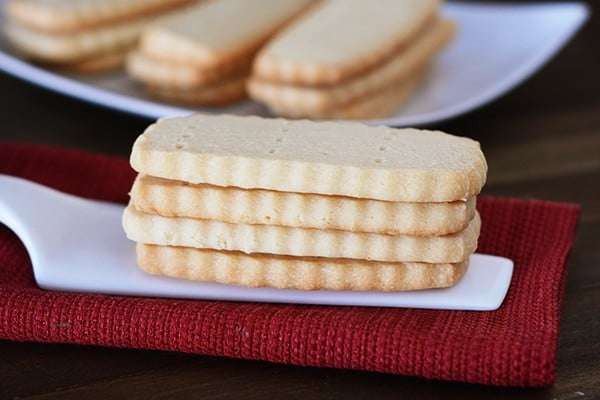
Amazing Scottish Shortbread
User Reviews
4.9
Amazing Scottish Shortbread
Description
The Amazing Scottish Shortbread recipe combines room temperature salted butter with vanilla extract and powdered sugar, creaming them until smooth to start. Adding all-purpose flour, cake flour, and salt gently mixes to form a soft dough. Cake flour contributes to a lighter, tender shortbread texture compared to using only all-purpose flour.
The dough is shaped into a roughly 1.5-inch-high rectangular slab, chilled until firm, then sliced into thin 1/4-inch strips before baking. This chilling not only firms the dough but also helps maintain clean, precise slices for even baking. The end shortbread is thin and delicate, with a crisp bite and buttery flavor.
This shortbread can be served as a simple tea-time cookie or dessert accompaniment. Variations include substituting rice flour for cake flour to achieve a somewhat lighter, crispier cookie, or cutting the shortbread thicker—up to 3/4-inch slices—with a corresponding increase in baking time. Proper chilling and gentle mixing maintain the tender crumb.
Storage recommendations include refrigerating the dough for several days if needed before baking, allowing flexibility around preparation timing.
Ingredients
- 4 ticks butter room temperature, salted
- 1 tablespoon vanilla extract
- 1 ½ cups powdered sugar
- 2 ½ cups all-purpose flour
- 1 cup cake flour
- ¼ teaspoon salt
Instructions
- In a large bowl (or in the bowl of a stand mixer), beat the butter, vanilla and powdered sugar together with an electric mixer (use the paddle attachment on a stand mixer, if using) until combined.
- Gradually add the all-purpose flour, cake flour and salt and mix until just combined (don't over mix the dough).
- Press the dough into a rectangle shape about 1 1/2 inches high (see pictures below) on a parchment lined baking sheet. Cover with plastic wrap and refrigerate until firm, about an hour. The dough can e refrigerated for several days. Alternately, if you want to cut the shortbread into different shapes (other than a thin rectangle), press the dough into a disc-shape and cover with plastic wrap and refrigerate (similar to how you would do it if refrigerating sugar cookie dough or a pie crust).
- Once firm, take a large, sharp knife or the straight edge of a bench scraper and cut the long rectangle dough into 1/4-inch slices (again, see picture below). If the cookies aren't perfectly straight not he edges, press them into an even shape or trim the edges. Otherwise, roll the dough out on a lightly floured countertop to about 1/4-inch thickness and cut into desired shapes.
- Place the cut cookies about 1-inch apart on a parchment or silpat-lined baking sheet. Prick each cookie a few times with the tines of a fork.
- Preheat the oven to 350 degrees F. Bake the cookies for 15-18 minutes until lightly golden around the edges, increasing or decreasing the baking time as needed. Let the cookies sit on the baking sheets for 2-3 minutes after removing from the oven before sliding to a cooling rack to cool completely.
- The shortbread can be stored covered at room temperature for several days.
Notes
- Cake flour makes the shortbread lighter and more tender; a DIY cake flour substitution is available if needed.
- Substituting rice flour for cake flour will create a lighter, crisper texture in the shortbread.
- The dough can be sliced thin for delicate shortbread or thicker slices (up to 3/4 inch); thicker slices require longer baking time, nearly doubled.
- Dough can be refrigerated for several days before baking, allowing for flexible preparation.
Nutrition Information
Show DetailsNutrition Facts
Serving: 24or so depending on size
Amount Per Serving
Calories kcal
% Daily Value*
| Serving | 1 Shortbread | |
| Calories | 232kcal | 12% |
| Carbohydrates | 21g | 7% |
| Protein | 2g | 4% |
| Fat | 15g | 23% |
| Saturated Fat | 10g | 50% |
| Cholesterol | 40mg | 13% |
| Sodium | 159mg | 7% |
| Fiber | 1g | 4% |
| Sugar | 7g | 14% |
* Percent Daily Values are based on a 2,000 calorie diet.
User Reviews
Overall Rating
4.9
You'll Also Love