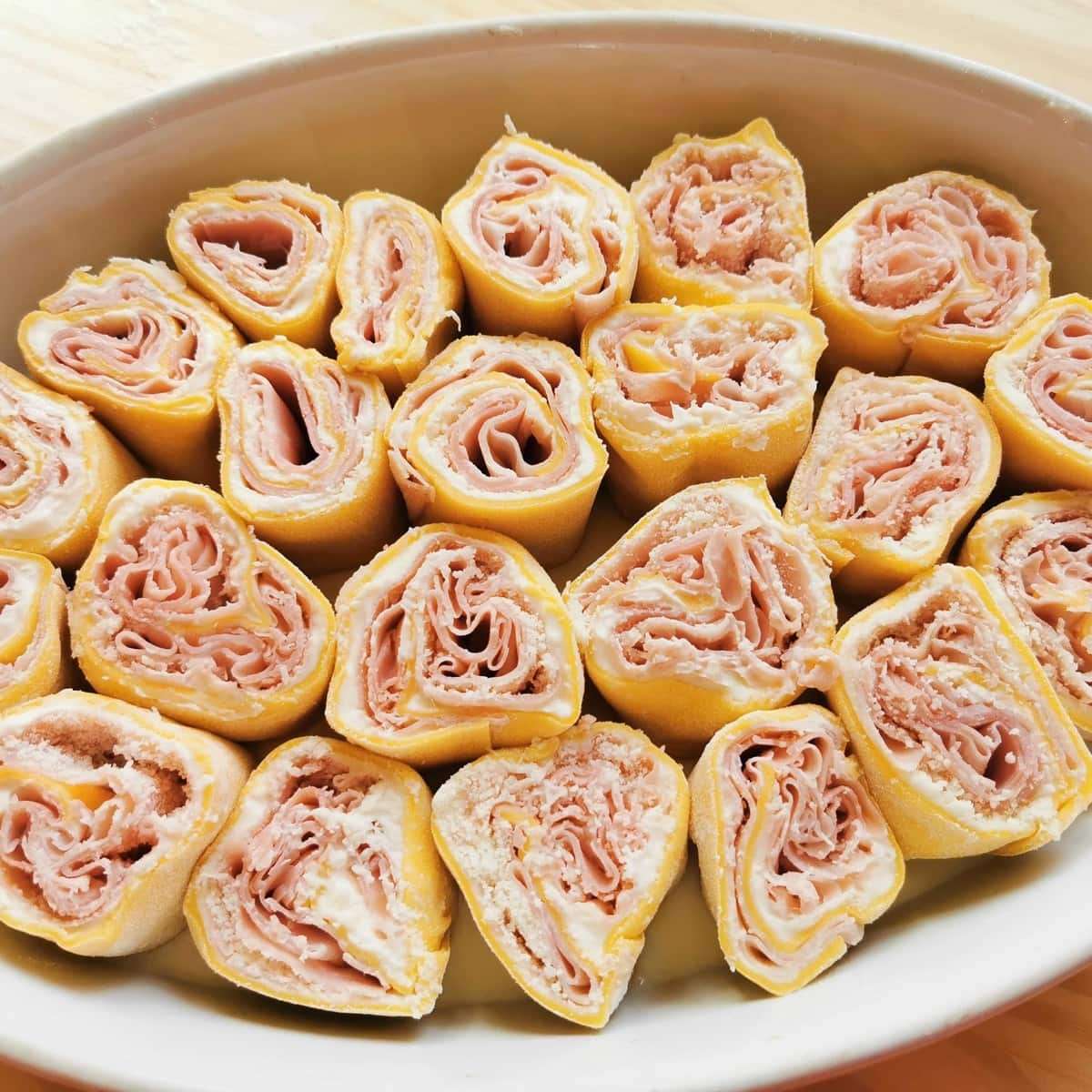
Baked Pasta Roses (pasta rosettes)
User Reviews
5
-
Prep Time
20 mins
-
Cook Time
35 mins
-
Total Time
55 mins
-
Servings
6
-
Calories
759 kcal
-
Course
Main Course
-
Cuisine
Italian
Baked Pasta Roses (pasta rosettes)
Description
Baked Pasta Roses involve rolling strips of thin pasta sheets around a mixture of soft cheese and ham to form rosettes. These pasta rosettes are placed snugly in a dish, creating a flower-like arrangement. A béchamel sauce made from butter, flour, milk, and seasoned with nutmeg and pepper is poured over the pasta to add creaminess and moisture during baking.
The homemade lasagne dough includes eggs and flour kneaded into a smooth, elastic dough and rolled thin, although dried sheets can be used after blanching. The filling balances the mild, tangy flavor of stracchino cheese (or substitutes like ricotta or mascarpone) with slices of ham, adding saltiness and texture.
This dish bakes until the pasta is tender and sauce bubbly, creating individual spirals that hold their shape and can be served in portions. It pairs well with a light salad or as a festive entrée suitable for gatherings or special dinners.
Fresh pasta sheets don’t require preboiling if thin but can be quickly blanched if uncertain about doneness. Cheeses such as Emmental or Asiago may be used to vary the flavor. Vegetarian versions can replace ham with vegetables like spinach or mushrooms and substitute vegetarian parmesan cheese.
Ingredients
Ingredients for roses
- 9 oz stracchino cheese or ricotta, mascarpone, fontina etc
- 3.5 oz cooked ham or prosciutto crudo (parma ham, thin slices
- 5-6 lasagne sheets pasta quantity depends on how thick you cut the roses. I used 4 large homemade lasagne sheets more than double the size of a standard pasta sheet, fresh or dried, 8x18 cm (3.5x7in
- 2.5 oz Parmesan Cheese grated, Parmigiano style
Ingredients for béchamel
- 2.5 oz all-purpose flour or Italian '00' flour
- 3 cups milk fresh
- nutmeg
- salt to taste
- black pepper to taste
- 2.5 oz butter unsalted
Ingredients for homemade lasagne sheets
- 4 egg large
- 14 oz Italian '00' flour or all purpose flour, soft wheat
- salt a large pinch.
Instructions
How to make homemade lasagne pasta sheets
- Sift the flour into a bowl. Beat the eggs and add to the flour with a pinch of salt.
- Mix the eggs and flour together using a fork until the eggs are well incorporated in the flour.
- Continue mixing the flour and eggs together using your hands until you have the start of a dough that doesn't stick to the sides of the bowl.
- Turn the dough out onto a floured work surface and knead using the heel of your hands for about 7-10 minutes until you have a relatively smooth elastic dough.
- Roll the dough into a ball and seal it in cling film. Leave it to rest for 30 minutes.
- After 30 minutes. Cut ⅕ of the dough off and reseal the rest. Use a rolling pin or the heel of your hand to flatten the piece of dough enough to pass it through a pasta rolling machine. You can also just continue using a rolling pin to roll the dough out to the required thickness and size.
- If using a pasta machine, pass the dough 2-3 times through the widest setting, folding it into thirds each time. Then pass it through the next 2-3 settings depending on what size you want it. The pasta sheets need to be quite thin. (3mm or 1/10 in).
- In order to get larger sheets, it's better to finish rolling out using a rolling pin on a floured work surface. This is what I did, as my pasta machine doesn't produce wide enough sheets.
Make the béchamel.
- Melt the butter in a non-stick saucepan over a low heat. Add the flour and stir until you have a smooth paste.
- Add the milk a little at a time and continue to stir until the sauce starts to thicken. Add salt, pepper and nutmeg to taste. You can also add grated Parmigiano if you desire.
- Remove from the heat and allow to cool covered with cling film. If your bechamel seems lumpy whisk with an immersion blender!
Make the pasta roses and bake them.
- Put a fresh pasta sheet onto a floured piece of baking paper. Cover the pasta with a thin layer of stracchino cheese and sprinkle grated Parmigiano on top of the stracchino. Then cover with thin ham slices.
- If you aren't using a soft creamy cheese, cover one edge of the pasta sheet with a spoonful of béchamel to prevent the pasta rolls from opening. The béchamel acts like a glue.
- Roll the sheet into a swiss roll shape. If it's very long cut it in half. If you have the time, wrap the rolls in the baking paper and leave in the fridge for an hour or more. This makes them easier to cut but isn't obligatory.
- Repeat the filling process with all the pasta sheets and the rest of the ham and cheese.
- Coat the bottom of an oven dish with bechamel. Cut the pasta rolls using a very sharp knife into 3cm pieces (1.2in) and place side by side in the oven dish.
- Pour the rest of the bechamel over the pasta roses and sprinkle with parmigiano.
- Cover with aluminium foil and cook at 180° in a preheated oven for 15 minutes. Remove the aluminium foil and cook for another 10-15 minutes until the top becomes golden and crispy.
- Serve with extra grated parmigiano and chopped parsley if desired
Notes
- Dried lasagna sheets require brief boiling and cooling before rolling into roses, while fresh sheets can often be used without pre-cooking if thin enough.
- Various soft cheeses can be used in place of stracchino; choose according to your preferred flavor and texture.
- Vegetarian versions can swap ham for vegetables like spinach or mushrooms and use vegetarian Parmesan alternatives.
- Adjust the rolling direction and size of pasta sheets to control the number and size of pasta roses formed.
Nutrition Information
Show DetailsNutrition Facts
Serving: 6Serving
Amount Per Serving
Calories 759 kcal
% Daily Value*
| Calories | 759kcal | 38% |
| Carbohydrates | 85g | 28% |
| Protein | 30g | 60% |
| Fat | 33g | 51% |
| Saturated Fat | 17g | 85% |
| Polyunsaturated Fat | 3g | 18% |
| Monounsaturated Fat | 10g | 50% |
| Trans Fat | 0.4g | 20% |
| Cholesterol | 190mg | 63% |
| Sodium | 501mg | 21% |
| Potassium | 450mg | 10% |
| Fiber | 3g | 12% |
| Sugar | 7g | 14% |
| Vitamin A | 939IU | 19% |
| Calcium | 415mg | 42% |
| Iron | 5mg | 28% |
* Percent Daily Values are based on a 2,000 calorie diet.
User Reviews
Overall Rating
5
You'll Also Love