Bisi Bele Bath Recipe (Karnataka Style)
User Reviews
4.8
-
Prep Time
1 hr
-
Cook Time
20 mins
-
Total Time
1 hr 20 mins
-
Servings
6
-
Calories
389 kcal
-
Course
Main Course
-
Cuisine
Indian
Bisi Bele Bath Recipe (Karnataka Style)
Description
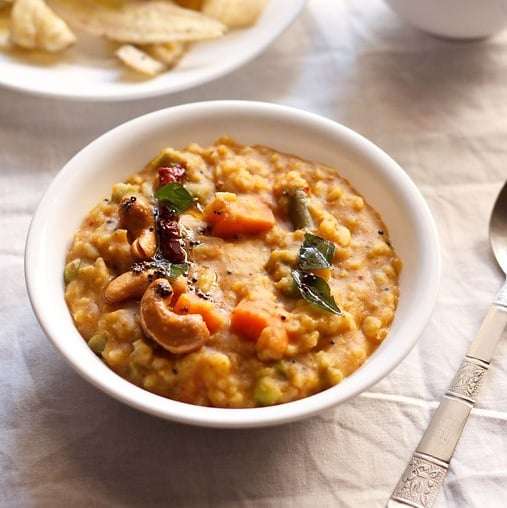
"Bisi Bele Bath Recipe (Karnataka Style)" combines cooked sona masuri rice with peanuts, well-cooked tur dal lentils, and assorted vegetables like carrot, green beans, peas, eggplant, onion, and tomato. Tamarind soaked and extracted adds a tangy note, while a special bisi bele bath spice powder imparts warmth and complexity. The rice and peanuts are cooked together, lentils pressure-cooked with turmeric, and vegetables simmered in tamarind water with seasoning until tender.
The dish is finished with a tempering of ghee or oil, mustard seeds, dried red chilies, curry leaves, hing, and cashews, contributing aromatic and textural contrasts. The final dish has a thick, porridge-like consistency with a blend of spicy, tangy, and nutty flavors typical of this traditional Karnataka preparation.
Bisi Bele Bath serves as a main meal, especially comforting in cooler weather or as a wholesome one-pot lunch or dinner option. It pairs naturally with papad or pickle as accompaniments.
Notes indicate flexibility in rice variety and vegetable choice, substitution of ghee with oil, and that the rice and peanuts can be cooked either in a pan, pressure cooker, or Instant Pot with adjusted water amounts. Adding jaggery can balance the tanginess if preferred.
Ingredients
For cooking rice
- 1 cup rice (I used sona masuri rice)
- ¼ cup peanuts - raw
- ¼ teaspoon rock salt (edible and food grade) or regular salt, add as required
- 2.5 cups water - for cooking the rice in a pan
For cooking lentils
- ¾ cup tur dal (tuvar dal or pigeon pea lentils)
- ½ teaspoon turmeric powder
- 2 cups water - for cooking lentils in a stovetop pressure cooker
For cooking vegetables
- 1 carrot - medium-sized, 100 to 120 grams
- 18 to 20 green beans 80 to 100 grams, French beans
- ½ cup green peas - 60 to 70 grams, fresh or frozen
- 3 to 4 eggplant small sized eggplants, 80 to 100 grams
- 1 onion - medium-sized, or 2 to 3 shallots, 80 to 100 grams
- 1 tomato - medium-sized, 80 to 100 grams
- 1 tablespoon tamarind (tightly packed) soaked in ½ or ⅔ cup warm water
- 2 to 2.5 cups water - for cooking the vegetables
- 1 cup water - to be added later, add as needed
- 3 tablespoons bisi bele bath powder mixed in 1 cup water
- ¼ teaspoon rock salt (edible and food grade) or regular salt, for cooking the vegetables
- 1 teaspoon rock salt (edible and food grade) or regular salt, added later or add as required
- 2 tablespoons desiccated coconut - unsweetened
For tempering
- 3 to 4 tablespoon ghee or oil
- 1 or 2 marathi moggu (kapok buds), optional
- 1 teaspoon mustard seeds
- 2 to 3 byadagi chillies or dry kashmiri red chillies or dry red chilies
- 12 to 15 curry leaves
- ¼ teaspoon asafoetida (hing)
- 18 to 20 cashews
Instructions
Cooking rice
- Rinse the rice and peanuts a couple of times in water. Take them in a pan and pour 2.5 cups water over them.
- Soak both rice and peanuts for 20 to 25 mins. Later add the salt.
- Keep the pan the stovetop and cook the rice on medium to medium-high heat.
- If required, then you can add some more water while cooking the rice.
- Bring to a boil and then lower the heat. Simmer till the rice grains are tender and cooked well and all the water has been absorbed. The peanuts would also cook well. Cover and set aside.
Cooking lentils and veggies
- Soak 1 tablespoon tightly packed tamarind in ½ or ⅔ cup warm water for 25 to 30 mins.
- Later squeeze and extract the tamarind pulp in the soaked water. Strain and set aside.
- In a pressure cooker, add rinsed tur dal, turmeric powder and 2 to 2.5 cups water.
- Pressure cook for 8 to 9 whistles on medium heat or until the dal is cooked soft and mushy.
- Once the pressure drops on its own in the cooker, then only open the lid. Mash the dal with a spoon and set aside.
- In another pan, take all the chopped veggies and ¼ teaspoon salt. Pour 2 cups water and stir to combine.
- Cover and allow the veggies to cook till they are fork tender but still retain their shape.
Making bisi bele bath
- Now in the cooker containing the mashed dal, add the cooked rice and peanuts.
- Then add the cooked vegetables along with its stock. Stir lightly to mix.
- Add 1 cup water. Add the prepared tamarind pulp. Mix everything well taking care the rice grains do not break.
- Now in another pan or bowl, take the 3 tablespoons of the bisi bele bath masala and 1 cup water.
- Stir to mix very well. The masala tends to stick to the back of the spoon while stirring, so scrape it off and add to the mixture.
- Now add this bisi bele bath powder and water mixture in the cooker.
- Add desiccated coconut. Add 1 teaspoon salt or as required. Stir and mix.
- Keep the cooker without the lid on the stove top and simmer on a low heat for about 15 to 20 mins. Add more water if required.
- Keep on stirring often. The raw aroma of the tamarind has to go away and all the flavors should be blended well. Cover and set aside once done.
Tempering bisi bele bath
- In a another pan or the tadka (tempering) pan, heat ghee or oil first. Crackle the mustard seeds and then temper the curry leaves, marathi moggu, dry red chilies, cashews and asafoetida till the dry red chilies change color and the cashews turn a light golden. Don't burn the spices.
- Pour this tempering in the prepared bisi bele bath. Stir and cover the cooker with its lid for about 5 mins, so that the tempering flavors infuse in the bisi bele bath.
- Later serve the bisi bele bath with potato wafers or banana chips/wafers or fried or roasted papads. While serving you can top with some ghee if you prefer.
Notes
- Use short- or medium-grain rice varieties for best texture; sona masuri is recommended.
- Prefer unpolished tur dal for the lentils for authentic flavor and texture.
- Adjust spice and salt to taste; add jaggery to balance tanginess if desired.
- Omit cashews if unavailable.
- Ghee can be substituted with oil for tempering.
- Vegetables such as carrots, turnips, peas, green beans, kohlrabi, capsicum, chayote, cauliflower, or broccoli can be included.
- Rice and peanuts can be cooked in pressure cooker or Instant Pot with adjusted water quantities.
Nutrition Information
Show DetailsNutrition Facts
Serving: 6Serving
Amount Per Serving
Calories 389 kcal
% Daily Value*
| Calories | 389kcal | 19% |
| Carbohydrates | 55g | 18% |
| Protein | 12g | 24% |
| Fat | 15g | 23% |
| Saturated Fat | 7g | 35% |
| Polyunsaturated Fat | 2g | 12% |
| Monounsaturated Fat | 5g | 25% |
| Cholesterol | 19mg | 6% |
| Sodium | 630mg | 26% |
| Potassium | 571mg | 12% |
| Fiber | 10g | 40% |
| Sugar | 9g | 18% |
| Vitamin A | 2223IU | 44% |
| Vitamin B1 (Thiamine) | 0.2mg | |
| Vitamin B2 (Riboflavin) | 0.1mg | |
| Vitamin B3 (Niacin) | 26mg | |
| Vitamin B6 | 0.3mg | |
| Vitamin C | 54mg | 60% |
| Vitamin E | 1mg | |
| Vitamin K | 19µg | |
| Calcium | 75mg | 8% |
| Vitamin B9 (Folate) | 293µg | |
| Iron | 2mg | 11% |
| Magnesium | 71mg | 18% |
| Phosphorus | 156mg | |
| Zinc | 1mg |
* Percent Daily Values are based on a 2,000 calorie diet.
User Reviews
Overall Rating
4.8
You'll Also Love