Capsicum Chutney Recipe (Red Bell Pepper Chutney)
User Reviews
5
Capsicum Chutney Recipe (Red Bell Pepper Chutney)
Description
The preparation begins by frying split urad dal and chana dal in sesame oil over a low flame until golden, avoiding burning to preserve nutty flavor. Sesame seeds are then added and cooked until crackling, followed by incorporating dried red chili, curry leaves, and asafoetida to infuse the oil with aromatic notes.
Next, chopped red bell peppers are added and sautéed gently with salt until softened, typically taking 6 to 7 minutes. Desiccated coconut and tamarind are stirred in to add sweetness and a tangy depth, though fresh coconut may be substituted for moisture variation. Optionally, sugar or jaggery can be added to balance flavors more toward sweet.
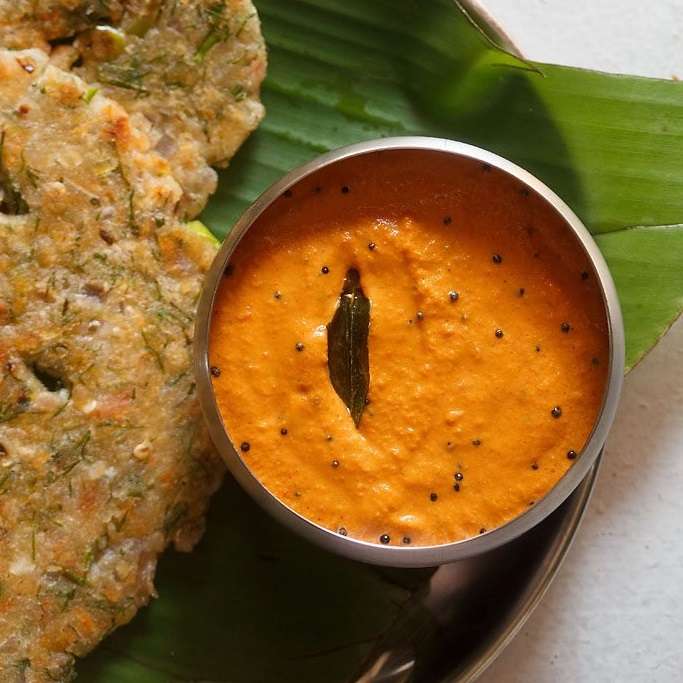
This chutney is not very spicy by default but can be adjusted by increasing the number of red chilies during frying. The final result is a coarse-textured chutney with layers of nuttiness, slight heat, and sweetness.
It pairs well with South Indian meals, dosa, idli, or as a spread to complement a variety of dishes.
Ingredients
main ingredients
- 1 tablespoon sesame oil (gingelly oil)
- 1 teaspoon urad dal (split and husked black gram)
- 1 teaspoon chana dal (split and husked bengal gram)
- 1 tablespoon sesame seeds
- 1 dry red chili
- 1 pinch asafoetida (hing)
- 6 to 7 curry leaves
- 175 grams red bell pepper or 1.5 cups chopped red capsicum
- ¼ cup desiccated coconut
- ½ teaspoon tamarind
- ⅓ cup water or add as required
- salt as required
for tempering
- 2 teaspoons sesame oil (gingelly oil)
- ½ teaspoon mustard seeds
- 4 to 5 curry leaves
- 1 pinch asafoetida (optional)
Instructions
Frying lentils and sesame seeds
- Heat a pan and keep the flame to a low. Add sesame oil. When the oil becomes hot, add urad dal (split and husked black gram) and chana dal (split and husked bengal gram).
- On a low flame stirring often fry both the lentils, till they turn golden. Make sure not to burn them.
- Then add sesame seeds.
- Mix and fry till the sesame seeds start crackling.
- Then add the red chili, curry leaves and a pinch of asafoetida (hing). Mix very well. This is not a spicy chutney and the taste is on sweeter side. However if you want to make it spicy you then you can increase the number of red chillies now.
Sautéing capsicum
- Next add chopped red capsicum (shimla mirch). Mix well.
- Add salt as required. Mix again and saute capsicum on a low flame.
- Saute capsicum till they soften for about 6 to 7 minutes on a low flame.
- Then add desiccated coconut and dried tamarind. You can also add fresh coconut instead of desiccated coconut. A bit of sugar or jaggery can also be added. You can also add roasted peanuts to make it more healthy and filling.
- Mix very well and switch off the flame.
Blending chutney
- Let the mixture become warm or cool down at room temperature. Then add it in a blender or food processor or grinder jar along with water.
- Blend till smooth.
- Remove the chutney in a bowl. Scrape of the sides and bottom of the blender or grinder jar and add the remaining chutney in the same bowl.
- If you want, you can even add some water and then swirl the jar. This way the chutney at the bottom and sides of the jar gets mixed with the water. But do note that not to add too much water as then the chutney will become thin.
Tempering capsicum chutney
- Heat sesame oil in the same pan and add mustard seeds.
- Once the mustard seeds crackle, add curry leaves and a pinch of asafoetida (optional). Mix and stir.
- Pour all of the tempering in the chutney. Mix well.
- Serve capsicum chutney with idli, dosa, adai or vada or steamed rice. You can also serve it with akki roti. Leftover chutney can be refrigerated and it stays good for 1 to 2 days.
Nutrition Information
Show DetailsNutrition Facts
Serving: 5Serving
Amount Per Serving
Calories 99 kcal
% Daily Value*
| Calories | 99kcal | 5% |
| Carbohydrates | 6g | 2% |
| Protein | 2g | 4% |
| Fat | 8g | 12% |
| Saturated Fat | 3g | 15% |
| Polyunsaturated Fat | 2g | 12% |
| Monounsaturated Fat | 2g | 10% |
| Sodium | 237mg | 10% |
| Potassium | 114mg | 2% |
| Fiber | 2g | 8% |
| Sugar | 2g | 4% |
| Vitamin A | 1199IU | 24% |
| Vitamin B1 (Thiamine) | 1mg | |
| Vitamin B2 (Riboflavin) | 1mg | |
| Vitamin B3 (Niacin) | 23mg | |
| Vitamin B6 | 1mg | |
| Vitamin C | 85mg | 94% |
| Vitamin E | 1mg | |
| Vitamin K | 3µg | |
| Calcium | 34mg | 3% |
| Vitamin B9 (Folate) | 254µg | |
| Iron | 1mg | 6% |
| Magnesium | 16mg | 4% |
| Phosphorus | 32mg | |
| Zinc | 1mg |
* Percent Daily Values are based on a 2,000 calorie diet.
User Reviews
Overall Rating
5
You'll Also Love