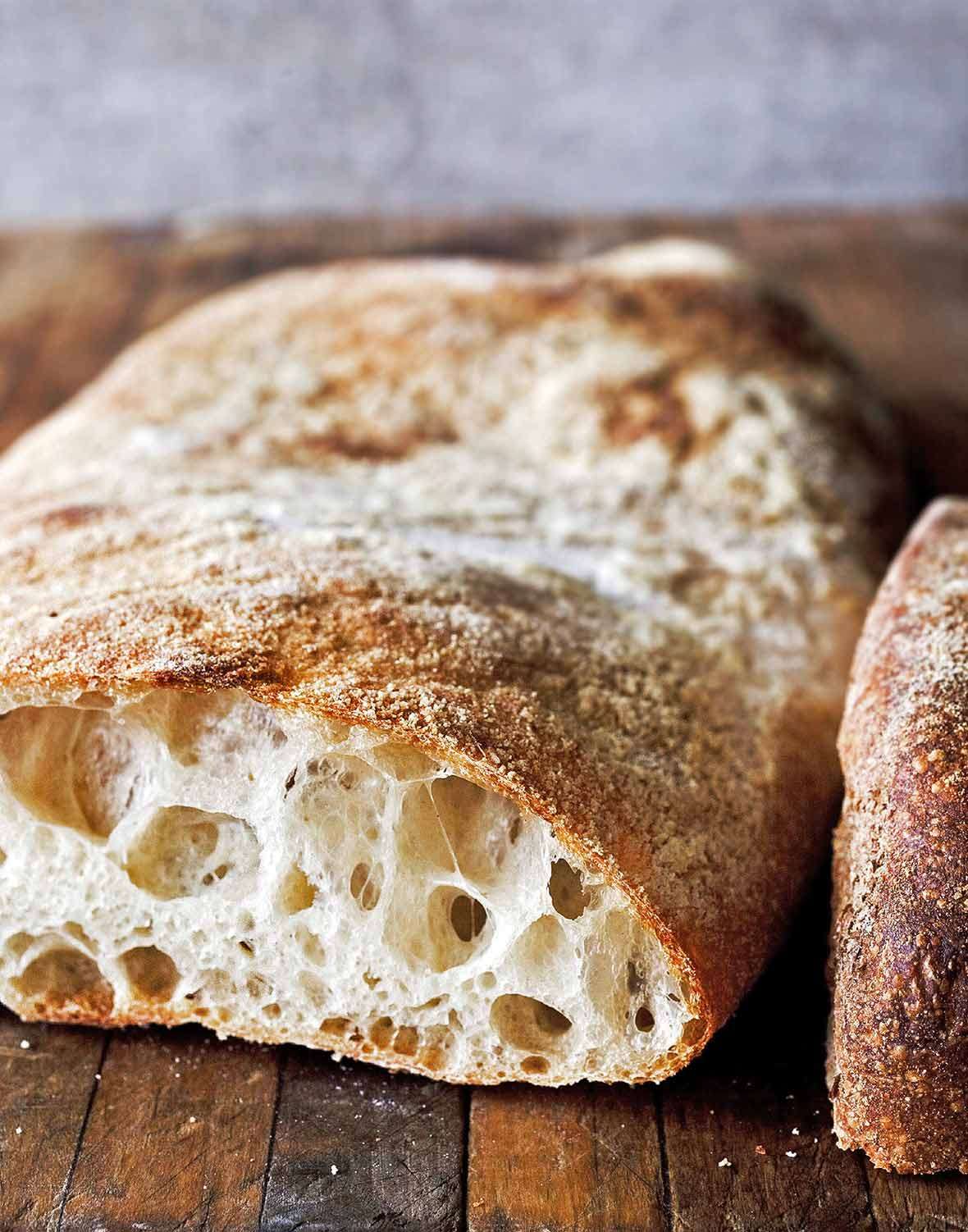
Ciabatta
User Reviews
4.7
Ciabatta
Description
This Ciabatta bread recipe relies on a pre-fermented biga and a very wet dough mixed using a stand mixer or food processor. The flour and salt are introduced after the yeast and milky mixture blend with the biga, then kneaded briefly. The dough’s intense stickiness challenges handling, but wet hands and minimal flour during shaping help preserve the bread's light, open crumb structure.
The dough is shaped into flat rectangular loaves on parchment and allowed to rise until puffy but not fully doubled. Despite their somewhat flat and loose appearance before baking, these loaves develop a crisp crust and airy crumb in the oven. Careful following of the recipe and handling instructions prevents overly dense or tough bread.
Ciabatta is suited for sandwiches and dipping, offering a chewy, moist interior with a golden crust. Because of the dough’s unusual characteristics, it’s recommended to use the outlined techniques and tools for the best results. Future attempts will bring more ease as familiarity with handling sticky dough grows.
The recipe discourages baking the bread by hand due to difficulties managing the dough's stickiness and a tendency to add too much flour, which negatively impacts texture.
Ingredients
- 1 teaspoon active dry yeast
- 5 tablespoons (2 1/2 ounces) milk warm
- 1 cup plus 3 tablespoons (9 1/2 ounces) water at room temperature (if using a food processor, use cold water)
- 1 tablespoon (1/2 ounce) olive oil plus more for the bowl
- 2 very full cups (17 1/2 ounces) biga rested for 12 hours
- 3 3/4 cups (17 1/2 ounces) all-purpose flour plus more for the work surface, unbleached
- 1 tablespoon (1/2 ounce) salt
- cornmeal
Instructions
- If making the bread in a stand mixer: Stir the yeast into the milk in a mixer bowl; let stand until creamy, about 10 minutes. Add the water, oil, and biga (be sure to weigh the biga, don't just measure it by volume) and mix with the paddle until blended. Mix the flour (be sure to weigh the flour, don't just measure it by volume) and salt, add to the bowl, and mix for 2 to 3 minutes. Change to the dough hook and knead for 2 minutes at low speed, then 2 minutes at medium speed. The dough will be very sticky. Knead briefly on a well-floured surface, adding as little flour as possible, until the dough is still sticky but beginning to show evidence of being velvety, supple, springy, and moist. (If the dough seems almost impossibly sticky to work with, reread the headnote above from author Carol Field.) If making the bread in a food processor: Stir the yeast into the milk in a large bowl; let stand until creamy, about 10 minutes. Add 1 cup plus 3 tablespoons of cold water, the oil, and the biga (be sure to weigh the biga, don't just measure it by volume) and mix, squeezing the biga between your fingers to break it up. Place the flour (be sure to weigh the flour, don't just measure it by volume) and salt in the food processor fitted with the dough blade and pulse several times to sift the ingredients. With the machine running, pour the biga mixture through the feed tube and process until the dough comes together. The dough will be very sticky. Process about 45 seconds longer to knead. Finish kneading on a well-floured surface until the dough is still sticky but beginning to show signs of being velvety, supple, moist, and springy. (If the dough seems almost impossibly sticky to work with, reread the headnote above from author Carol Field.)
- Place the dough in an oiled bowl, cover with plastic wrap, and let rise at room temperature until doubled, about 1 1/4 hours. The dough should be full of air bubbles, supple, elastic, and sticky.
- Turn the dough onto a generously floured surface and cut it into 4 equal portions. Roll each portion into a cylinder, then stretch each cylinder into a rectangle about 10 by 4 inches, pulling with your fingers to get each portion of dough long and wide enough.
- Generously flour 4 pieces of parchment paper placed on peels or upside-down baking sheets. Place each loaf, seam side up, on a piece of parchment. Dimple the loaves vigorously with your fingertips or knuckles so that they won’t rise too much. The dough will look heavily pockmarked, but it is very resilient, so don’t be concerned.
- Cover the loaves loosely with damp towels and let rise until puffy but not doubled in size, 1 1/2 to 2 hours. The loaves will look flat and definitely unpromising, but rest assured that they will rise more in the oven.
- About 30 minutes before baking, preheat the oven to 425°F (220°C) and slide 2 baking stones on the center rack to heat. [Editor's Note: If, like us, you haven’t yet bought yourself a baking stone, flip some large cast-iron skillets upside down and bake the bread on their bottoms. It ought to do the trick. It has for us.]
- Just before baking the bread, sprinkle the stones with cornmeal. Carefully invert each loaf onto a stone. If the dough sticks a bit to the parchment, just gently work it free from the paper. If you need to, you can leave the paper on and remove it 10 minutes into baking.
- Bake the ciabatta for a total of 20 to 25 minutes, spraying the oven 3 times with water in the first 10 minutes. Transfer the loaves to wire racks to cool.
Notes
- Weigh ingredients for accuracy, especially flour and biga; avoid packed flour which alters dough consistency.
- Wet your hands and tools to handle the extremely sticky dough without adding excess flour.
- Do not be discouraged by the flat, looser shape of the loaves before baking; they will rise well in the oven.
- Using a stand mixer or food processor is recommended; hand kneading is difficult and often leads to over-flouring the dough.
Nutrition Information
Show DetailsNutrition Facts
Serving: 40servings
Amount Per Serving
Calories 86 kcal
% Daily Value*
| Serving | 1slice | |
| Calories | 86kcal | 4% |
| Carbohydrates | 17g | 6% |
| Protein | 2g | 4% |
| Fat | 1g | 2% |
| Saturated Fat | 1g | 5% |
| Monounsaturated Fat | 1g | 5% |
| Cholesterol | 1mg | 0% |
| Sodium | 145mg | 6% |
| Fiber | 1g | 4% |
| Sugar | 1g | 2% |
* Percent Daily Values are based on a 2,000 calorie diet.
User Reviews
Overall Rating
4.7
You'll Also Love