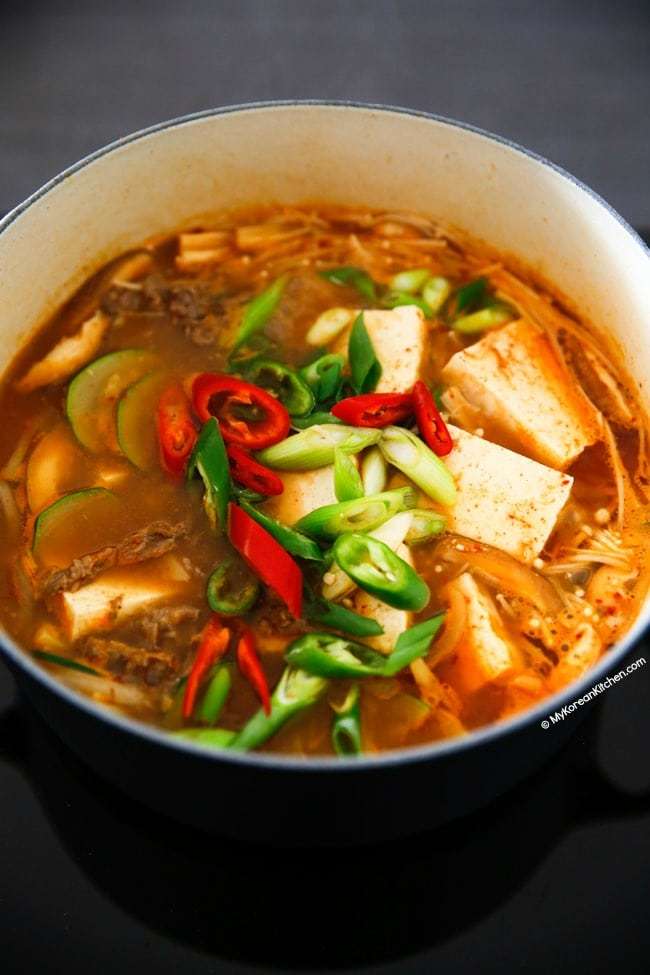
Doenjang Jjigae (Korean Soybean Paste Stew)
User Reviews
5
-
Prep Time
15 mins
-
Cook Time
10 mins
-
Total Time
25 mins
-
Servings
4
-
Calories
154 kcal
-
Course
Main Course
-
Cuisine
Korean
Doenjang Jjigae (Korean Soybean Paste Stew)
Description
This Korean Doenjang Jjigae recipe starts by marinating thin slices of beef brisket with rice wine and black pepper, then browning the meat in a pot without added oil. Potatoes are added next to start softening before pouring in rice water and seasonings. The broth is thickened and flavored with doenjang (fermented soybean paste), ssamjang (a spicy dipping sauce), and gochugaru (Korean chili flakes), which are dissolved through a sieve for even distribution. Garlic is added for aromatic depth.
After bringing the broth to a boil, zucchini and onions are added briefly to preserve texture, followed by enoki and shiitake mushrooms and tofu for richness and umami. The stew is finished with green onions and optional sliced chilies for freshness and heat. Traditionally served alongside steamed rice and various banchan (side dishes), this stew combines hearty meat and vegetables with the distinctive fermented soybean flavor and mild spice.
The recipe uses rice water obtained from rinsing rice, which provides a light starchiness to the broth. Ingredients like doenjang and ssamjang give complexity and familiar Korean flavors typical of home cooking. The stew simmers quickly once all components are added, allowing vegetables to retain some firmness.
Ingredients
- 160 g beef brisket or any cuts that are suitable for soup and stew, (5.6 ounces), thinly sliced (ideally paper thin) and cut into bite size pieces
- 2 Tbsp rice wine (mirim)
- A few cracks black pepper ground
- 3.5 cups rice water , obtained by rinsing rice
- 3 Tbsp doenjang (Korean soybean paste)
- 1 Tbsp ssamjang (Korean spicy dipping sauce)
- 2 tsp gochugaru (Korean chili flakes)
- 1 tsp garlic minced
- 100 g potato (3.5 ounces), all rounder variety, thinly sliced
- 90 g zucchini (3.1 ounces), thinly sliced
- 35 g onion (1.2 ounces), thinly sliced
- 100 g enoki mushrooms (3.5 ounces), stems removed and separated
- 45 g shiitake mushrooms (1.5 ounces), thinly sliced
- 250 g tofu (8.8 ounces), sliced into medium rectangle pieces
- 20 g green onions (0.7 ounces), thinly sliced
- 2-3 chilies (optional), green and red, thinly sliced
Instructions
- Combine the beef with rice wine and black peppers in a bowl. Mix them well. Preheat a medium sized pot briefly over medium high heat. Add the meat and stir. (You won’t need to add any oil as the meat should have some fat attached to it.) Cook until it browns. Add the potatoes and stir for about 2 mins.
- Pour over the rice water and start boiling. Add doenjang (Korean soybean paste) and ssamjang (Korean spicy dipping sauce) into the water, using a sieve, so it is easier to dissolve. Add gochugaru (Korean chili flakes) and garlic. Stir around.
- Once the water starts rolling boiling, add the zucchini and onions. Boil for 1 min. Add the mushrooms and tofu then boil for 1 min. Add green onions and chilies and boil a further 1 min. Remove from the heat.
- Serve with steamed rice and other Korean side dishes. (i.e. the side dish above shows – Korean egg roll, seasoned seaweed, radish kimchi)
Notes
- 1 tablespoon equals 15 ml and 1 cup equals 250 ml for measuring accuracy.
- Rice water used as broth base adds subtle starch and body to the soup.
- Thinly sliced beef brisket should be paper-thin and cut into bite-size pieces for even cooking.
- Refer to an essential Korean ingredients list to better understand specific staples like doenjang, ssamjang, and gochugaru.
Nutrition Information
Show DetailsNutrition Facts
Serving: 4Serving
Amount Per Serving
Calories 154 kcal
% Daily Value*
| Calories | 154kcal | 8% |
| Carbohydrates | 16g | 5% |
| Protein | 13g | 26% |
| Fat | 4g | 6% |
| Saturated Fat | 1g | 5% |
| Cholesterol | 25mg | 8% |
| Sodium | 629mg | 26% |
| Potassium | 563mg | 12% |
| Fiber | 4g | 16% |
| Sugar | 4g | 8% |
| Vitamin A | 606IU | 12% |
| Vitamin C | 41mg | 46% |
| Calcium | 28mg | 3% |
| Iron | 3mg | 17% |
* Percent Daily Values are based on a 2,000 calorie diet.
User Reviews
Overall Rating
5
You'll Also Love