Easy Roast Duck Legs
User Reviews
5
-
Prep Time
10 mins
-
Cook Time
2 hrs
-
Total Time
2 hrs 10 mins
-
Servings
6 people
-
Calories
250 kcal
-
Course
Main Course
-
Cuisine
French
Easy Roast Duck Legs
Description
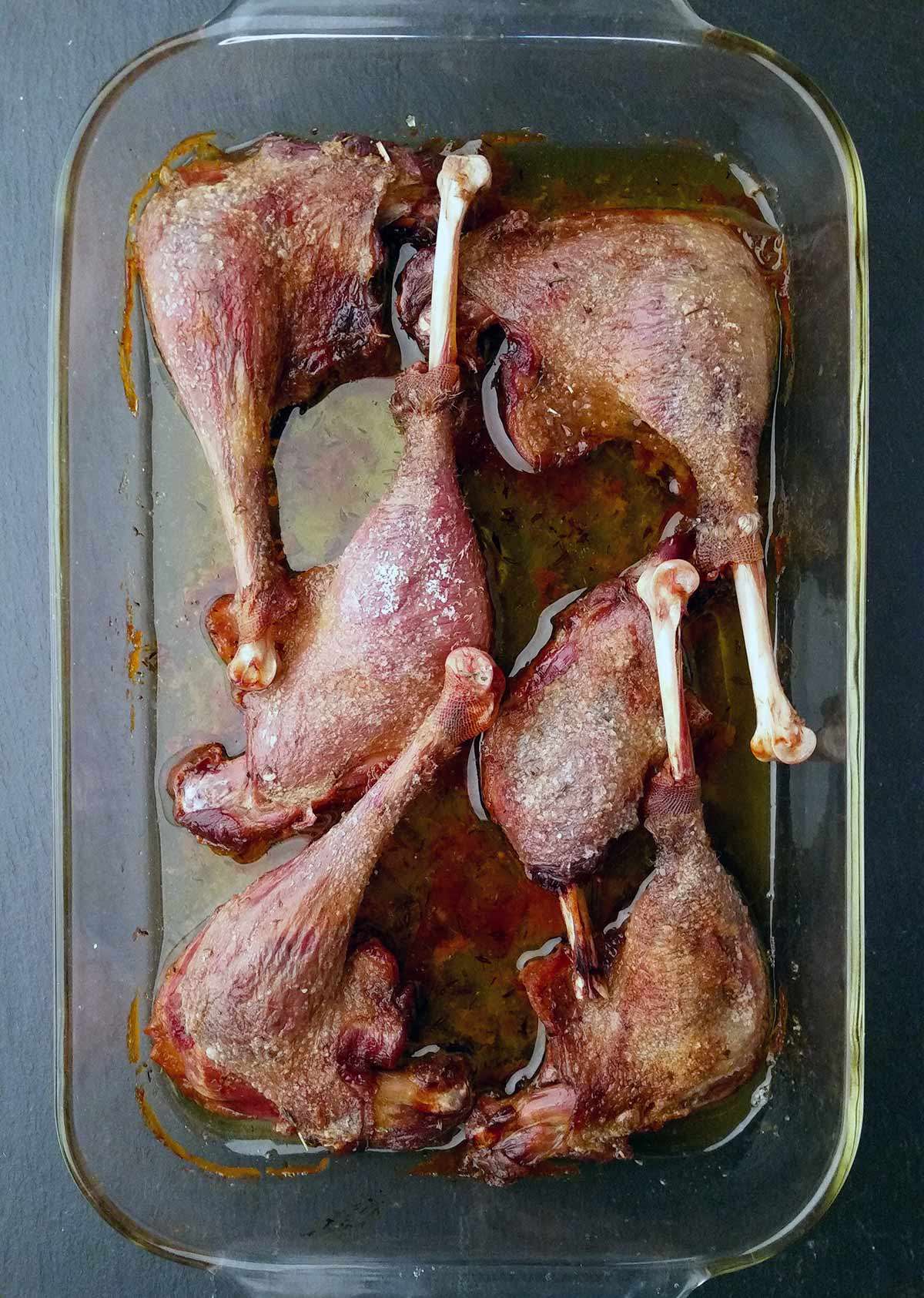
This recipe focuses on roasting duck (or goose) legs in a low oven temperature starting from a cold oven. Scoring the skin without piercing the meat helps the fat render out and baste the meat. The duck legs are salted and allowed to come to room temperature before cooking in a small casserole dish with a thin layer of duck fat or another fat source. The slow, gentle heat melts the fat, crisps the skin, and cooks the meat through while keeping it tender.
The method avoids preheating the oven; instead, it places the legs inside and then turns on the heat, which helps render more fat slowly. Depending on the quantity and size of legs, some additional fat may be needed to prevent drying out. The result is a rich, tender roast with crispy skin that pairs well with simple seasoning or sauces.
Once cooked, the duck legs can be stored and reheated with the skin refreshed under a broiler or in the oven. The recipe allows for various sauce pairings, or simply black pepper and citrus for serving.
Ingredients
- 2 to 3 pounds duck legs (or goose legs)
- salt
- duck fat butter or lard
Instructions
- Pat the duck or goose legs dry with paper towels. If you have store-bought duck legs, prick the skin of the duck all over with a needle or the point of a sharp knife. Do not pierce the meat itself. Piercing the skin gives the fat a place to seep out. Salt your duck legs well and set them aside, skin side up. Let them come to room temperature for at least 30 minutes and up to 90 minutes.
- Put the legs in a small casserole. How small? You want the casserole to be just big enough to hold the legs. Now you need some fat. If the legs themselves are fatty, you will only need to pour a thin sheen of oil or melted duck fat on the bottom of the casserole, then place the duck legs close together, but not overlapping. If the legs are skinny, add enough fat to come about 1/4 inch up the sides of the dish.
- Put the casserole in the oven and turn it to 300°F; if you have a digital oven, you could even go down to 285°F. Do not preheat the oven. Every duck has a different level of fat, so doneness is more an art than a science. But it will take at least 90 minutes, and probably two hours, and even 3 or 4 hours won't hurt them. After 90 minutes, check the duck: It should be partly submerged in melted fat and the skin should be getting crispy.
- When the skin is starting to look crispy, turn the heat to 375°F. Check after 15 minutes. You’re looking for a light golden brown. Remove the casserole from the oven and let cool for 10 to 15 minutes before eating. Save the accumulated fat for cooking vegetables, other meats or for keeping your skin shiny. I strain the fat through a paper towel, but you really only need to do this if you are saving the fat for several weeks or months; strained, it will keep for 6 months tightly covered in the fridge. Well wrapped, the duck meat itself will last up to 2 weeks in the fridge.
Notes
- The meat needs to cook immersed in fat to stay moist; if avoiding excessive fat, chicken or duck stock can be used but skin will not crisp as well.
- Cooked duck legs keep in the refrigerator for up to one week and freeze well.
- To reheat, crisp skin by placing under a broiler or heated oven; the meat is fine served at room temperature.
Nutrition Information
Show DetailsNutrition Facts
Serving: 6people
Amount Per Serving
Calories 250 kcal
% Daily Value*
| Calories | 250kcal | 13% |
| Protein | 31g | 62% |
| Fat | 13g | 20% |
| Saturated Fat | 3g | 15% |
| Cholesterol | 131mg | 44% |
| Sodium | 127mg | 5% |
| Vitamin C | 2mg | 2% |
| Calcium | 12mg | 1% |
| Iron | 2mg | 11% |
* Percent Daily Values are based on a 2,000 calorie diet.
User Reviews
Overall Rating
5
You'll Also Love