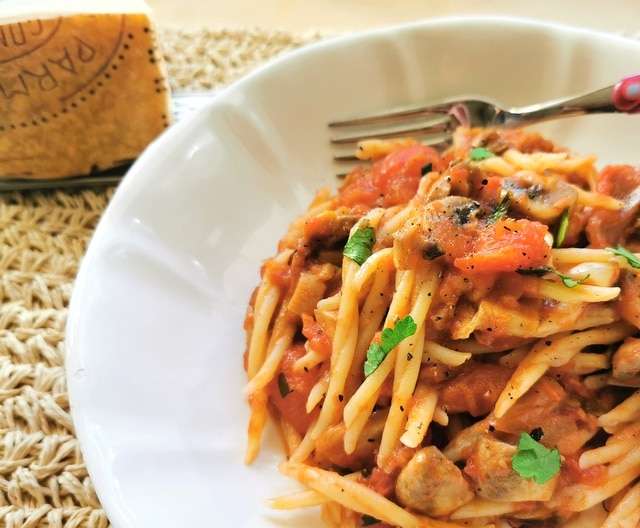
Genovese mushroom ragu with trofie pasta.
User Reviews
5
-
Prep Time
30 mins
-
Cook Time
45 mins
-
Servings
4
-
Calories
470 kcal
-
Course
Main Course
-
Cuisine
Mediterranean, Italian
Genovese mushroom ragu with trofie pasta.
Description
This Genovese mushroom ragu uses a combination of fresh or soaked dried porcini mushrooms and champignons cooked with finely chopped onion, garlic, rosemary, and parsley. The addition of white wine and both fresh peeled tomatoes and tomato passata produces a balanced tomato sauce that melds with the mushrooms. Bay leaves infuse further subtle herbal notes during a slow simmer of about 30 minutes, resulting in a rich, thick ragu.
Cooked trofie pasta, a short twisted shape, is tossed with this mushroom ragu, allowing the sauce to cling in its folds. The ragu’s deep umami and herbal flavors pair well with this textured pasta, creating a satisfying meal featuring earthy mushroom highlights and a fresh finish from parsley.
The recipe is flexible, allowing choice of pasta types such as tagliatelle or penne. Using dried porcini requires soaking and straining the soaking liquid to enrich the sauce. The ragu can be adjusted in consistency by adding soaking water if needed.
Ingredients
- 400 g Trofie pasta (14oz) or other pasta like tagliatelle
- 300 g porcini mushrooms 10oz) or 30 g dried porcini, fresh (ceps
- 250 g champignon mushrooms 9oz) or other fresh mushrooms, fresh
- 1 onion peeled and finely chopped
- 1-2 garlic peeled and finely chopped, cloves
- 1 handful parsley washed and finely chopped, fresh
- 2 bay leaf
- 1 prig rosemary chopped, fresh
- 200 g plum tomatoes (7oz) blanched, peeled and chopped
- 250 g tomato passata (9oz)
- ½ glass white wine dry
- salt for pasta and to taste
- black pepper to taste, freshly ground
Instructions
- If using dried porcini, soak them in a bowl of hot water for about 30 minutes.
- If using other mushrooms as well (or fresh porcini) clean them by brushing the dirt off them and then chop into small pieces.
- Peel and chop the onion very finely and place it in a heavy skillet or pan with a little olive oil. Cook until the onion becomes translucent. Add the mushrooms after having cleaned and roughly cut them if fresh, or after soaking them in hot water.
- Chop the garlic, rosemary and parsley, then add to the mushrooms; after a few minutes, pour in half a glass of white wine and allow the alcohol to evaporate.
- Blanch the tomatoes in boiling water then peel and chop them and add them to the pan.
- Add salt to taste and bay leaves.. If using passata too, add it once the fresh tomatoes have started to soften. Stir and continue cooking for about 30 minutes.
- If the sauce seems dry add some of the porcini soaking water (after straining it) or if using only fresh mushrooms, you can add some of the pasta cooking water once the pasta is almost ready.
- Meanwhile put a large pan of water on to boil for the pasta. Add salt once it starts to boil and bring to the boil again. Cook the pasta al dente according to the instructions on the packet.
- Drain the pasta and add to the sauce. Mix well and add more fresh parsley and ground black pepper. Serve with some grated Parmigiano Reggiano if required.
Notes
- Dried porcini require soaking in hot water before use; strain the soaking water for sauce if desired.
- Fresh mushrooms should be brushed clean and chopped before use.
- Either fresh peeled tomatoes alone or combined with tomato passata can be used.
- Common pasta pairings include trofie, tagliatelle, ravioli, or penne according to preference.
Nutrition Information
Show DetailsNutrition Facts
Serving: 4Serving
Amount Per Serving
Calories 470 kcal
% Daily Value*
| Calories | 470kcal | 24% |
| Carbohydrates | 90g | 30% |
| Protein | 19g | 38% |
| Fat | 2g | 3% |
| Saturated Fat | 0.4g | 2% |
| Polyunsaturated Fat | 1g | 6% |
| Monounsaturated Fat | 0.2g | 1% |
| Sodium | 36mg | 2% |
| Potassium | 1118mg | 24% |
| Fiber | 7g | 28% |
| Sugar | 11g | 22% |
| Vitamin A | 740IU | 15% |
| Vitamin C | 19mg | 21% |
| Calcium | 52mg | 5% |
| Iron | 3mg | 17% |
* Percent Daily Values are based on a 2,000 calorie diet.
User Reviews
Overall Rating
5
You'll Also Love