Homemade lasagne/lasagna pasta
User Reviews
5
-
Prep Time
45 mins
-
Total Time
45 mins
-
Servings
5
-
Calories
342 kcal
-
Course
Main Course
-
Cuisine
Italian
Homemade lasagne/lasagna pasta
Description
Homemade lasagne pasta combines Italian 00 flour with eggs and a pinch of salt to form a traditional dough. Kneading the dough thoroughly develops gluten, resulting in a smooth, elastic, and slightly tacky texture. Rolling the dough paper-thin produces delicate sheets that become tender when baked in layered dishes like lasagna, allowing sauce and cheese to meld well.
The dough can either be precooked briefly in boiling salted water or used raw, with adjustments to sauce liquidity to ensure even cooking. Drying fresh pasta on semolina flour or a fine tea towel with air circulation prevents sheets from sticking and maintains their texture.
Proper handling of fresh pasta sheets, including spacing them apart and using floured surfaces, supports ease in assembly and enhances the final dish's quality. This recipe yields about 500g of fresh pasta dough, sufficient for typical lasagna preparations, and can be adapted using all-purpose flour if needed.
Ingredients
- 400 g Italian 00 flour 14oz) All purpose flour can be used too, soft wheat
- 4 egg large
- 1 pinch salt
Instructions
- To make the pasta, mound your flour on a large wooden board. Make a well in the center and add a pinch of salt.
- Break the eggs into the well and whisk them a little ( you can also beat eggs in a small bowl and then add to flour or start by mixing flour and eggs together in a bowl and then turn out onto a board to knead)
- Start to incorporate the eggs and flour by slowly bringing more flour in from the inside edges of the well. You can use a fork or scraper for this.
- Continue mixing the flour with the eggs until they are no longer runny.
- Using your hands now, bring the outside edges in, forming a large mass on your board.
- Begin to knead the dough as you would bread, pushing it down with the heel of your hand.
- Continue kneading for about 7-10 minutes. Knead until the pasta dough is smooth, elastic, and just slightly tacky. You can dust the dough with more flour if it’s too sticky, but try not to add too much additional flour or the pasta will be tough.
- Roll the dough into a ball and wrap it in cling film and let it sit for about 30 minutes.
- Cut off ⅙ of the dough, re-wrap the rest in cling film so it doesn’t dry out and roll out the piece you cut off until it is flat enough that you can pass it through a pasta machine if you are using one.
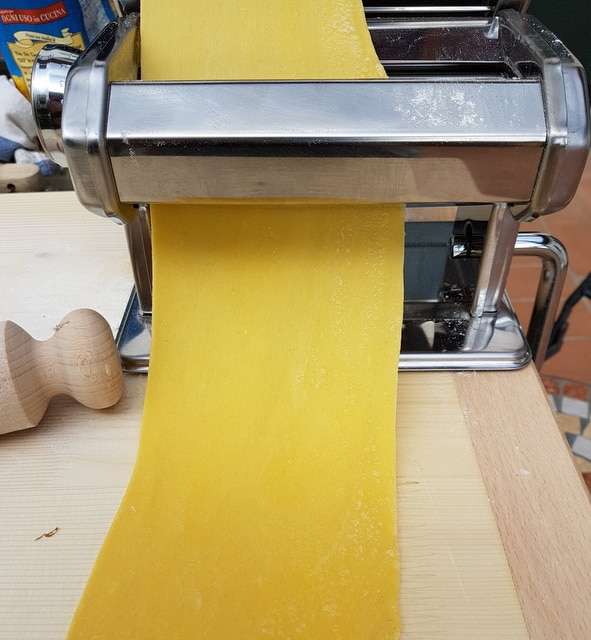
- I used my pasta machine to roll out the sheets, first 3-4 times on number 6 or 7 on the dial (widest setting) and then a couple of times more on number 4. Each time you pass the dough through the machine fold it first into thirds and pass it through again until it comes out with the right thickness and length. If you want even thinner sheets you can also pass the dough through again on number 2 or 3. Cut the sheet to the length you want.
- If you aren’t using a machine you need to keep rolling out the dough until it is thin enough to almost see your fingers through it. Then cut the sheet to the size you want.
- Transfer the ready sheets to a drying rack while you prepare the rest. Repeat with the remaining dough. (the lasagne can be stored, when completely dry and stiff, for up to 1 week). If you don't have a drying rack see recipe notes.
Notes
- The thinness of your pasta sheets significantly affects the final lasagna's texture and flavor balance with sauce and cheese.
- Fresh pasta can be either briefly boiled before baking or used raw; if raw, make your sauce slightly thinner to allow cooking in the oven.
- Dry pasta sheets spaced apart on a lightly floured surface help prevent sticking before assembly.
- Consider using semolina flour for dusting when drying to maintain pasta texture better.
- This recipe yields around 500g of pasta sheets, enough for a standard lasagna depending on sheet thickness and size.
Nutrition Information
Show DetailsNutrition Facts
Serving: 5Serving
Amount Per Serving
Calories 342 kcal
% Daily Value*
| Calories | 342kcal | 17% |
| Carbohydrates | 61g | 20% |
| Protein | 13g | 26% |
| Fat | 4g | 6% |
| Saturated Fat | 1g | 5% |
| Polyunsaturated Fat | 1g | 6% |
| Monounsaturated Fat | 1g | 5% |
| Trans Fat | 0.01g | 1% |
| Cholesterol | 131mg | 44% |
| Sodium | 59mg | 2% |
| Potassium | 134mg | 3% |
| Fiber | 2g | 8% |
| Sugar | 0.3g | 1% |
| Vitamin A | 190IU | 4% |
| Calcium | 32mg | 3% |
| Iron | 4mg | 22% |
* Percent Daily Values are based on a 2,000 calorie diet.
User Reviews
Overall Rating
5
You'll Also Love