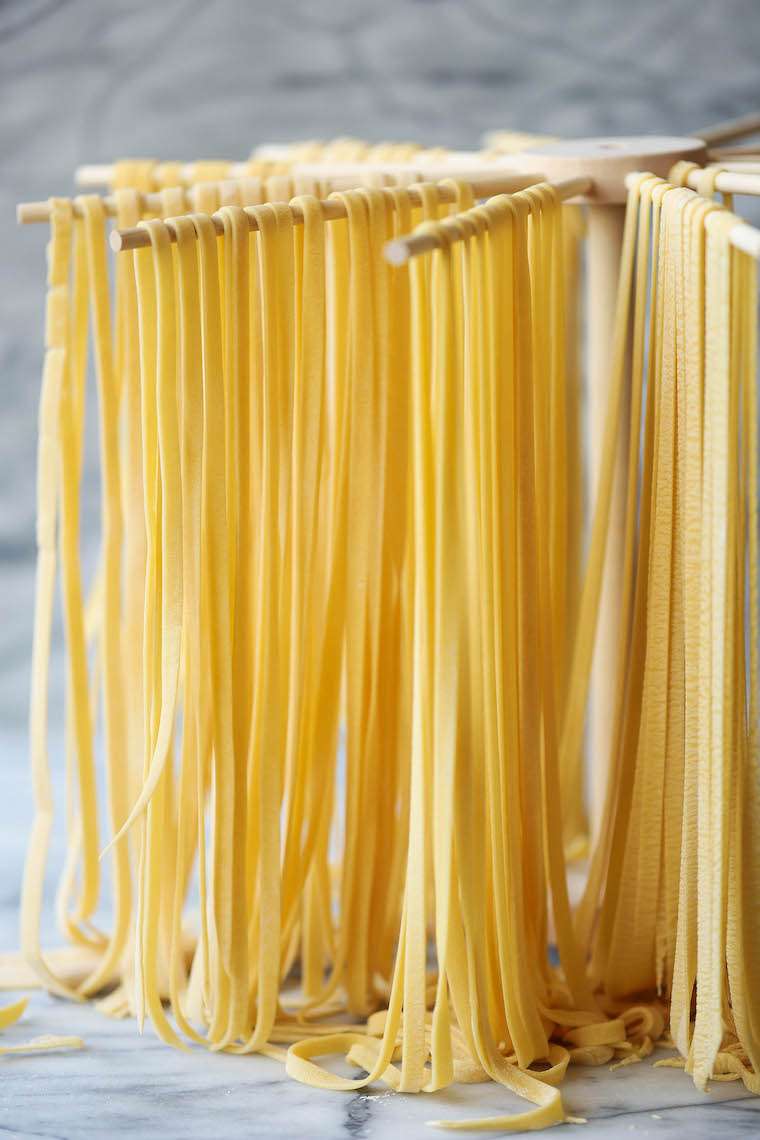
Homemade Pasta
User Reviews
5
-
Prep Time
1 hr 30 mins
-
Total Time
1 hr 30 mins
-
Servings
1 pound
-
Course
Main Course
Homemade Pasta
Description
Homemade Pasta starts with mixing all-purpose and semolina flours alongside eggs, olive oil, salt, and water to form a soft dough. The dough is kneaded briefly on a lightly floured surface to bring it together and then wrapped and rested to relax the gluten, which makes it easier to work with. After resting, the dough is divided and rolled out using a pasta roller, adjusting thickness gradually to achieve an even sheet suitable for further shaping. This method ensures the pasta has an elastic, slightly tacky texture essential for good pasta that cooks evenly.
The dough incorporates semolina flour for texture and all-purpose flour for structure, balanced by eggs and olive oil to enrich and bind. Resting the dough after mixing improves extensibility and rollability, while kneading engages the gluten network. The rolling attachment helps develop thin sheets of pasta that can be cut or shaped into desired pasta forms.
This homemade pasta dough can be used fresh in a variety of pasta preparations, serving well with sauces or fillings. Since the dough is versatile, it serves as a base for many kinds of pasta dishes. Following the outlined steps ensures consistent dough quality suited for further pasta-making.
Ingredients
- 3 cups all-purpose flour
- 3 cups semolina flour all-purpose flour can be substituted, or 00 flour
- 6 egg large
- 1 tablespoon olive oil
- Pinch salt
- ¾ cup water or more, as needed
Instructions
- In the bowl of an electric mixer fitted with dough hook attachment, beat the flours, eggs, olive oil, salt and water on medium-low speed until a soft, smooth ball of dough is formed, about 5-10 minutes. If the dough is too dry, add more water as needed. The dough should feel elastic and slightly tacky to the touch.
- Working on a lightly floured surface, knead the dough 3-4 times until it comes together.
- Wrap tightly in plastic wrap and let stand at room temperature for at least one hour or in the refrigerator overnight, letting it come to room temperature prior to using.
- Using the KitchenAid® Stand Mixer Pasta Roller Attachment, adjust thickness to setting #1.
- Working on a lightly floured surface, divide dough into 4 equal pieces.
- Working one piece at a time, turn on the stand mixer at speed 2 and feed dough through the pasta roller to knead, lightly flouring the dough as needed to avoid sticking. Fold dough in half and roll again, repeating as needed, until dough is smooth.
- Adjust thickness to setting #2. Feed dough, repeating once.
- Adjust thickness to setting #3. Feed dough, repeating once.
- Adjusting thickness to setting #4. Feed dough, repeating once. Turn off mixer.
- Using the KitchenAid® Stand Mixer Fettuccine Cutter Attachment, turn on the stand mixer at speed 4 and feed dough through the pasta cutter before carefully arranging pasta on a pasta drying rack for 30 minutes, lightly flouring the pasta as needed to avoid sticking.
- Transfer to an airtight container and place in the refrigerator for up to 2 days or in the freezer for up to 2 weeks.
User Reviews
Overall Rating
5
You'll Also Love