How to Cut Whole Pork Shoulder
User Reviews
5
-
Prep Time
20 mins
-
Total Time
20 mins
-
Course
Main Course
How to Cut Whole Pork Shoulder
Description
The method begins by draining and rinsing the whole pork shoulder to remove packaging liquids, followed by patting it dry for easier handling. Positioning the shoulder skin side down allows clear access to the internal bone, which runs at an angle. By locating the membrane seam along the bone and using fingers to separate it first, the meat can be carefully cut away from the bone with small, controlled knife strokes, minimizing risk and maximizing meat retention.
The instructions emphasize safety with slow, deliberate cutting motions to avoid slips. Leaving some meat on the bone is acceptable since it contributes flavor when making stock or soup later. Using proper reusable storage bags is recommended for environmental friendliness when storing the prepared meat.
This guide is practical for cooks wanting to process a whole pork shoulder themselves to control cuts for smoking, roasting, or other preparations where precise deboning is beneficial.
Ingredients
- 1 Pork Picnic Shoulder whole
Instructions
Preparation:
- In your kitchen sink, carefully remove the pork shoulder from the packaging. There is almost always excess liquid to drain off. Gently rinse the pork shoulder (avoid splashing water around, and be sure to disinfect the area afterwards). Pat dry with a paper towel and transfer the pork shoulder to a large cutting board.
De-boning:
- Position the pork shoulder with the large skin side down and the broad side facing away from you. You can see the inside bone poking through both ends.
- Find the seam/muscle membrane that runs from one end of the bone to the other and use your fingers to separate and pull the meat apart. Carefully make small cuts in the seam until the membrane pulls apart.
- Continue to cut along the bone from the broad end of the pork shoulder over to the tapered end to fully expose it. Note that the bone is not straight, but bent at an angle. Gently pull the meat apart, and cut around and down the lengths of bone. Pulling the meat creates tension, which makes cutting through the membrane around the bone easier. Take your time with it!
- Soon, you’ll see that you’ve sort of “flattened” the pork shoulder, and the bone will be clearly exposed. Continue to cut around the bone until you can get your fingers under it. Next, lift the bone and slide your knife tip under it. Cut under and around the bone to separate it from the meat.
- Now grip the detached end of the bone and continue to cut the meat around the bone until the bone is completely separated from the meat. Lifting the bone up and letting the neat hang down creates tension between the meat and bone that makes cutting the meat away from the bone easier.
Breakdown:
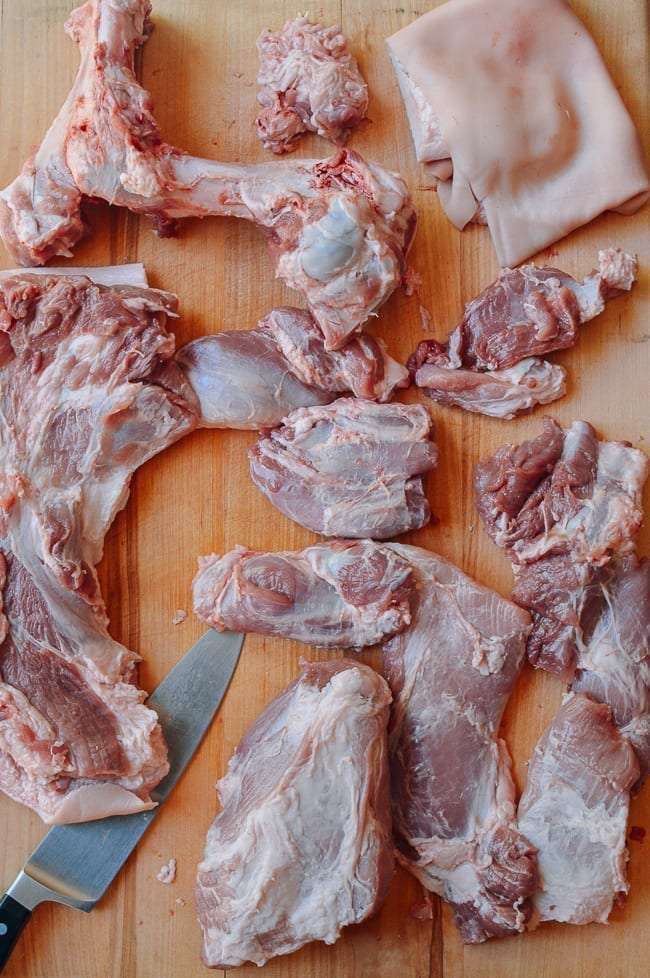
- Find other muscle membranes, and cut between the membrane/seams to separate the pieces of meat. You’ll find that the thickest pork chunk on the broad end of the roast works well for stir fries, since it is quite lean. Cut along the seam of this large chunk until you get to the skin, and continue to cut and separate the meat from the skin until the large pork chunk is detached. (Before stir-frying, trim off the muscle membrane and fat to ensure you get tender slices.)
- Continue to find and cut along membranes and seams until you have separated most of the pork chunks from the middle, and near the narrow part of the pork on the leg. The medium pieces can be cut into chunks for stewing, used to make ground pork, or even butterflied for char siu.
- Now you should have skin and fat on one side and a thinner cut of fat and meat that resembles pork belly on the other side. Cut off the portion that has only skin and fat and reserve.
- Now you’ll be left with what resembles pork belly––a long piece with layers of fat, meat and skin––along with some remaining chunks of pork. Remove the pork belly piece, and continue cutting along the seams to separate the remaining pork chunks.
Notes
- Use slow, controlled knife cuts with minimal tension to prevent slipping and injuries.
- Leaving some meat on the bone is fine since it adds flavor to stocks or soups.
- Use reusable silicone bags for storing pork shoulder to reduce environmental waste.
User Reviews
Overall Rating
5
You'll Also Love