How To Make Curd | Dahi (Homemade Indian Yogurt)
User Reviews
4.7
How To Make Curd | Dahi (Homemade Indian Yogurt)
Description
Starting with half a liter of whole milk boiled in a clean thick-bottomed pan, the milk is heated over medium-low to medium heat with occasional stirring to prevent burning until it reaches boiling point. It is then removed from heat and allowed to cool to warm (between 39 to 44 °C or 102 to 111 °F), checked by finger touch or thermometer.
Once warm, 1 to 2 teaspoons of live curd starter (dahi or yogurt) are mixed thoroughly into the milk to evenly distribute the bacteria. The mixture is then covered and left undisturbed in a warm place to ferment for several hours until set into curd. This method works well in warm climates; in cold conditions, temperature control is essential for the curd to set properly.
The recipe advises using pasteurized or previously boiled milk to ensure safety. Once set, the curd can be refrigerated and the curd starter preserved for future batches. Packaged starters may be used if live curd is unavailable. The process can be scaled as needed.
Ingredients
- ½ litre milk whole
- 1 to 2 teaspoons curd (dahi or yogurt) to be used as a starter
Instructions
Boil Milk
- Rinse a thick bottomed pan or saucepan with clean water.
- Pour milk into it and heat it on the stovetop on a medium-low to medium heat.
- Stir a couple of times when the milk is getting heated so that the milk does not get burnt from the bottom.
- When the milk comes to a boil, it will start rising. Before it spills out of the pan, switch off the heat. Set the pan aside on the kitchen countertop.
- Let the milk become warm at room temperature.
- To check if the milk has become warm dip your little finger (touch method) into the milk and you should feel warm and not hot. Second way is to touch the sides of the pan and it should feel warm and not hot.
- The third way is to check with a food thermometer and it should have a temperature between 39 to 44 degrees Celsius or 102 to 111 degree Fahrenheit.
- Once the milk has become warm, you can use the same pan for setting curd or transfer the warm milk in another bowl.
Make Curd
- Add 1 teaspoon of curd starter to the milk and mix thoroughly with a small wired whisk.
- Cover with lid and allow the milk to ferment for 5 to 6 hours or until the curd is set
- Depending on the temperature it may take more hours. You can also use Instant pot yogurt function to set the curd.
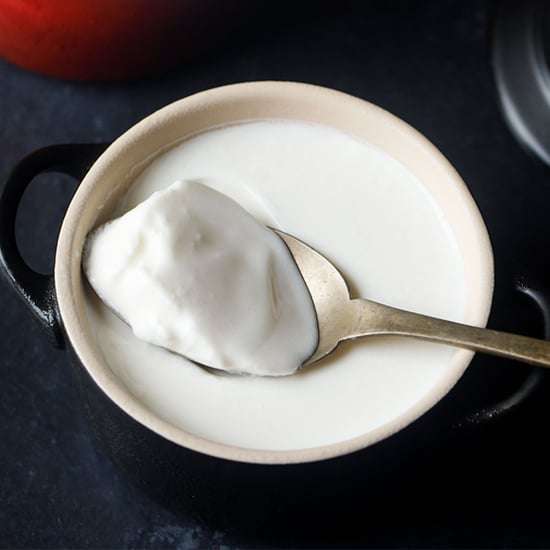
- On fermentation the curd will have a pleasant fermented aroma and with a slight tangy taste and it will also have a wobbly thick texture.
- Once the curd is made, refrigerate it so that it does not get overfermented.
- If you need sour curd for any recipe then keep the curd for a couple of hours at room temperature. This will lead to more fermentation and the curd will become sour or very sour.
- You can eat this curd with your meals. You can also add it to variety of recipes like curd rice, buttermilk, lassi, kadhi, mor kuzhambu, dahi kabab, dahi vada, dahi bhalla, biryani, paneer tikka or make raita with it.
Storage
- As soon as the curd is set and fermented well, place it in the refrigerator covered with a lid. Use a clean dry spoon to remove the curd and place the bowl or container back in the fridge.
- Homemade yogurt or dahi keeps well in the fridge for about 4 to 5 days.
Notes
- Use whole milk boiled and cooled to warm temperature for thick, creamy curd.
- In warm climates, mixing starter with cold refrigerated milk can speed fermentation, but avoid this with raw or unpasteurized milk.
- Milk temperature before adding starter should be warm, not hot, to avoid killing fermentation bacteria.
- In cold climates, ensure milk is warm before adding starter to enable proper setting.
- Once set, refrigerate curd and reserve some as starter for future batches.
- Use pasteurized or previously boiled milk to prevent harmful microorganisms.
- Packaged curd starters can be used when live curd is unavailable.
- Process and quantities may be scaled according to need.
Nutrition Information
Show DetailsNutrition Facts
Serving: 1medium size bowl of curd
Amount Per Serving
Calories 304 kcal
% Daily Value*
| Calories | 304kcal | 15% |
| Carbohydrates | 23g | 8% |
| Protein | 17g | 34% |
| Fat | 16g | 25% |
| Saturated Fat | 10g | 50% |
| Polyunsaturated Fat | 1g | 6% |
| Monounsaturated Fat | 4g | 20% |
| Cholesterol | 65mg | 22% |
| Sodium | 229mg | 10% |
| Potassium | 772mg | 16% |
| Sugar | 23g | 46% |
| Vitamin A | 493IU | 10% |
| Vitamin B1 (Thiamine) | 1mg | |
| Vitamin B2 (Riboflavin) | 1mg | |
| Vitamin B3 (Niacin) | 1mg | |
| Vitamin B6 | 1mg | |
| Vitamin B12 | 2µg | 83% |
| Vitamin C | 2mg | 2% |
| Vitamin D | 1µg | 5% |
| Vitamin E | 1mg | |
| Vitamin K | 1µg | |
| Calcium | 603mg | 60% |
| Vitamin B9 (Folate) | 35µg | |
| Iron | 1mg | 6% |
| Magnesium | 60mg | 15% |
| Phosphorus | 473mg | |
| Zinc | 3mg |
* Percent Daily Values are based on a 2,000 calorie diet.
User Reviews
Overall Rating
4.7
You'll Also Love