How To Make Soft Roti / Chapati? (Whole Wheat Indian Flatbread Recipe)
User Reviews
4.9
How To Make Soft Roti / Chapati? (Whole Wheat Indian Flatbread Recipe)
Description
Soft Roti or Chapati is made from whole wheat flour combined with water and optionally a small amount of neutral oil. Starting with gradual water addition ensures the dough isn’t too sticky or dry. Kneading smooths the dough and encourages gluten development, essential for softness. Resting covered for 15 to 30 minutes relaxes the gluten, making the dough easier to roll and yielding pliable rotis.
Each roti is rolled out thinly on a floured surface and cooked on a hot tava or griddle until brown spots appear and it puffs slightly, indicating doneness. Applying ghee or oil after cooking helps keep them soft and adds flavor. The key to softness lies in dough consistency, kneading technique, and careful cooking.
This basic flatbread has a neutral flavor that pairs well with various curries, dals, or vegetables. It’s a staple in Indian cuisine and offers a healthier alternative to breads made with refined flour. The recipe includes tips for storage, reheating, and substitutions including vegan options.
Adjusting dough hydration is important; too sticky or hard dough can be corrected by adding flour or water respectively. Practice and patience help master rolling evenly thin rotis without tearing. Proper storage in airtight containers and reheating on a tava or microwave maintains freshness for 2-3 days.
Ingredients
- 2 cups whole wheat flour
- 3/4-1 cup water
- 1 teaspoon neutral cooking oil optional, generic cooking oil
- 1/4 cup whole wheat flour to roll roti
- ghee to spread on cooked roti (optional)
Instructions
Make Roti Dough
- In a large bowl or flat plate with high edges, take the whole wheat flour. Slowly start adding water and mix with hand. Don’t add all water at once. Keep adding water as needed, while mixing.
- Once the dough starts to form, do not add more water. It takes a little more than 3/4 cup of water to make the dough. The amount of water will vary depending on the brand of whole wheat flour.
- Make the dough smooth by kneading it with your fist. Add some water to your hand and knead 2-3 times. When you press your finger against the dough, it should leave an impression. This is the right consistency of the dough.
- Cover with a damp cloth or plastic wrap and let the dough rest for at least 15 mins and up to 30 mins. This helps gluten to release and the dough becomes more elastic. Open and knead once again.
- You can apply some oil to make the dough edges less sticky. but this is not necessary to get soft rotis.
Roll Roti
- Keep the rolling board and rolling pin ready. Keep a bowl of dry flour and a bowl of ghee to apply on the roti once it is ready. You want to roll and cook the roti’s at the same time, so the rolled dough does not become dry.
- Make small balls from the dough by rotating between your palms. Make the ball a bit flat. Dip a ball in dry flour, place on the marble or wooden base (chalka) and roll with the rolling pin.
- Do not apply too much pressure while rolling. Apply equal pressure on all sides while rolling. When you roll with gentle hands, the dough flattens and moves in circles with the rolling pin. You can also turn the roti with your hands at 90 degrees multiple times while rolling, so that it forms a circle. Apply dry dough about half way through on both sides and roll again.
Cooking phulka
- Preheat a Tawa (griddle) on medium-high flame. Pick the roti and flip between both both palms to remove any extra dry flour. Transfer roti on the tawa.
- Turn when the color starts changing and small air pockets form in about 5-10 seconds. For the other side, now we want to cook until there are some brown spots on the roti.
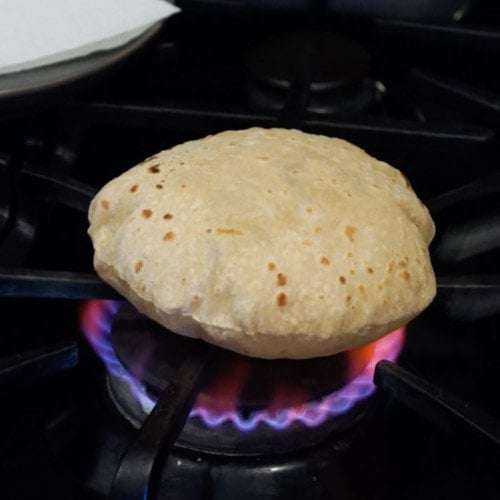
- Now you can cook directly on flame. Use tongs (chimta) to turn from side to side until the roti puffs.
Cooking roti / chapati
- If you don’t have a flame or are doing induction cooking. Follow phulka steps as above. Then turn the roti on tawa and cook until there are brown spots on the other side too. Press gently with a flat spatula, which will help the roti to fluff up. Turn couple of times while cooking and pressing gently.
- Take the phulka / roti / chapati and place on a paper towel (or a thin cloth) on a plate and apply ghee. Repeat process of rolling and cooking for rest of the dough.
- Enjoy roti / phulka warm with any curry, dal or vegetables.
Notes
- To adjust dough consistency, add flour if sticky or water if too hard to get a soft, pliable texture.
- Let the dough rest covered with a damp cloth for 15-30 minutes to improve elasticity and softness.
- Apply ghee or oil after cooking to maintain softness and add flavor; vegan versions can use oil or vegan butter.
- Store cooked rotis in an airtight container; they keep 2-3 days refrigerated or freeze with parchment paper between layers for longer storage.
- Reheat rotis on a hot tava or briefly in the microwave on a paper towel to restore softness before serving.
- Practice rolling with even pressure to avoid tears and achieve thin, uniform rotis.
Nutrition Information
Show DetailsNutrition Facts
Serving: 12roti's
Amount Per Serving
Calories 79 kcal
% Daily Value*
| Calories | 79kcal | 4% |
| Carbohydrates | 16g | 5% |
| Protein | 2g | 4% |
| Sodium | 1mg | 0% |
| Potassium | 81mg | 2% |
| Fiber | 2g | 8% |
| Calcium | 8mg | 1% |
| Iron | 0.8mg | 4% |
* Percent Daily Values are based on a 2,000 calorie diet.
User Reviews
Overall Rating
4.9
You'll Also Love