Irish Soda Bread
User Reviews
4.7
Irish Soda Bread
Description
The Irish Soda Bread recipe uses a blend of all-purpose and cake flour along with baking soda and cream of tartar to leaven the bread without yeast. Softened butter is mixed into the flour for richness, and buttermilk is used to activate the baking soda and provide moisture and acidity. The dough is carefully kneaded just enough to come together and retain some texture, preventing toughness.
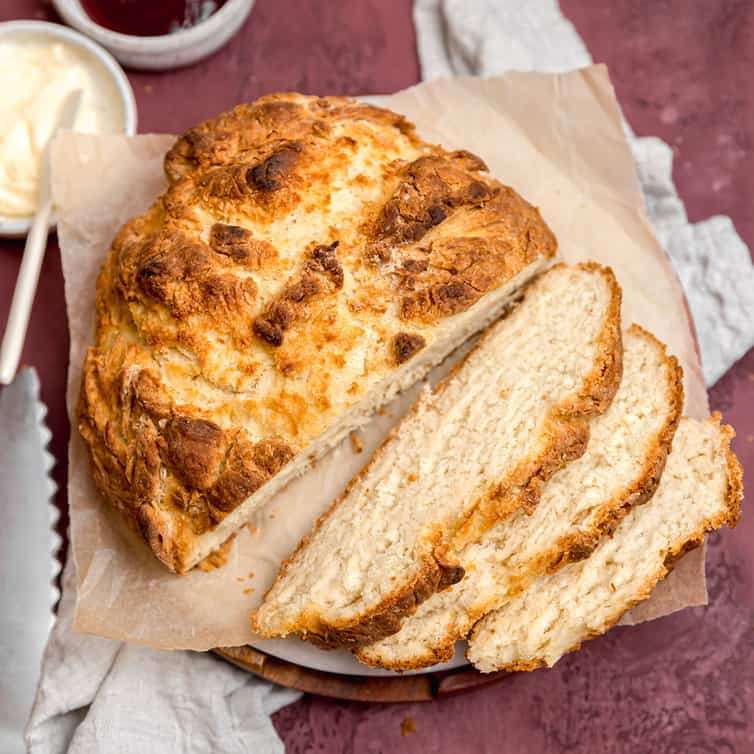
The dough is formed into a round loaf, scored across the top, and baked at 400 degrees Fahrenheit until golden brown and cooked through, as confirmed by a skewer test or internal temperature. The finished bread has a firm crust and a tender, slightly crumbly interior with a mild sourness from the buttermilk.
Irish Soda Bread pairs well with hearty soups, stews, or as a simple bread for butter and jam. The loaf can be sliced and toasted, offering versatility for breakfast or snacks.
This recipe includes notes on substituting cake flour with all-purpose flour and cornstarch, and a method for creating buttermilk with milk and acid if unavailable. The bread freezes well for up to three months when wrapped properly, allowing for convenient storage and use.
Ingredients
- 3 cups all-purpose flour
- 1 cup cake flour
- 2 tablespoons granulated sugar
- 1½ teaspoons baking soda
- 1½ teaspoons cream of tartar
- 1½ teaspoons salt
- 2 tablespoons butter softened, unsalted
- 1½ cups buttermilk
- 1 tablespoon butter melted, unsalted
Instructions
- Adjust an oven rack to the upper-middle position and preheat oven to 400 degrees F.
- In a large bowl, whisk together the flours, sugar, baking soda, cream of tartar, and salt. Work the softened butter into the dry ingredients with a fork or your fingertips until the texture resembles coarse crumbs.
- Add the buttermilk and stir with a fork just until the dough begins to come together. Turn out onto a floured work surface and knead just until the dough becomes cohesive and bumpy, 12 to 14 turns. (Do not knead until the dough is smooth, or the bread will turn out tough.)
- Pat the dough into a round about 6 inches in diameter and 2 inches high; place on a parchment-lined baking sheet or in a 12-inch cast iron skillet. Score the dough by cutting a cross shape on the top of the loaf.
- Bake until the loaf is golden brown and a skewer inserted into the center comes out clean, or the internal temperature reaches 180 degrees F on an instead-read thermometer, 40 to 45 minutes. Remove the loaf from the oven and brush the surface with the melted butter. Cool to room temperature before slicing, about 30 to 40 minutes. Leftovers should be wrapped in plastic wrap and stored at room temperature for up to 3 days.
Notes
- If cake flour is unavailable, substitute ¾ cup sifted all-purpose flour plus 2 tablespoons cornstarch.
- To make buttermilk substitute, mix 1½ tablespoons lemon juice or vinegar with whole or 2% milk to 1½ cups; let sit 5 minutes before using.
- The bread should be kneaded only until dough is cohesive and still slightly bumpy to avoid toughness.
- Freeze the cooled loaf or slices tightly wrapped for up to 3 months; thaw in refrigerator or at room temperature.
- Baking in a cast iron skillet is traditional and helps form a crisp crust.
Nutrition Information
Show DetailsNutrition Facts
Serving: 12servings (1 loaf)
Amount Per Serving
Calories 203 kcal
% Daily Value*
| Calories | 203kcal | 10% |
| Carbohydrates | 35g | 12% |
| Protein | 5g | 10% |
| Fat | 4g | 6% |
| Saturated Fat | 2g | 10% |
| Cholesterol | 10mg | 3% |
| Sodium | 460mg | 19% |
| Potassium | 146mg | 3% |
| Fiber | 1g | 4% |
| Sugar | 3g | 6% |
| Vitamin A | 135IU | 3% |
| Calcium | 41mg | 4% |
| Iron | 1.5mg | 8% |
* Percent Daily Values are based on a 2,000 calorie diet.
User Reviews
Overall Rating
4.7
You'll Also Love