Kamut Flour Bread Recipe
User Reviews
5
Kamut Flour Bread Recipe
Description
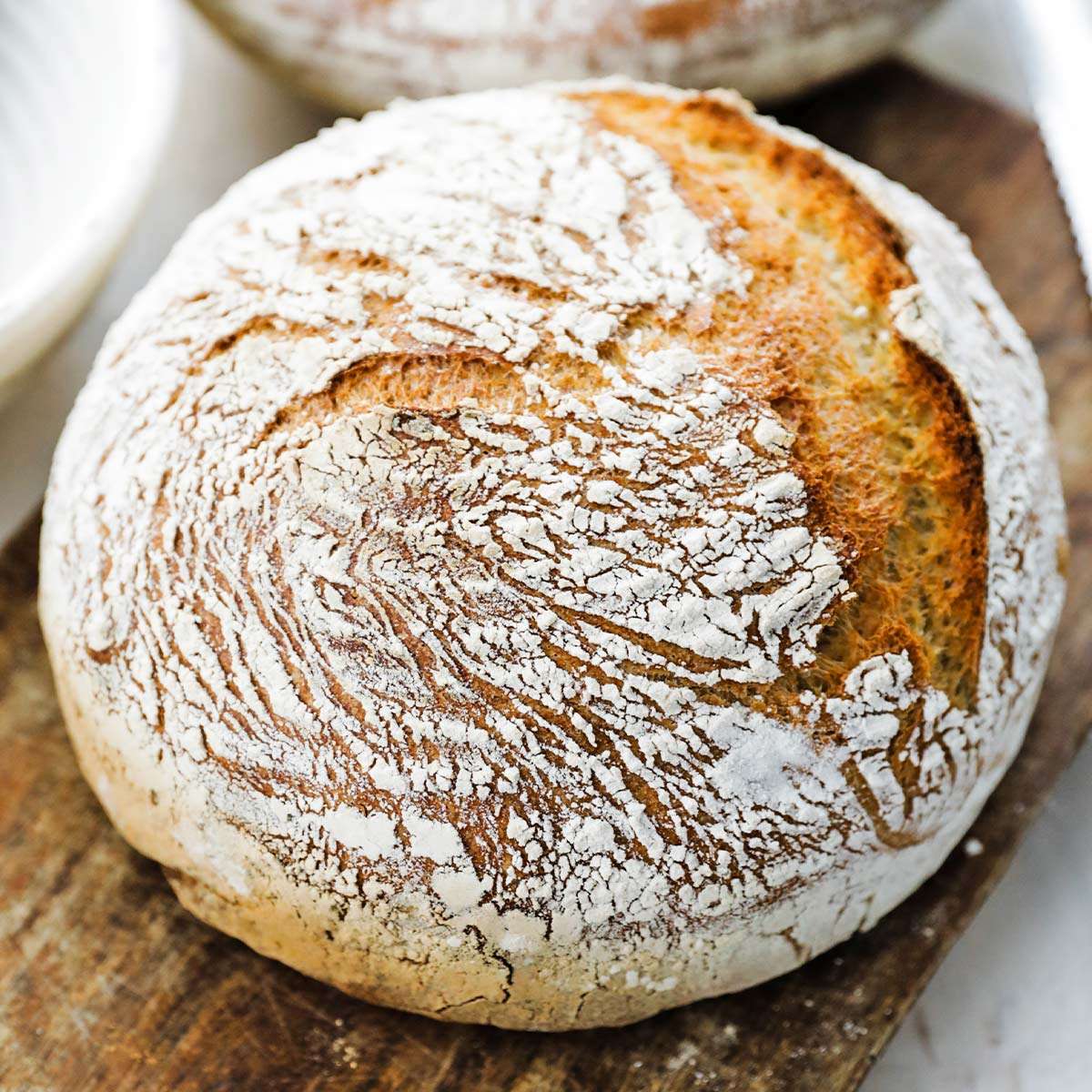
This Kamut Flour Bread Recipe combines three flours—kamut, bread, and ivory wheat—into a hydrated, yeasted dough with a biga pre-ferment. The process involves mixing a portion of the bread flour and water with a small amount of yeast, fermenting it at room temperature until tripled in size, developing flavor and extensibility. The remaining flours, yeast, salt, and warm water are then mixed with the biga, followed by a resting period.
The dough receives several stretch-and-fold cycles over more than an hour to build gluten strength. After a secondary rise until tripled, it is shaped into two balls for proofing in baskets. Baking is traditionally done in preheated Dutch ovens to create an even oven spring and a deeply caramelized crust from the Maillard reaction. The resulting bread has a chewy interior and a golden, crisp crust.
This bread is excellent for sandwiches or as an accompaniment to meals. Its natural acidity, from fermentation, helps prolong shelf life, allowing it to be stored at room temperature for a couple of days or refrigerated longer. Measurements by weight ensure consistent hydration and dough texture.
Handling tips include sifting flours to aerate and prevent lumps, verifying dough temperature after kneading for optimal fermentation, and wrapping baked loaves in a towel or bread bag for storage. Keeping the bread warm pre-serving can be done in a low oven wrapped in foil for up to 30 minutes.
Ingredients
- 650 grams bread flour
- 250 grams kamut flour
- 150 grams wheat flour Ivory
- 880 grams water
- 25 grams salt coarse
- 4.5 grams active yeast
Instructions
- In a large container, mix together 550 grams of bread flour with 396 grams of water at 80° to 82° and .5 grams of yeast until combined. Cover and let sit at room temperature for 10 to 24 hours or until tripled in size.
- In a separate large container, mix together the remaining 150 grams of bread flour, Kamut, ivory wheat flour, salt, remaining 4 grams of yeast, and remaining 484 grams of water at 100 to 102° until combined.
- Add the biga to the mixture and vigorously mix it by squeezing, stretching, and folding until thoroughly mixed in, about 3 to 4 minutes. Cover and let rest for 20 minutes.
- Fold the dough by stretching and turning it 6 to 8 times every 20 minutes for 80 minutes.
- Cover and let rest for 2 more hours or until tripled in size.
- Divide the dough on a clean surface dusted with flour and form 2 taught dough balls. Transfer each to a floured proofing basket, cover with a towel, and let proof for 60 to 90 minutes.
- Place 2 Dutch oven pots into an oven preheated to 500° and let them sit for 30 minutes.
- Remove the pots and place the dough carefully into each Dutch oven. Score it with a bread knife or blade, cover, and bake for 30 minutes, then uncover and bake for another 20 to 25 minutes or until the outside of the bread is dark brown.
- Set on a cooling rack for 30 minutes.
- Slice and serve.
Notes
- Use a kitchen scale to measure ingredients precisely for best results.
- Maintain warm rising conditions, such as a turned-off preheated oven, to encourage proper fermentation.
- Bake bread in preheated Dutch ovens to promote oven spring and develop a crispy crust.
- Store baked bread wrapped in a towel or bread bag at room temperature up to two days; refrigerate up to 10 days or freeze for two months.
- Sifting flours before mixing helps aerate and ensures even hydration.
- Allow bread to rest wrapped in foil in a 200°F oven for up to 30 minutes to keep warm before serving.
Nutrition Information
Show DetailsNutrition Facts
Serving: 16Serving
Amount Per Serving
Calories 244 kcal
% Daily Value*
| Serving | 1slice | |
| Calories | 244kcal | 12% |
| Carbohydrates | 48g | 16% |
| Protein | 8g | 16% |
| Fat | 1g | 2% |
| Saturated Fat | 0.1g | 1% |
| Polyunsaturated Fat | 0.3g | 2% |
| Monounsaturated Fat | 0.1g | 1% |
| Sodium | 610mg | 25% |
| Potassium | 53mg | 1% |
| Fiber | 3g | 12% |
| Sugar | 0.2g | 0% |
| Vitamin A | 1IU | 0% |
| Vitamin C | 0.001mg | 0% |
| Calcium | 10mg | 1% |
| Iron | 2mg | 11% |
* Percent Daily Values are based on a 2,000 calorie diet.
User Reviews
Overall Rating
5
You'll Also Love