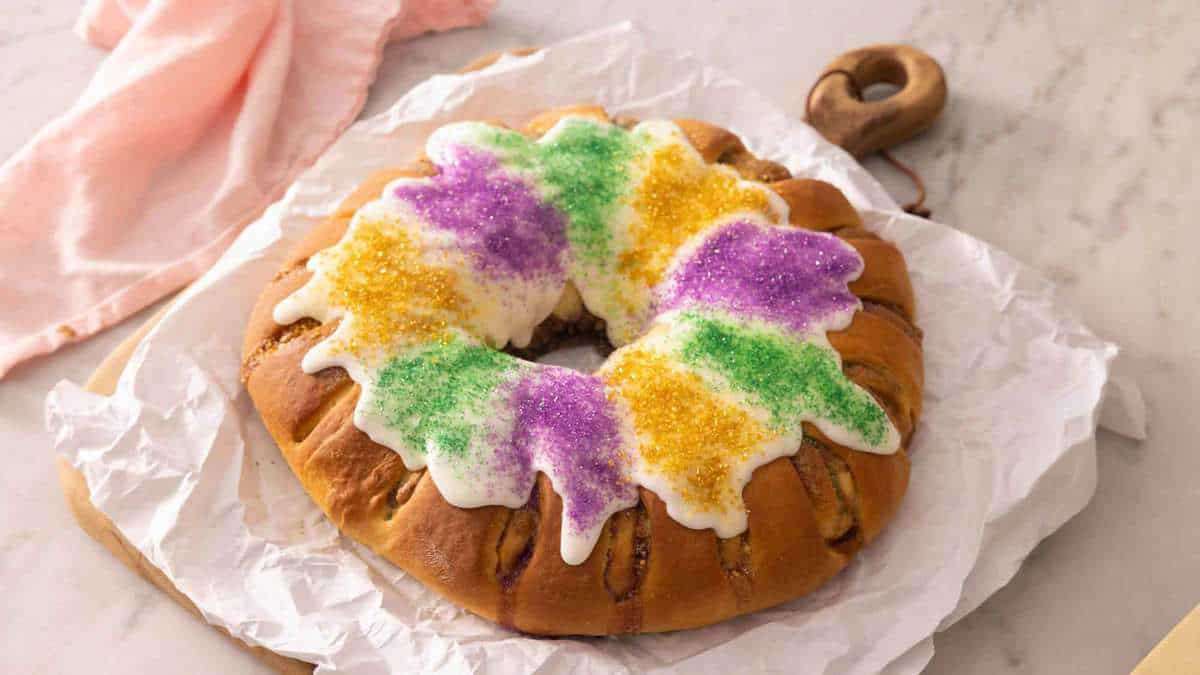
King Cake
User Reviews
4.9
King Cake
Description
The King Cake dough is prepared by mixing dry ingredients including flour, sugar, yeast, salt, and nutmeg with warm milk, butter, eggs, and vanilla. The dough is mixed until smooth and slightly sticky and allowed to rise until doubled. It is then rolled into a large rectangle and spread with a cinnamon and brown sugar butter filling. After rolling the dough, it can be shaped traditionally or braided before baking to golden perfection, resulting in a soft bread with a fragrant, buttery cinnamon interior.
Finishing the cake with a powdered sugar glaze combined with milk and vanilla adds a sweet topping to complement the cinnamon layers. Sprinkling the traditional green, purple, and yellow sanding sugars provides the festive look typical of King Cake. This bread works well sliced for celebrations or as a sweet breakfast treat.
Accurate flour measurement is important for dough consistency, and ingredients like eggs should be at room temperature for even mixing. The dough rising time depends on kitchen temperature, ideally around 75 to 78°F. There is flexibility in flavoring the dough or filling with additional spices, citrus zest, nuts, or chocolate to customize the cake according to preference.
Ingredients
For the Dough:
- 3¼ to 3½ cups all-purpose flour (390g-420g)
- ⅓ cup granulated sugar (66g)
- 1 packet instant yeast (7g, 0.25oz)
- 1 teaspoon salt
- ¼ teaspoon nutmeg grated
- ½ cup milk 110-120F / 120ml, warm
- ½ cup butter melted (113g, unsalted
- 3 large egg room temperature
- ½ teaspoon vanilla extract
For the Filling:
- ¾ cup light brown sugar firmly packed(165g)
- 2 teaspoons ground cinnamon
- 4 tablespoons butter melted (57g, unsalted
For the Icing:
- 1¼ cup powdered sugar (150g)
- 2 tablespoons milk
- ½ teaspoon vanilla extract
- sanding sugar green, purple, and yellow
Instructions
For the Dough:
- In the bowl of a stand mixer, whisk together 3¼ cups flour, sugar, yeast, salt, and nutmeg. Add the milk, butter, eggs, and vanilla. Using the dough hook attachment, mix on medium-low speed until a smooth and sticky dough forms, about 15 minutes, scraping down the bowl a few times throughout mixing. The dough will be loose, almost like a stretchy cake batter. It should feel tacky but not stick to a clean finger when quickly touched. Add the remaining ¼ cup of flour if the dough is sticking to your finger after 15 minutes. Scrape the dough down into the bowl, cover, and let rise in a warm spot until doubled in size, about 1 hour.
- On a lightly floured work surface, turn out the risen dough. Roll and stretch the dough into a 10x20-inch rectangle. Let it rest while you make the filling.
For the Filling:
- In a small bowl, combine brown sugar, cinnamon, and butter, stirring until well combined. Spread the filling over the dough, leaving a ½-inch border on one long side.
- Starting at the long side opposite the border, tightly roll up the dough into a log, pinching the seam to seal. Roll seam side down. Carefully transfer to a piece of parchment paper. Bring the two ends together to form a wreath, and pinch the ends together to create a wreath.
- Place the wreath with the parchment paper on a rimmed baking sheet, reshaping the wreath into a circle, if needed. With scissors, cut the edge of the dough to allow expansion and prevent cracking as the dough rises. Loosely cover and let rise until doubled in size, 45 minutes to 1 hour.
- While rising, preheat the oven to 350F.
- When risen, use a sharp knife or kitchen shears to make cuts about a third of the way through, spaced 1 inch apart all around the outside of the dough ring.
- Uncover and bake for 25 to 30 minutes or until golden brown. Let cool completely on the pan. Transfer to a serving platter.
For the Icing:
- In a small bowl, whisk together confectioners’ sugar and milk until thick but spoonable. Spoon over the top of the cake, using the spoon to cover the top, and push the icing to drip down the sides. Decorate with alternating sections of green, purple, and yellow sugars.
Notes
- Measure flour by fluffing and spooning into measuring cups to avoid packing and ensure correct dough texture.
- Use room temperature eggs for even incorporation without overmixing the dough.
- Maintain kitchen temperature between 75-78°F for optimal dough rising times.
- Roll the dough tightly to avoid gaps between layers after baking.
- Milk temperature for yeast activation should be 110-120°F to preserve yeast activity.
- Customize by adding vanilla extract or citrus zest to the dough or experimenting with nuts and spices in the filling.
- Consider braiding the dough strips before shaping for a decorative alternative to traditional King Cake form.
Nutrition Information
Show DetailsNutrition Facts
Serving: 12servings
Amount Per Serving
Calories 400 kcal
% Daily Value*
| Calories | 400kcal | 20% |
| Carbohydrates | 65g | 22% |
| Protein | 6g | 12% |
| Fat | 13g | 20% |
| Saturated Fat | 8g | 40% |
| Polyunsaturated Fat | 1g | 6% |
| Monounsaturated Fat | 4g | 20% |
| Trans Fat | 1g | 50% |
| Cholesterol | 78mg | 26% |
| Sodium | 224mg | 9% |
| Potassium | 100mg | 2% |
| Fiber | 1g | 4% |
| Sugar | 38g | 76% |
| Vitamin A | 442IU | 9% |
| Vitamin C | 1mg | 1% |
| Calcium | 45mg | 5% |
| Iron | 2mg | 11% |
* Percent Daily Values are based on a 2,000 calorie diet.
User Reviews
Overall Rating
4.9
You'll Also Love