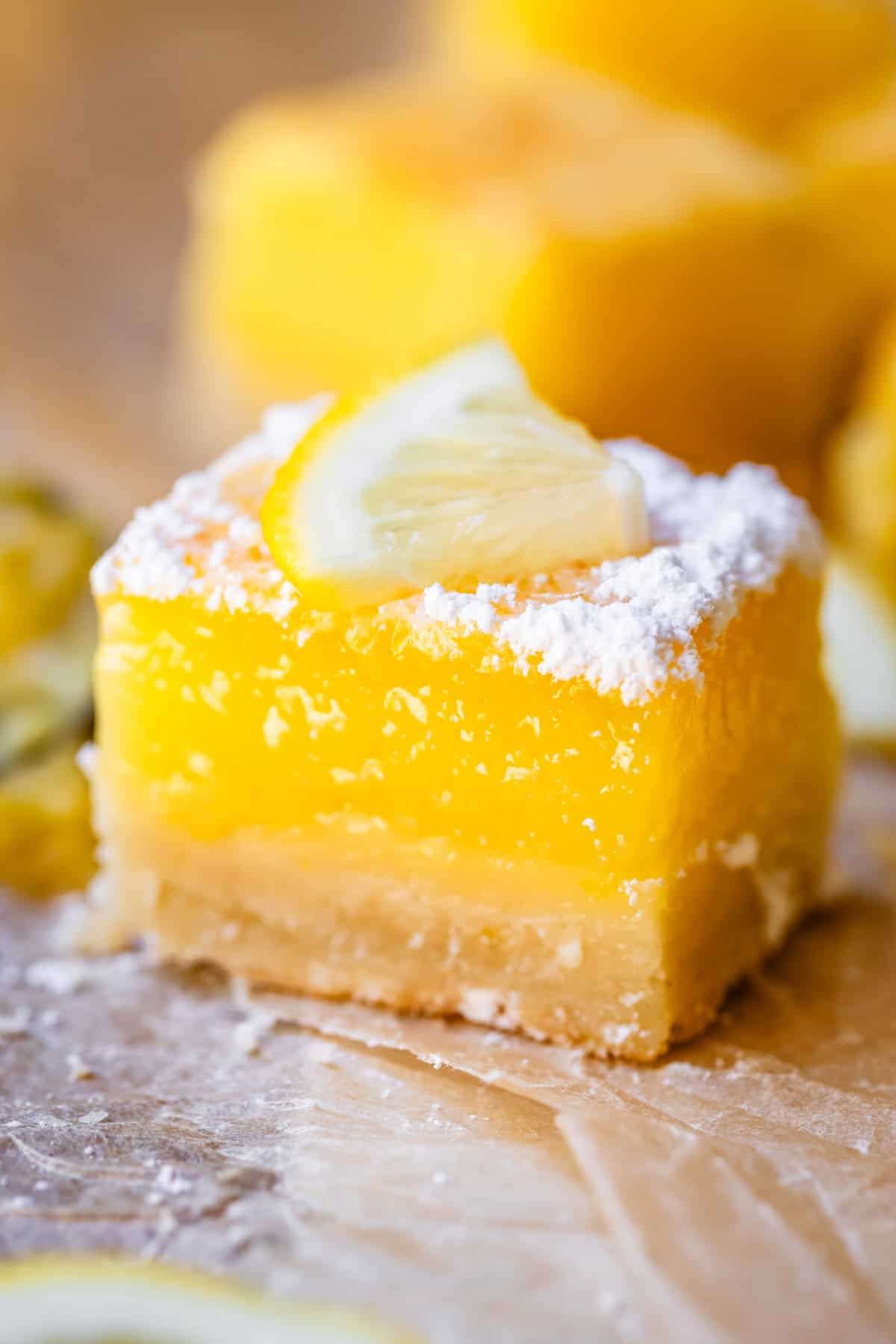
Lemon Bars Recipe
User Reviews
5
Lemon Bars Recipe
Description
Lemon Bars Recipe combines a shortbread crust with a lively lemon custard. The crust is prepared by cutting cold butter into a mixture of flour, cornstarch, powdered sugar, salt, and lemon zest, then pressed and chilled before baking. The custard uses fresh lemon juice and zest with eggs, sugar, flour, and salt, poured over the prebaked crust and baked until set. The result is a firm base with a vibrant, tangy topping that balances sweet and sour flavors. Once cooled, the bars are dusted with powdered sugar to add mild sweetness.
The tartness comes from a considerable amount of lemon juice and zest, making these bars distinctly sharp in flavor. The crust’s cornstarch and cold butter provide a delicate crumb that holds the custard layer well. Cutting the bars into squares makes them easy to serve and share.
Because of their strong tart flavor, adjustments can be made by increasing sugar or reducing zest to suit sweeter preferences. Gluten-free flour substitutions can be used for the crust and custard without affecting texture notably. These bars are suitable for dessert or a lemon-flavored snack and can be refrigerated to firm up and retain freshness.
Ingredients
For the crust:
- 1 and 3/4 cups all-purpose flour spooned and leveled
- 1/4 cup cornstarch
- 2/3 cup powdered sugar
- 1/2 teaspoon kosher salt use half the amount of table salt
- 1 teaspoon lemon the zest of one lemon, zest
- 1 cup butter COLD (2 sticks)
For the custard:
- 6 large egg
- 2 and 1/4 cups granulated sugar
- 1/2 cup + 1 tablespoon all-purpose flour spooned and leveled
- 1/2 teaspoon kosher salt use half the amount of table salt
- 2 tablespoons lemon about 6-8 lemons. More zest=more tart, zest
- 1 cup + 2 tablespoons lemon juice about 6-8 medium lemons, fresh
- powdered sugar for dusting the finished lemon bars
Instructions
- For the crust: Line a 9x13 inch glass or ceramic pan with parchment paper, or spray the sides of the pan with nonstick spray or rub with butter.
- In a large bowl, add the dry ingredients: 1 and 3/4 cup flour (Make sure you use a spoon to add the flour to your measuring cup, then level it off with a knife. You don't want to pack your flour.) Add 1/4 cup cornstarch, 2/3 cup powdered sugar, 1/2 teaspoon kosher salt, and the zest from 1 lemon, using a microplane grater. Whisk it all together.
- Use a pastry cutter (or a butter knife) to cut the butter into the flour. Keep pressing the butter through the pastry cutter (or keep cutting the butter with the knife) until all the pieces are about the size of a pea or slightly larger. See photos.
- Press the butter and flour mixture into the 9x13 inch pan. Use a measuring cup to pack it in. The mixture will seem dry and powdery, that's okay! Pack it in and tightly as you can.
- Freeze the pan for about 20 minutes, or chill in the fridge for 30 minutes. Cold butter hitting a hot oven is what makes your shortbread crust flaky and tender!
- Preheat the oven to 350 degrees while your unbaked crust chills.
- Bake the crust at 350 for about 24-25 minutes, until the edges are golden brown and the top of the crust no longer looks shiny. Don't leave it in too long, you want to take it out when the center is still pale on top (but completely matte). There will be little craggy holes in your crust, totally normal. They are air pockets (how you know the shortbread is flaky!)
- Let the crust cool completely, or almost completely, while you make the lemon custard. You can put the crust in the fridge or freezer if you want, to speed this up.
- For the lemon custard: In a large bowl or stand mixer, add all the remaining ingredients: 6 eggs, 2 and 1/4 cups granulated sugar,* 1/2 cup + 1 tablespoon flour, 1/2 teaspoon kosher salt, 2 tablespoons lemon zest, and 1 cup + 2 tablespoons fresh lemon juice.
- Beat the mixture together thoroughly for about 2 minutes, stopping to scrape the sides and bottom of the bowl. Use your whisk attachment if you have a stand mixer, or just use beaters if you have a hand mixer. Make sure the eggs are totally mixed in. If you lift the beater and keep coming up with solid white egg proteins, keep mixing. (If you see a few stubborn ones, you can just pick them out.)
- Pour the lemon custard mixture over the cooled shortbread crust.
- Bake the lemon custard for an additional 30-35 minutes in the preheated oven. The edges should be set, while the center can still be a little wiggly (just a little). The center should not be sloshy or look liquid-y. The very edges may need to get very dark, even slightly burned looking, to get the center as set as it needs to be. The bars will firm up as they cool.
- Let cool for 20-30 minutes on a wire rack.
- Chill. Cover the bars with plastic wrap (don't let it touch the top) and refrigerate for at least 2-3 hours until they are very cold all the way through. This is not just because we like cold lemon bars; it's also the final step to help the custard set up and not be too-liquidy.
- Let rest, if you have time. I prefer to eat lemon bars about 30 minutes out of the fridge.
- Slice the lemon bars. Use a sharp chef's knife, and wipe the knife between each cut. I prefer to cut off the very edges of the lemon bars and feed them to myself (or my kids :) For guests, I serve the center pieces. Lemon bars don't have to be cut into big pieces. They are quite rich and a little goes a long way. (I prefer to cut them into small squares and then eat 5,000 at a time, but that's just me.)
- Dust with powdered sugar right before serving. Add powdered sugar to a sieve and shake it over the lemon bars, then transfer to a serving platter. Don't bother doing this ahead of time, because it will just seep into the custard and you won't see it. The powdered sugar should be dusted on last minute.
- Store any leftovers covered in the fridge. They will keep for several days! Not that I would know!
- Freezing: You can totally freeze lemon bars, amazing right? Let them thaw overnight in the fridge before serving.
Notes
- Adjust the amount of sugar and lemon zest in the custard to control tartness according to taste preferences.
- Use gluten-free flour blends as a direct substitute in both crust and custard for a gluten-free version.
- Make sure to spoon and level flour to avoid packing, which affects crust texture.
Nutrition Information
Show DetailsNutrition Facts
Serving: 24Servings
Amount Per Serving
Calories 232 kcal
% Daily Value*
| Serving | 1square | |
| Calories | 232kcal | 12% |
| Carbohydrates | 35g | 12% |
| Protein | 3g | 6% |
| Fat | 9g | 14% |
| Saturated Fat | 5g | 25% |
| Polyunsaturated Fat | 1g | 6% |
| Monounsaturated Fat | 2g | 10% |
| Trans Fat | 0.3g | 15% |
| Cholesterol | 67mg | 22% |
| Potassium | 48mg | 1% |
| Fiber | 1g | 4% |
| Sugar | 22g | 44% |
| Vitamin A | 305IU | 6% |
| Vitamin C | 5mg | 6% |
| Calcium | 13mg | 1% |
| Iron | 1mg | 6% |
* Percent Daily Values are based on a 2,000 calorie diet.
User Reviews
Overall Rating
5
You'll Also Love