Peanut Butter Butterfinger Cookies
User Reviews
5
Peanut Butter Butterfinger Cookies
Description
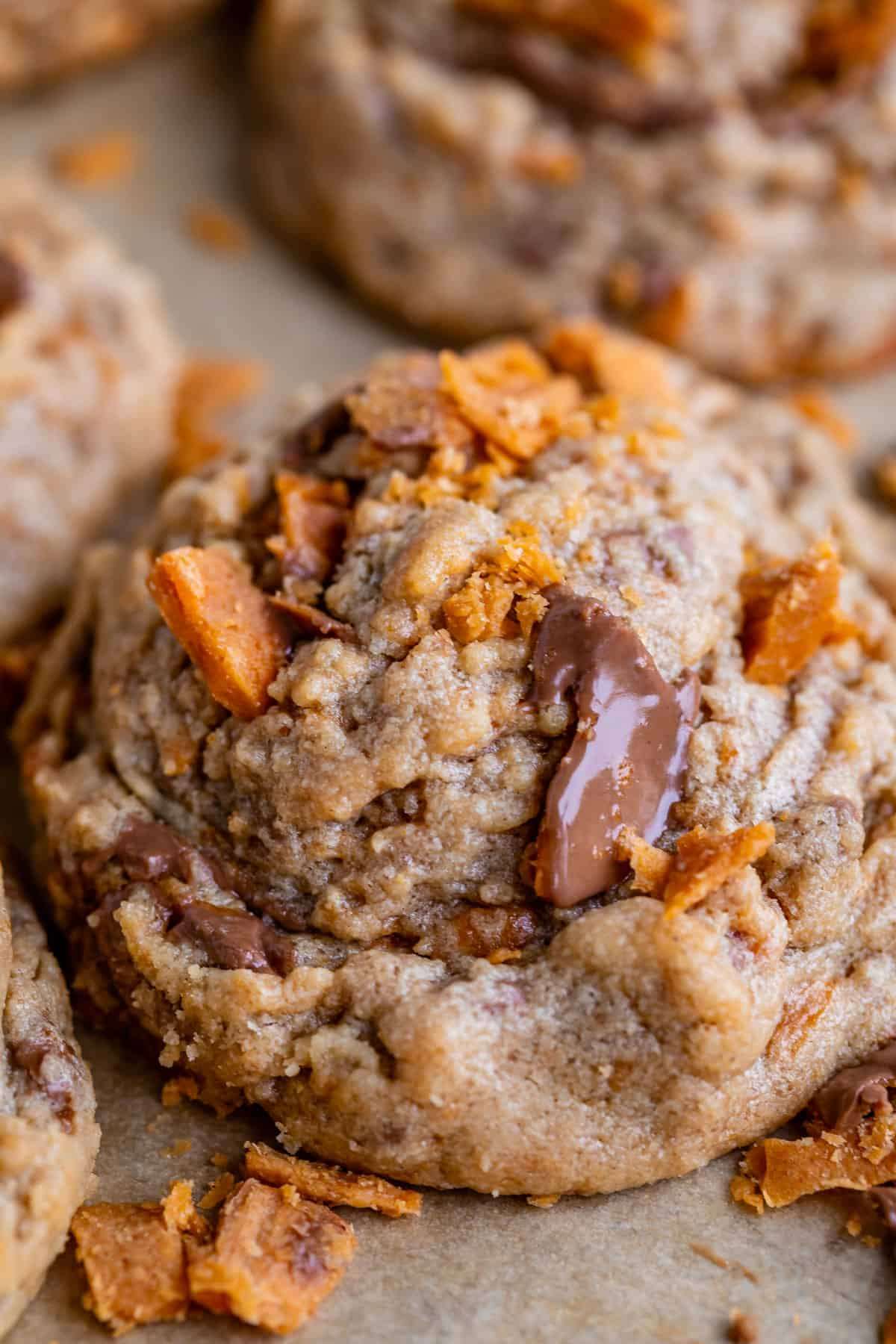
Peanut Butter Butterfinger Cookies blend a smooth peanut butter base made from creamed butter, sugars, peanut butter, egg, and vanilla with dry ingredients including flour, baking soda, baking powder, and salt. Chopped Butterfinger bars are mixed in to add crisp, peanut butter-flavored candy pieces with a chocolate coating. The dough is soft and can be chilled for 15 minutes to improve handling and flavor melding, but baking without chilling also works.
Baked cookies develop a light golden surface and crisp edges, while the interior remains tender. The Butterfinger chunks provide bursts of crunch and chocolate flavor, contrasting with the creamy peanut butter dough. These cookies can be served as a sweet treat with milk or coffee and are suitable for snack or dessert occasions where a candy-inspired peanut butter cookie is desired.
Notes include suggestions on how to measure flour accurately and Butterfinger substitution equivalents, plus the flexibility to omit chilling without sacrificing final texture.
Ingredients
- 3/4 cup butter softened (1 and 1/2 sticks)
- 1/2 cup granulated sugar
- 1/2 cup brown sugar packed
- 1 cup peanut butter don't use natural pb
- 1 large egg
- 1 & 1/2 teaspoons vanilla
- 1 & 1/2 cups all-purpose flour spooned and leveled
- 1/2 teaspoon baking soda
- 1/2 teaspoon baking powder
- 1/4 teaspoon kosher salt
- 16 ounces Butterfinger candy bar chopped, see note
Instructions
- In a large bowl or stand mixer, beat 3/4 cup softened butter (this is 1 and 1/2 sticks) until it is smooth and creamy, scraping the sides of the bowl.
- Add 1/2 cup sugar and 1/2 cup packed brown sugar. Beat well for about 2 minutes until it is fluffy, scraping the sides. There should be no chunks of butter.
- Add 1 cup peanut butter. I like Jif best. And I love my adjustable measuring cup for this job, it's so much easier!
- Add 1 egg and 1 and 1/2 teaspoons vanilla. Beat until combined, scraping the sides of the bowl occasionally.
- Add 1 and 1/2 cups all-purpose flour, making sure you spoon the flour into the measuring cup and level off. Add the flour to the bowl, but don't stir it in yet. Add 1/2 teaspoon baking soda, 1/2 teaspoon baking powder, and 1/4 teaspoon kosher salt on top of the flour. Stir it in with your teaspoon to combine the dry ingredients together a bit, making sure to break up any clumps.
- Turn the mixer on to combine the dry ingredients into the dough. Don't overdo it! Once the dough barely starts to come together (with some flour still visible), stop and scrape the sides and bottom of the bowl. (Over mixing cookie dough results in tough cookies.)
- Add 16 ounces of chopped butterfingers and mix in until just barely incorporated. You can use 2 (8-ounce) bags of "Butterfinger Bits" (found in the baking aisle), but this is kind of a rare find. See notes* for how many butterfingers to use if you can't find the Bits. See photos for the level of coarseness we're going for, if you're chopping.
- Cover the bowl and chill the dough for 15 minutes to an hour.** (Or up to 24 hours!) Try not to eat it all. I think this is some of my favorite cookie dough EVER, no lie. It is peanut buttery crispity perfection.
- Preheat the oven to 350 degrees F. Line two baking sheets with parchment paper or a silicone baking mat.
- Shape the dough into 2 inch balls. I used this cookie scoop and seriously overpacked it.
- Place on a baking sheet at least an inch or two apart from each other. I added 12 cookies to a 12×18 inch half baking sheet.
- Bake the cookies at 350 for about 10 minutes.
- The cookies are done baking when the edges are set. They should not be shiny in the middle. They will be very puffy, but should have spread a bit from their ball-shape. If they have not spread much, use your spatula to gently press on the top of each cookie to flatten them a bit. Do this after you take them out of the oven, or even 2 minutes before they are done. Top each cookie with more butterfinger crumbles, if you have any left.
- Let the cookies set up on the pan for at least 5 minutes before transferring to a wire rack to cool completely.
- Strange note: I do not love eating these cookies warm. (Besides Sugar cookies, I think this is a first for me!) The butterfinger melts in the oven and I don't love the chewy texture. I prefer to wait until they are approaching room temperature before eating.
- This recipe makes about 25 cookies. Store leftovers in a tightly sealed container for up to 3 days.
- The dough freezes very well. Place cookie dough balls in a ziplock bag and freeze for up to 3 months. Bake on a pan straight from frozen (as directed plus another minute or two), and be prepared to press down on them with your spatula after baking to help them spread. You can also freeze the baked cookies in a sealed container up to 4 weeks. Let thaw at room temp, sealed.
Notes
- Use 16 ounces of crushed Butterfinger bars; both Butterfinger Bits and full-size bars have the same ingredients and can be crushed as desired.
- Chilling the dough for about 15 minutes improves flavor development and dough handling but is not mandatory.
- Spoon and level flour when measuring to ensure accurate amounts for proper dough consistency.
Nutrition Information
Show DetailsNutrition Facts
Serving: 25cookies
Amount Per Serving
Calories 169 kcal
% Daily Value*
| Serving | 1cookie | |
| Calories | 169kcal | 8% |
| Carbohydrates | 19g | 6% |
| Protein | 4g | 8% |
| Fat | 9g | 14% |
| Saturated Fat | 3g | 15% |
| Polyunsaturated Fat | 2g | 12% |
| Monounsaturated Fat | 4g | 20% |
| Trans Fat | 1g | 50% |
| Cholesterol | 17mg | 6% |
| Potassium | 89mg | 2% |
| Fiber | 1g | 4% |
| Sugar | 13g | 26% |
| Vitamin A | 119IU | 2% |
| Calcium | 16mg | 2% |
| Iron | 1mg | 6% |
* Percent Daily Values are based on a 2,000 calorie diet.
User Reviews
Overall Rating
5
You'll Also Love