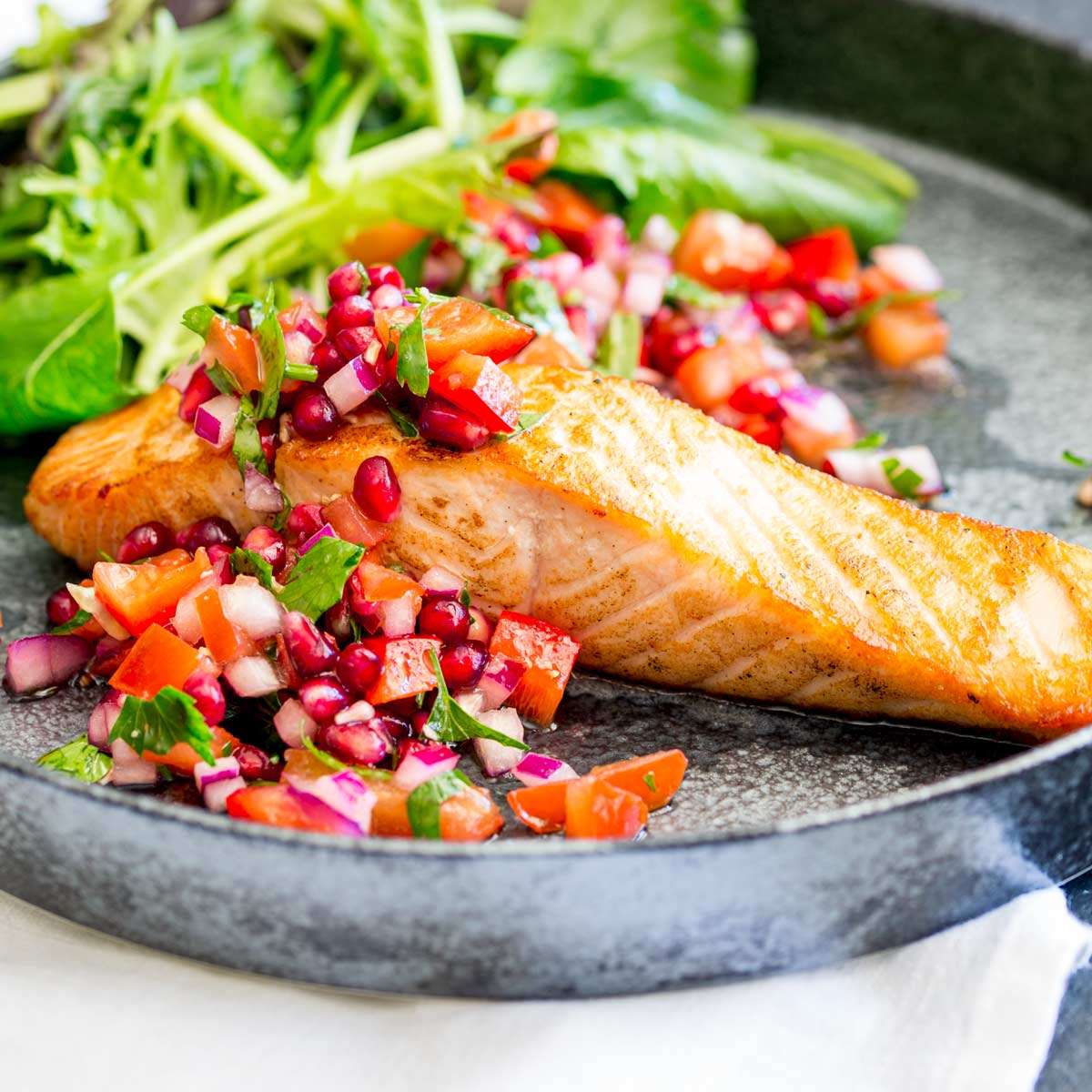
Pomegranate Salmon
User Reviews
4.9
-
Prep Time
10 mins
-
Cook Time
8 mins
-
Total Time
18 mins
-
Servings
4
-
Calories
422 kcal
-
Course
Main Course
-
Cuisine
Australian
Pomegranate Salmon
Description
The recipe begins by marinating finely chopped red onion in apple cider vinegar and salt to mellow its flavor. Pomegranate arils are extracted by tapping the cut fruit, collecting juice and seeds that add bright jewel-like bursts and tartness to the salsa. Freshly chopped tomato, red bell pepper, and parsley join the mixture, along with seasoning and olive oil to bind the flavors together.
The salmon fillets are simply seasoned with salt and cooked in olive oil, usually for about six minutes to retain a soft, just-cooked interior. Cooking the salmon presentation-side up initially helps form a crust on the top and maintains the fillet’s shape. Served warm with the pomegranate salsa spooned atop, this dish contrasts the richness of the fish with the colorful, fresh, and slightly sweet salsa.
Substitutions for vinegars like white wine or balsamic are acceptable. Honey or maple syrup can be added to the salsa based on sweetness preference and the natural sweetness of the fruit and vegetables. Cooking times can be adjusted for preferred salmon doneness.
Ingredients
For the salsa
- ¼ cup red onion , finely chopped
- 1 tablespoon apple cider vinegar (see note 1)
- 1 pomegranate (or 2 cups of pomegranate arils)
- 2 tomato seeds removed and finely chopped
- ½ cup red bell pepper , finely chopped
- ¼ cup parsley chopped, fresh
- ¼ teaspoon salt
- ¼ teaspoon black pepper
- 2 tablespoon extra virgin olive oil
- 1 teaspoon honey , optional (see note 2)
For the salmon
- 1 tablespoon extra-virgin olive oil
- ½ teaspoon salt
- 4 salmon roughly 6oz/170g each, fillets
Instructions
For the salsa
- Place the chopped red onion in a small bowl and add the vinegar and a pinch of salt. Stir to combine and set aside for 5 minutes. (I use this time to cut all the other veg and prep the pomegranate)¼ cup red onion1 tbsp apple cider vinegar
- Cut the pomegranate in half around the middle. Hold the pomegranate cut side down over a large bowl, and use a wooden spoon to whack out the pomegranate arils. Squeeze any extra juice into the bowl.1 pomegranate
- Add the chopped bell pepper and chopped tomato and stir well.½ cup red bell pepper2 tomatoes
- Add in the onions with their vinegar.
- Stir in the parsley, salt, pepper, and extra virgin olive oil.¼ cup fresh parsley¼ tsp salt¼ tsp black pepper2 tbsp extra virgin olive oil
- Taste your salsa and add the honey if you want extra sweetness.1 tsp honey
- Let the salsa sit for 10 minutes while you cook the salmon.
For the salmon
- Season the top of the salmon fillets evenly with salt.4 salmon fillets½ teaspoon salt
- Place a large nonstick frying pan or skillet over medium-high heat and add the oil.1 tablespoon extra-virgin olive oil
- Add salmon to the pan, presentation side down. Sear for 3 minutes and then flip and cook for 3 minutes on the underside. (see note 3&4)
To serve
- Place the salmon on the plate and spoon over a large spoonful of the salsa.
Notes
- Use white wine or balsamic vinegar as alternatives to apple cider vinegar in the salsa.
- Adjust honey or sweetener quantity in salsa to taste depending on the sweetness of tomatoes and pomegranate.
- Salmon cooks about 6 minutes for a tender interior; increase to 4 minutes per side for firmer texture.
- Place salmon presentation side up when pan cooking to achieve a crust and help retain shape.
Nutrition Information
Show DetailsNutrition Facts
Serving: 4Serving
Amount Per Serving
Calories 422 kcal
% Daily Value*
| Calories | 422kcal | 21% |
| Carbohydrates | 19g | 6% |
| Protein | 36g | 72% |
| Fat | 22g | 34% |
| Saturated Fat | 3g | 15% |
| Polyunsaturated Fat | 6g | 35% |
| Monounsaturated Fat | 11g | 55% |
| Cholesterol | 94mg | 31% |
| Sodium | 526mg | 22% |
| Potassium | 1226mg | 26% |
| Fiber | 4g | 16% |
| Sugar | 14g | 28% |
| Vitamin A | 1493IU | 30% |
| Vitamin C | 46mg | 51% |
| Calcium | 44mg | 4% |
| Iron | 2mg | 11% |
* Percent Daily Values are based on a 2,000 calorie diet.
User Reviews
Overall Rating
4.9
You'll Also Love