Portuguese Easter Bread
User Reviews
5
-
Prep Time
3 hrs
-
Cook Time
22 mins
-
Total Time
3 hrs 22 mins
-
Servings
10
-
Course
Side Dish
-
Cuisine
Portuguese
Portuguese Easter Bread
Description
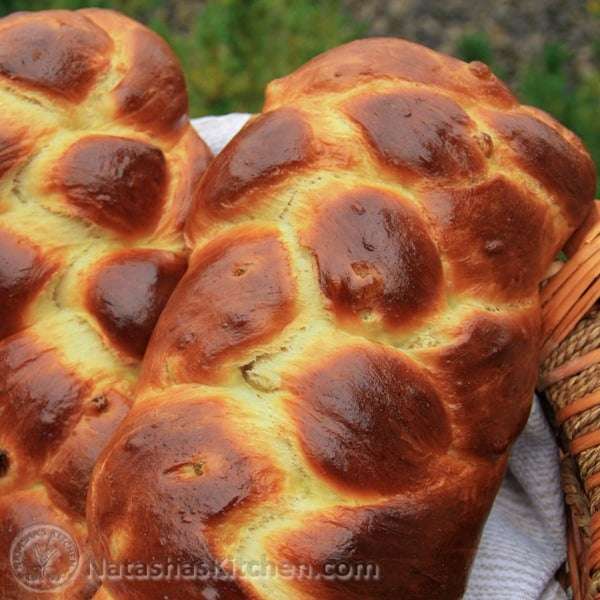
Portuguese Easter Bread combines warm milk, sugar, butter, salt, active dry yeast, and a mix of beaten eggs to create an enriched dough with a tender crumb and mild sweetness. The addition of raisins soaked in boiling water softens them and disperses some flavor before integrating them into the dough. Kneading is done either by mixer or by hand until the dough is smooth and elastic but still slightly sticky—this helps maintain moisture and softness in the final bread.
The recipe calls for a generous amount of flour to develop gluten structure but emphasizes not over-flouring to keep the dough tender. Proper proofing of the yeast starter ensures a good rise. This bread is traditional to Easter, fitting for celebrations requiring a softly textured, fruity loaf with a delicate balance between sweetness and richness.
After baking, the bread has a soft crust and maintains moistness inside, making it suitable for slicing and serving with butter or as part of holiday meals.
Ingredients
- 1 milk 1/2 cup, very warm
- 1 cup white sugar plus 1 teaspoon sugar
- 1/2 cup unsalted butter 8 tablespoons, softened
- 1 tsp salt
- 2 active dry yeast 1 and 1/2 Tbsp, envelopes
- 3 egg well beaten
- 6 1/2 Cups all-purpose flour unsifted
- 1 egg
- 1 tsp water
- 3/4 cup raisins 1 cup white or brown raisins plus 2 cups boiling water
Instructions
- Place 1 cup white or brown raisins in a bowl with 2 cups boiling water for 10 minutes. Drain well and set the raisins aside.
- Pour 1/2 cup warm milk (heated 30 seconds in micro) into a large measuring cup. Add 1 tsp sugar and sprinkle yeast over the top. Stir and let it stand to proof until bubbly and doubled in volume, about 10 minutes.
- Combine 1 Cup of very warm milk (1 minute in micro), with the 1 Cup sugar, softened butter and 1 tsp salt in a large bowl. Stir until most of the butter is melted.
- Stir in 3 well-beaten eggs, then yeast mixture into the butter mixture. Using the dough hook attachment (or a wooden spoon if mixing by hand), Beat in 6 1/2 cups flour, one cup at a time until a soft dough forms. Knead for 8-12 minutes or until smooth and elastic. Dough will still be a little sticky and will stick to the bowl, but should not stick to your fingers. If kneading by hand, turn out onto a well-floured surface and knead 8-12 minutes (using only enough flour necessary to prevent sticking to your hands).
- Stir in the raisins until evenly distributed.
- Transfer the dough to a large buttered bowl, turning it to bring the buttered side up. Cover with a tea towel and let rise in a warm place, away from draft, about 1 and 1/2 hours or until double in volume. (I set my oven to low, then turned it off and let the dough sit in a warm oven; about 100 degrees F).
- Punch dough down. Tur out onto a lightly floured surface. Divide the dough in half. Divide one half into four equal pieces and form about 15" strips with each quarter.
- Pinch the four strips together on one end and let the braiding begin!
- Cross the far right strip over it's neighbor.
- Tuck the far left strip under it's neighbor and over the next strip. Repeat steps until you finish the braid, then pinch together the other end.
- Place each braid in a buttered baking dish (the would have expanded even better if I had used a large baking pan). Cover loosely with a towel and let them sit for 30 minutes.
- After the braids have been sitting for 30 minutes, now pre-heat the oven to 375°F.
- Beat together 1 egg and 1 tsp water. Generously brush the top and sides of the bread with the egg mix just before baking.
- Bake each loaf separately for 20-22 minutes or until golden brown.
User Reviews
Overall Rating
5
You'll Also Love